

A 17-21; P 1,9-11; total GR 11-14 1st arch anteriorly + 12-19 posteriorly, 12-16 2nd arch anteriorly + 14-17 posteriorly; 12-15 3rd arch
anteriorly. Short rugose proj ections or serrae along rear edge of P spine.
Generally brown to greyish or greenish brown above,
lighter to whitish on sides and below, midline of abdomen
whitish, never pigmented. Attains 55 cm. Sea, estuaries and
rivers from Walvis Bay to Natal.
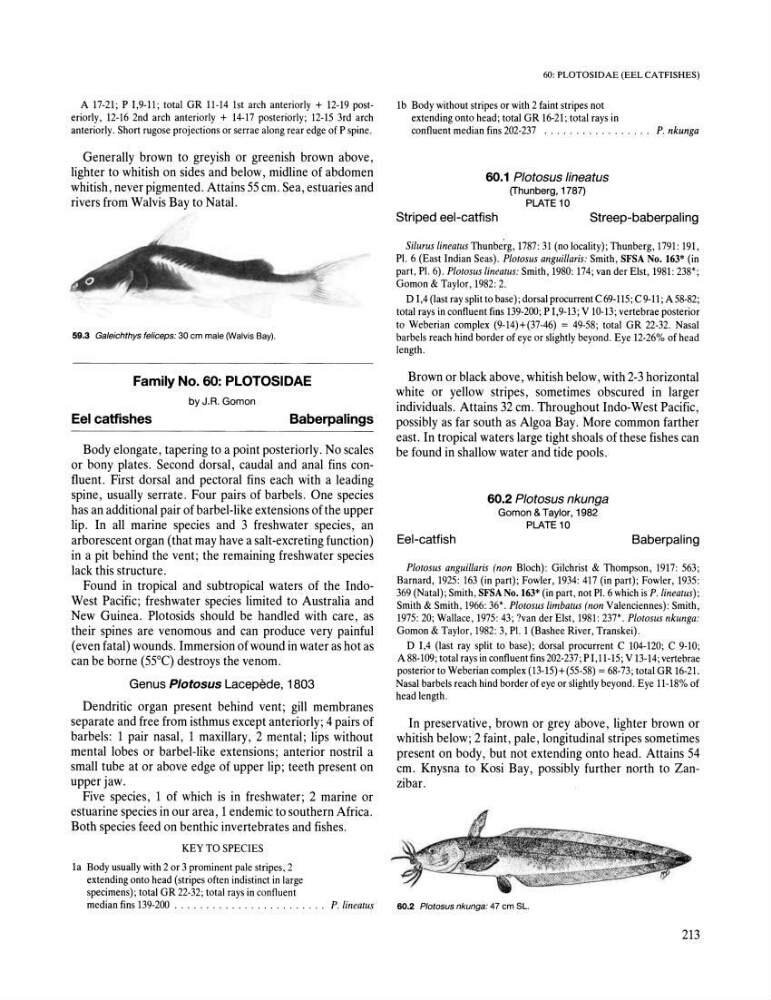
59.3 Ga/eiehthys fe/ieeps: 30 em male (Walvis Bay).
Family No. 60: PLOTOSIDAE
by J.R. Gomon
Eel catfishes
Baberpalings
Body elongate, tapering to a point posteriorly. No scales
or bony plates. Second dorsal, caudal and anal fins confluent. First dorsal and pectoral fins each with a leading
spine, usually serrate. Four pairs of barbels. One species
has an additional pair of barbel-like extensions of the upper
lip. In all marine species and 3 freshwater species, an
arborescent organ (that may have a salt-excreting function)
in a pit behind the vent; the remaining freshwater species
lack this structure.
Found in tropical and subtropical waters of the IndoWest Pacific; freshwater species limited to Australia and
New Guinea. Plotosids should be handled with care, as
their spines are venomous and can produce very painful
(even fatal) wounds. Immersion of wound in water as hot as
can be borne (55°C) destroys the venom.
Genus Plotosus Lacepede, 1803
Dendritic organ present behind vent; gill membranes
separate and free from isthmus except anteriorly; 4 pairs of
barbels: 1 pair nasal, 1 maxillary, 2 mental; lips without
mental lobes or barbel-like extensions; anterior nostril a
small tube at or above edge of upper lip; teeth present on
upper jaw.
Five species, 1 of which is in freshwater; 2 marine or
estuarine species in our area, 1 endemic to southern Africa.
Both species feed on benthic invertebrates and fishes.
KEY TO SPECIES
la Body usually with 2 or 3 prominent pale stripes, 2
extending onto head (stripes often indistinct in large
specimens); total GR 22-32; total rays in confluent
median fins 139-200 . . . . . . . . . . . . . . . . . . . . . . . . P. lineatus
60: PLOTOSIDAE (EEL CATFISHES)
1 b Body without stripes or with 2 faint stripes not
extending onto head; total GR 16-21; total rays in
confluent median fins 202-237 ................. P. nkunga
60.1 Plotosus lineatus
(Thunberg, 1787)
PLATE 10
Striped eel-catfish
Streep-baberpaling
Silurus lineatus Thunberg, 1787: 31 (no locality); Thunberg, 1791: 191,
PI. 6 (East Indian Seas). Plotosus anguillaris: Smith, SFSA No. 163* (in
part, PI. 6). Plotosus lineatus: Smith, 1980: 174; van der Elst, 1981: 238*;
Gomon & Taylor, 1982: 2.
D 1,4 (last ray split to base); dorsal procurrent C 69-115; C 9-11; A 58-82;
total rays in confluent fins 139-200; P 1,9-13; V 10-13; vertebrae posterior
to Weberian complex (9-14)+(37-46) = 49-58; total GR 22-32. Nasal
barbels reach hind border of eye or slightly beyond. Eye 12-26% of head
length.
Brown or black above, whitish below, with 2-3 horizontal
white or yellow stripes, sometimes obscured in larger
individuals. Attains 32 cm. Throughout Indo-West Pacific,
possibly as far south as Algoa Bay. More common farther
east. In tropical waters large tight shoals of these fishes can
be found in shallow water and tide pools.
Eel-catfish
60.2 Plotosus nkunga
Gomon & Taylor, 1982
PLATE 10
Baberpaling
Plotosus anguillaris (non Bloch): Gilchrist & Thompson, 1917: 563;
Barnard, 1925: 163 (in part); Fowler, 1934: 417 (in part); Fowler, 1935:
369 (Natal); Smith, SFSA No. 163* (in part , not PI. 6 which is P.lineatus);
Smith & Smith, 1966: 36*. Plotosus limbatus (non Valenciennes): Smith,
1975: 20; Wallace, 1975: 43; ?van der Elst, 1981: 237*. Plotosus nkunga:
Gomon & Taylor, 1982: 3, PI. 1 (Bashee River, Transkei).
D 1,4 (last ray split to base); dorsal procurrent C 104-120; C 9-10;
A 88-109; total rays in confluent fins 202-237; P 1,11-15; V 13-14; vertebrae
posterior to Weberian complex (13-15)+(55-58) = 68-73; total GR 16-21.
Nasal barbels reach hind border of eye or slightly beyond. Eye 11-18% of
head length.
In preservative, brown or grey above, lighter brown or
whitish below; 2 faint, pale, longitudinal stripes sometimes
present on body, but not extending onto head. Attains 54
cm. Knysna to Kosi Bay, possibly further north to Zanzibar.
60.2 P/otosus nkunga: 47 em SL.
213
anteriorly. Short rugose proj ections or serrae along rear edge of P spine.
Generally brown to greyish or greenish brown above,
lighter to whitish on sides and below, midline of abdomen
whitish, never pigmented. Attains 55 cm. Sea, estuaries and
rivers from Walvis Bay to Natal.
59.3 Ga/eiehthys fe/ieeps: 30 em male (Walvis Bay).
Family No. 60: PLOTOSIDAE
by J.R. Gomon
Eel catfishes
Baberpalings
Body elongate, tapering to a point posteriorly. No scales
or bony plates. Second dorsal, caudal and anal fins confluent. First dorsal and pectoral fins each with a leading
spine, usually serrate. Four pairs of barbels. One species
has an additional pair of barbel-like extensions of the upper
lip. In all marine species and 3 freshwater species, an
arborescent organ (that may have a salt-excreting function)
in a pit behind the vent; the remaining freshwater species
lack this structure.
Found in tropical and subtropical waters of the IndoWest Pacific; freshwater species limited to Australia and
New Guinea. Plotosids should be handled with care, as
their spines are venomous and can produce very painful
(even fatal) wounds. Immersion of wound in water as hot as
can be borne (55°C) destroys the venom.
Genus Plotosus Lacepede, 1803
Dendritic organ present behind vent; gill membranes
separate and free from isthmus except anteriorly; 4 pairs of
barbels: 1 pair nasal, 1 maxillary, 2 mental; lips without
mental lobes or barbel-like extensions; anterior nostril a
small tube at or above edge of upper lip; teeth present on
upper jaw.
Five species, 1 of which is in freshwater; 2 marine or
estuarine species in our area, 1 endemic to southern Africa.
Both species feed on benthic invertebrates and fishes.
KEY TO SPECIES
la Body usually with 2 or 3 prominent pale stripes, 2
extending onto head (stripes often indistinct in large
specimens); total GR 22-32; total rays in confluent
median fins 139-200 . . . . . . . . . . . . . . . . . . . . . . . . P. lineatus
60: PLOTOSIDAE (EEL CATFISHES)
1 b Body without stripes or with 2 faint stripes not
extending onto head; total GR 16-21; total rays in
confluent median fins 202-237 ................. P. nkunga
60.1 Plotosus lineatus
(Thunberg, 1787)
PLATE 10
Striped eel-catfish
Streep-baberpaling
Silurus lineatus Thunberg, 1787: 31 (no locality); Thunberg, 1791: 191,
PI. 6 (East Indian Seas). Plotosus anguillaris: Smith, SFSA No. 163* (in
part, PI. 6). Plotosus lineatus: Smith, 1980: 174; van der Elst, 1981: 238*;
Gomon & Taylor, 1982: 2.
D 1,4 (last ray split to base); dorsal procurrent C 69-115; C 9-11; A 58-82;
total rays in confluent fins 139-200; P 1,9-13; V 10-13; vertebrae posterior
to Weberian complex (9-14)+(37-46) = 49-58; total GR 22-32. Nasal
barbels reach hind border of eye or slightly beyond. Eye 12-26% of head
length.
Brown or black above, whitish below, with 2-3 horizontal
white or yellow stripes, sometimes obscured in larger
individuals. Attains 32 cm. Throughout Indo-West Pacific,
possibly as far south as Algoa Bay. More common farther
east. In tropical waters large tight shoals of these fishes can
be found in shallow water and tide pools.
Eel-catfish
60.2 Plotosus nkunga
Gomon & Taylor, 1982
PLATE 10
Baberpaling
Plotosus anguillaris (non Bloch): Gilchrist & Thompson, 1917: 563;
Barnard, 1925: 163 (in part); Fowler, 1934: 417 (in part); Fowler, 1935:
369 (Natal); Smith, SFSA No. 163* (in part , not PI. 6 which is P.lineatus);
Smith & Smith, 1966: 36*. Plotosus limbatus (non Valenciennes): Smith,
1975: 20; Wallace, 1975: 43; ?van der Elst, 1981: 237*. Plotosus nkunga:
Gomon & Taylor, 1982: 3, PI. 1 (Bashee River, Transkei).
D 1,4 (last ray split to base); dorsal procurrent C 104-120; C 9-10;
A 88-109; total rays in confluent fins 202-237; P 1,11-15; V 13-14; vertebrae
posterior to Weberian complex (13-15)+(55-58) = 68-73; total GR 16-21.
Nasal barbels reach hind border of eye or slightly beyond. Eye 11-18% of
head length.
In preservative, brown or grey above, lighter brown or
whitish below; 2 faint, pale, longitudinal stripes sometimes
present on body, but not extending onto head. Attains 54
cm. Knysna to Kosi Bay, possibly further north to Zanzibar.
60.2 P/otosus nkunga: 47 em SL.
213