

Order SALMONIFORMES
Suborder ARGENTINOIDEI
Pelvic fins abdominal; no fin spines; caudal fin shallowly
forked; dorsal adipose fin present in most families; usually
no teeth on basibranchials; crumenal organ (bilateral
pouches incorporating fifth ceratobranchial bone and its accessory cartilage) present.
The argentino ids are salmoniform fishes that have become adapted to a deep-sea habitat. The distinction and
relationships of the Order Salmoniformes are not yet clear
(Fink & Weitzman, 1982), but the argentinoid fishes are
generally accepted as a natural (monophyletic) group. The
Suborder Salmonoidei (including the salmonids, trout,
smelt, etc.) are mainly freshwater fishes, although some
species spend much of their life in the sea.
The family classification of the Argentinoidei is still
unsettled, with various groups shifting from subfamily to
family rank according to the latest findings and opinions of
the authors working on this group. Six families are here
recognised. The following key will not work for some genera that are not yet known from our area (e.g. Bathylychnops,
an opisthoproctid with non-tubular eyes, and Xenophthalmichthys, variously classified in the Argentinidae,
Bathylagidae or Microstomatidae, with anteriorly directed,
tubular eyes).
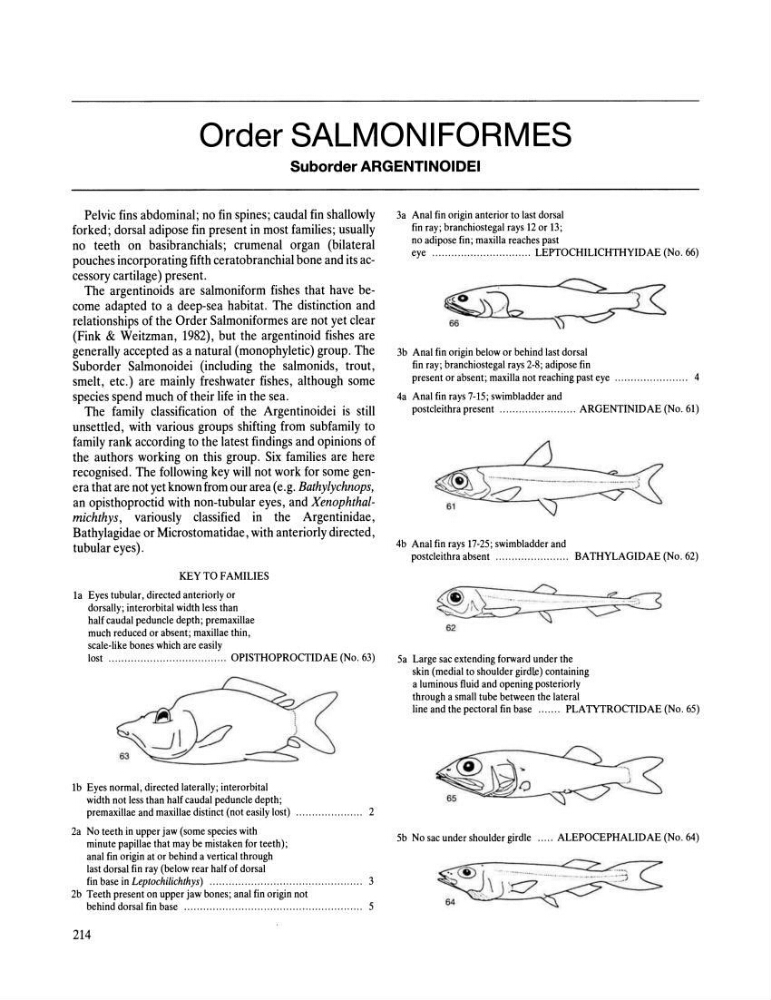
KEY TO FAMILIES
1a Eyes tubular, directed anteriorly or
dorsally; interorbital width less than
half caudal peduncle depth; premaxillae
much reduced or absent; maxillae thin,
scale-like bones which are easily
lost .............. .. ..................... OPISTHOPROCTIDAE (No. 63)
1b Eyes normal, directed laterally; interorbital
width not less than half caudal peduncle depth ;
premaxillae and maxillae distinct (not easily lost) .... ... .............. 2
2a No teeth in upper jaw (some species with
minute papillae that may be mistaken for teeth);
anal fin origin at or behind a vertical through
last dorsal fin ray (below rear half of dorsal
fin base in Leptochilichthys) ... ....... ... ... .. .......... ..... ... .. ..... ..... 3
2b Teeth present on upper jaw bones; anal fin origin not
behind dorsal fin base ....... .. ...... .. ......... ....... ... ..... ... .. ..... ..... 5
214
3a Anal fin origin anterior to last dorsal
fin ray; branchiostegal rays 12 or 13;
no adipose fin ; maxilla reaches past
eye ......................... ... ... LEPTOCHILICHTHYIDAE (No . 66)
~ 66
3b Anal fin origin below or behind last dorsal
fin ray; branchiostegal rays 2-8; adipose fin
present or absent; maxilla not reaching past eye ... .. ... .... ... ..... ... 4
4a Anal fin rays 7-15; swim bladder and
postcleithra present ........ ........ .. ...... ARGENTINIDAE (No. 61)
4b Anal fin rays 17-25; swimbladder and
postcleithra absent ...... ...... .... .... .. . BATHYLAGIDAE (No. 62)
5a Large sac extending forward under the
skin (medial to shoulder girdle) containing
a luminous fluid and opening posteriorly
through a small tube between the lateral
line and the pectoral fin base ...... . PLATYTROCTIDAE (No. 65)
5b No sac under shoulder girdle .. ... ALEPOCEPHALIDAE (No. 64)
Suborder ARGENTINOIDEI
Pelvic fins abdominal; no fin spines; caudal fin shallowly
forked; dorsal adipose fin present in most families; usually
no teeth on basibranchials; crumenal organ (bilateral
pouches incorporating fifth ceratobranchial bone and its accessory cartilage) present.
The argentino ids are salmoniform fishes that have become adapted to a deep-sea habitat. The distinction and
relationships of the Order Salmoniformes are not yet clear
(Fink & Weitzman, 1982), but the argentinoid fishes are
generally accepted as a natural (monophyletic) group. The
Suborder Salmonoidei (including the salmonids, trout,
smelt, etc.) are mainly freshwater fishes, although some
species spend much of their life in the sea.
The family classification of the Argentinoidei is still
unsettled, with various groups shifting from subfamily to
family rank according to the latest findings and opinions of
the authors working on this group. Six families are here
recognised. The following key will not work for some genera that are not yet known from our area (e.g. Bathylychnops,
an opisthoproctid with non-tubular eyes, and Xenophthalmichthys, variously classified in the Argentinidae,
Bathylagidae or Microstomatidae, with anteriorly directed,
tubular eyes).
KEY TO FAMILIES
1a Eyes tubular, directed anteriorly or
dorsally; interorbital width less than
half caudal peduncle depth; premaxillae
much reduced or absent; maxillae thin,
scale-like bones which are easily
lost .............. .. ..................... OPISTHOPROCTIDAE (No. 63)
1b Eyes normal, directed laterally; interorbital
width not less than half caudal peduncle depth ;
premaxillae and maxillae distinct (not easily lost) .... ... .............. 2
2a No teeth in upper jaw (some species with
minute papillae that may be mistaken for teeth);
anal fin origin at or behind a vertical through
last dorsal fin ray (below rear half of dorsal
fin base in Leptochilichthys) ... ....... ... ... .. .......... ..... ... .. ..... ..... 3
2b Teeth present on upper jaw bones; anal fin origin not
behind dorsal fin base ....... .. ...... .. ......... ....... ... ..... ... .. ..... ..... 5
214
3a Anal fin origin anterior to last dorsal
fin ray; branchiostegal rays 12 or 13;
no adipose fin ; maxilla reaches past
eye ......................... ... ... LEPTOCHILICHTHYIDAE (No . 66)
~ 66
3b Anal fin origin below or behind last dorsal
fin ray; branchiostegal rays 2-8; adipose fin
present or absent; maxilla not reaching past eye ... .. ... .... ... ..... ... 4
4a Anal fin rays 7-15; swim bladder and
postcleithra present ........ ........ .. ...... ARGENTINIDAE (No. 61)
4b Anal fin rays 17-25; swimbladder and
postcleithra absent ...... ...... .... .... .. . BATHYLAGIDAE (No. 62)
5a Large sac extending forward under the
skin (medial to shoulder girdle) containing
a luminous fluid and opening posteriorly
through a small tube between the lateral
line and the pectoral fin base ...... . PLATYTROCTIDAE (No. 65)
5b No sac under shoulder girdle .. ... ALEPOCEPHALIDAE (No. 64)