

59: ARilDAE (SEA CATFISHES)
Ib Teeth on palate various, fine to enlarged and blunt;
2 well-separated, rounded patches of teeth behind
premaxillary tooth band, followed by 2 large,
oblong patches of often molariform teeth; no GR on
rear or inner surfaces of 1 st 2 gill arches; surface of
head rugose posteriorly; posterior process of
c1eithrum a small sharp triangle . . ........ . . . . . ... Ariodes
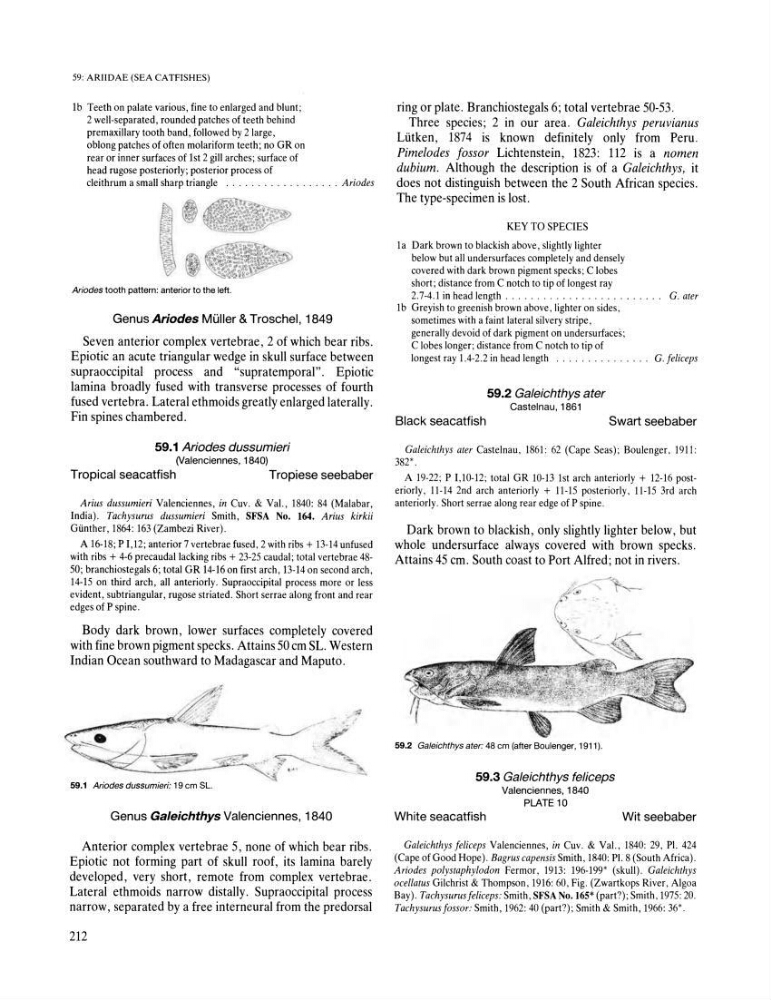
Ariodes tooth pattern: anterior to the left.
Genus Ariodes Muller & Troschel, 1849
Seven anterior complex vertebrae, 2 of which bear ribs.
Epiotic an acute triangular wedge in skull surface between
supraoccipital process and "supratemporal". Epiotic
lamina broadly fused with transverse processes of fourth
fused vertebra. Lateral ethmoids greatly enlarged laterally.
Fin spines chambered.
59.1 Ariodes dussumieri
(Valenciennes, 1840)
Tropical seacatfish
Tropiese seebaber
Arius dussumieri Valenciennes, in Cuv. & Val., 1840: 84 (Malabar,
India). Tachysurus dussumieri Smith, SFSA No. 164. Arius kirkii
Gunther, 1864: 163 (Zambezi River).
A 16-18; P 1,12; anterior 7 vertebraefused, 2 with ribs + 13-14 unfused
with ribs + 4-6 precaudallacking ribs + 23-25 caudal; total vertebrae 4850; branchiostegals 6; total GR 14-16 on first arch, 13-14 on second arch,
14-15 on third arch, all anteriorly. Supraoccipital process more or less
evident, subtriangular, rugose striated. Short serrae along front and rear
edges of P spine.
Body dark brown, lower surfaces completely covered
with fine brown pigment specks. Attains 50 cm SL. Western
Indian Ocean southward to Madagascar and Maputo .
. ~
59.1 Ariodes dussumieri: 19 em SL.
Genus Ga/eichthys Valenciennes, 1840
Anterior complex vertebrae 5, none of which bear ribs.
Epiotic not forming part of skull roof, its lamina barely
developed, very short, remote from complex vertebrae.
Lateral ethmoids narrow distally. Supraoccipital process
narrow, separated by a free interneural from the predorsal
212
ring or plate. Branchiostegals 6; total vertebrae 50-53.
Three species; 2 in our area. Galeichthys peruvianus
Liitken, 1874 is known definitely only from Peru.
Pimelodes fossor Lichtenstein, 1823: 112 is a nomen
dubium . Although the description is of a Galeichthys, it
does not distinguish between the 2 South African species.
The type-specimen is lost.
KEY TO SPECIES
la Dark brown to blackish above, slightly lighter
below but all undersurfaces completely and densely
covered with dark brown pigment specks; C lobes
short; distance from C notch to tip of longest ray
2.7-4.1 in head length. . . . . . . . . . . . . . . . . . . . . . . .. G. ater
Ib Greyish to greenish brown above, lighter on sides,
sometimes with a faint lateral silvery stripe,
generally devoid of dark pigment on undersurfaces;
C lobes longer; distance from C notch to tip of
longest ray 1.4-2.2 in head length ............... G. feliceps
59.2 Ga/eichthys ater
Castelnau, 1861
Black seacatfish
Swart seebaber
Galeichthys ater Castelnau. 1861: 62 (Cape Seas); Boulenger. 1911:
382*.
A 19-22; P 1,10-12; total GR 10-13 1st arch anteriorly + 12-16 posteriorly , 11-14 2nd arch anteriorly + 11-15 posteriorly , 11-15 3rd arch
anteriorly. Short serrae along rear edge of P spine.
Dark brown to blackish, only slightly lighter below, but
whole undersurface always covered with brown specks.
Attains 45 cm. South coast to Port Alfred; not in rivers.
59.2 Galeichthys ater: 48 em (after Boulenger, 1911).
59.3 Ga/eichthys fe/iceps
Valenciennes, 1840
PLATE 10
White seacatfish
Wit seebaber
Galeichthys feliceps Valenciennes, in Cuv. & Val., 1840: 29, PI. 424
(Cape of Good Hope). 8agrus capensis Smith, 1840: PI. 8 (South Africa).
Ariodes polystaphylodon Fermor, 1913: 196-199* (skull). Galeichthys
ocellatus Gilchrist & Thompson , 1916: 60, Fig. (Zwartkops River, Algoa
Bay). Tachysurusfeliceps: Smith , SFSA No. 165* (part?); Smith,1975: 20.
Tachysurus fossor: Smith , 1962: 40 (part?); Smith & Smith, 1966: 36*.
Ib Teeth on palate various, fine to enlarged and blunt;
2 well-separated, rounded patches of teeth behind
premaxillary tooth band, followed by 2 large,
oblong patches of often molariform teeth; no GR on
rear or inner surfaces of 1 st 2 gill arches; surface of
head rugose posteriorly; posterior process of
c1eithrum a small sharp triangle . . ........ . . . . . ... Ariodes
Ariodes tooth pattern: anterior to the left.
Genus Ariodes Muller & Troschel, 1849
Seven anterior complex vertebrae, 2 of which bear ribs.
Epiotic an acute triangular wedge in skull surface between
supraoccipital process and "supratemporal". Epiotic
lamina broadly fused with transverse processes of fourth
fused vertebra. Lateral ethmoids greatly enlarged laterally.
Fin spines chambered.
59.1 Ariodes dussumieri
(Valenciennes, 1840)
Tropical seacatfish
Tropiese seebaber
Arius dussumieri Valenciennes, in Cuv. & Val., 1840: 84 (Malabar,
India). Tachysurus dussumieri Smith, SFSA No. 164. Arius kirkii
Gunther, 1864: 163 (Zambezi River).
A 16-18; P 1,12; anterior 7 vertebraefused, 2 with ribs + 13-14 unfused
with ribs + 4-6 precaudallacking ribs + 23-25 caudal; total vertebrae 4850; branchiostegals 6; total GR 14-16 on first arch, 13-14 on second arch,
14-15 on third arch, all anteriorly. Supraoccipital process more or less
evident, subtriangular, rugose striated. Short serrae along front and rear
edges of P spine.
Body dark brown, lower surfaces completely covered
with fine brown pigment specks. Attains 50 cm SL. Western
Indian Ocean southward to Madagascar and Maputo .
. ~
59.1 Ariodes dussumieri: 19 em SL.
Genus Ga/eichthys Valenciennes, 1840
Anterior complex vertebrae 5, none of which bear ribs.
Epiotic not forming part of skull roof, its lamina barely
developed, very short, remote from complex vertebrae.
Lateral ethmoids narrow distally. Supraoccipital process
narrow, separated by a free interneural from the predorsal
212
ring or plate. Branchiostegals 6; total vertebrae 50-53.
Three species; 2 in our area. Galeichthys peruvianus
Liitken, 1874 is known definitely only from Peru.
Pimelodes fossor Lichtenstein, 1823: 112 is a nomen
dubium . Although the description is of a Galeichthys, it
does not distinguish between the 2 South African species.
The type-specimen is lost.
KEY TO SPECIES
la Dark brown to blackish above, slightly lighter
below but all undersurfaces completely and densely
covered with dark brown pigment specks; C lobes
short; distance from C notch to tip of longest ray
2.7-4.1 in head length. . . . . . . . . . . . . . . . . . . . . . . .. G. ater
Ib Greyish to greenish brown above, lighter on sides,
sometimes with a faint lateral silvery stripe,
generally devoid of dark pigment on undersurfaces;
C lobes longer; distance from C notch to tip of
longest ray 1.4-2.2 in head length ............... G. feliceps
59.2 Ga/eichthys ater
Castelnau, 1861
Black seacatfish
Swart seebaber
Galeichthys ater Castelnau. 1861: 62 (Cape Seas); Boulenger. 1911:
382*.
A 19-22; P 1,10-12; total GR 10-13 1st arch anteriorly + 12-16 posteriorly , 11-14 2nd arch anteriorly + 11-15 posteriorly , 11-15 3rd arch
anteriorly. Short serrae along rear edge of P spine.
Dark brown to blackish, only slightly lighter below, but
whole undersurface always covered with brown specks.
Attains 45 cm. South coast to Port Alfred; not in rivers.
59.2 Galeichthys ater: 48 em (after Boulenger, 1911).
59.3 Ga/eichthys fe/iceps
Valenciennes, 1840
PLATE 10
White seacatfish
Wit seebaber
Galeichthys feliceps Valenciennes, in Cuv. & Val., 1840: 29, PI. 424
(Cape of Good Hope). 8agrus capensis Smith, 1840: PI. 8 (South Africa).
Ariodes polystaphylodon Fermor, 1913: 196-199* (skull). Galeichthys
ocellatus Gilchrist & Thompson , 1916: 60, Fig. (Zwartkops River, Algoa
Bay). Tachysurusfeliceps: Smith , SFSA No. 165* (part?); Smith,1975: 20.
Tachysurus fossor: Smith , 1962: 40 (part?); Smith & Smith, 1966: 36*.