

Several genera and numerous species; represented in all
warm seas. Six species in 3 genera found in our area; stray
individuals of extralimital species can perhaps be expected
on our east coast. The flesh of some forms is dark and much
used for savoury pastes. In South Africa the huge catches of
anchovies are generally turned into fishmeal. As with the
Clupeidae, identification often requires a microscope. The
warm-water Indo-Pacific species have recently been revised
by Wongratana (1981), which supersedes the synopsis by
Whitehead (1973). Of the eleven new species proposed by
Wongratana (1983), none is recorded from our area.
KEY TO GENERA
la No scutes along belly; body subcylindrical; mlxilla
tip bluntly rounded, barely reaching edge of preopercle
Engraulis
1 b At least some scutes along belly . . . . . . . . . . . . . . . . . . . . . . 2
2a Sharp needle-like scutes in front of V, none behind;
silver band along flanks . . . . . . . . . . . . . . . . . . . . Stolephorus
2b Complete keel of sharp scutes from gill opening to
anus; no silver band along flanks ................. Thryssa
Genus Engraulis Cuvier, 1816
Our species seems identical to the Japanese anchovy.
Differences from the European anchovy, which reaches
south to at least Angola, are slight and all may in the future
be united as a single widespread species, E. encrasicolus
(Linnaeus, 1758).
Cape anchovy
55.1 Engraulis japonicus
Schlegel, 1846
PLATE 9
Kaapse ansjovis
Engraulis japonicus Schlegel, 1846: 238, PI. 108, Fig. 3 (Japan); Smith,
SFSA No. 123*; Whitehead, 1973: 218*; Wongratana, 1981: 219*.
Engraulis capensis Gilchrist, 1913: 62 (vicinity of Cape Peninsula); Smith
& Smith, 1966: 84*; Crawford, 1981: 51.
o ii-iii,12-14; A ii-iii,13-18; P i, 14-17; V i,6; LS 40- 45; lower GR 26-39.
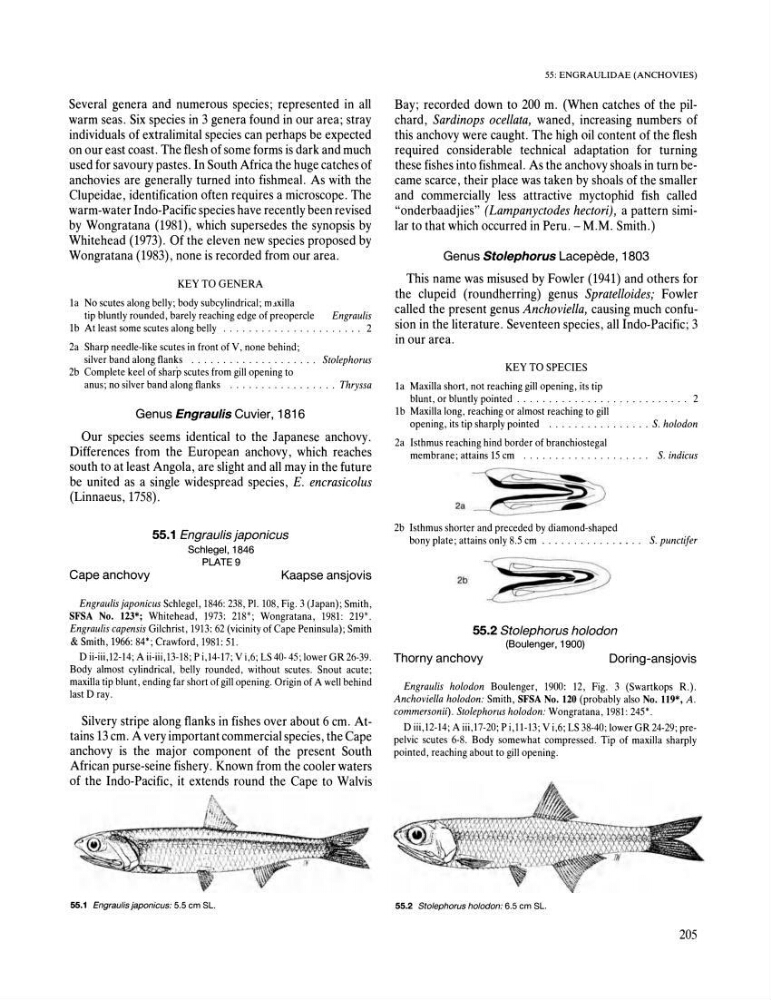
Body almost cylindrical, belly rounded, without scutes. Snout acute;
maxilla tip blunt, ending far short of gill opening. Origin of A well behind
last 0 ray.
Silvery stripe along flanks in fishes over about 6 cm. Attains 13 cm. A very important commercial species, the Cape
anchovy is the major component of the present South
African purse-seine fishery. Known from the cooler waters
of the Indo-Pacific, it extends round the Cape to Walvis
55.1 Engraulis japonicus: 5.5 em SL.
55: ENGRAULIDAE (ANCHOVIES)
Bay; recorded down to 200 m. (When catches of the pilchard, Sardinops ocellata, waned, increasing numbers of
this anchovy were caught. The high oil content of the flesh
required considerable technical adaptation for turning
these fishes into fishmeal. As the anchovy shoals in turn became scarce, their place was taken by shoals of the smaller
and commercially less attractive myctophid fish called
"onderbaadjies" (Lampanyctodes hectori), a pattern similar to that which occurred in Peru. - M.M. Smith.)
Genus Stolephorus Lacepede, 1803
This name was misused by Fowler (1941) and others for
the clupeid (roundherring) genus Spratelloides; Fowler
called the present genus Anchoviella, causing much confusion in the literature. Seventeen species, all Indo-Pacific; 3
in our area.
KEY TO SPECIES
la Maxilla short, not reaching gill opening, its tip
blunt, or bluntly pointed. . . . . . . . . . . . . . . . . . . . . . . . . . . 2
Ib Maxilla long, reaching or almost reaching to gill
opening, its tip sharply pointed . . . . . . . . . . . . . . . . S. holodon
2a Isthmus reaching hind border of branchiostegal
membrane; attains 15 cm . . . . . . . . . . . . . . . . . . .. S. indicus
2a
2b Isthmus shorter and preceded by diamond-shaped
bony plate; attains only 8.5 cm . . . . . . . . . . . . . . .. S. punctifer
2b
55.2 Stolephorus holodon
(Boulenger, 1900)
Thorny anchovy
Doring-ansjovis
Engraulis holodon Boulenger, 1900: 12, Fig. 3 (Swartkops R.).
Anchoviella holodon: Smith, SFSA No. 120 (probably also No. 119*, A.
commersonii). Stolephorus holodon: Wongratana, 1981: 245*.
o iii,12-14; A iii,17-20; P i,Il-13; V i,6; LS 38-40; lower GR 24-29; prepelvic scutes 6-8. Body somewhat compressed. Tip of maxilla sharply
pointed, reaching about to gill opening.
55.2 Stolephorus holodon: 6.5 em SL.
205
warm seas. Six species in 3 genera found in our area; stray
individuals of extralimital species can perhaps be expected
on our east coast. The flesh of some forms is dark and much
used for savoury pastes. In South Africa the huge catches of
anchovies are generally turned into fishmeal. As with the
Clupeidae, identification often requires a microscope. The
warm-water Indo-Pacific species have recently been revised
by Wongratana (1981), which supersedes the synopsis by
Whitehead (1973). Of the eleven new species proposed by
Wongratana (1983), none is recorded from our area.
KEY TO GENERA
la No scutes along belly; body subcylindrical; mlxilla
tip bluntly rounded, barely reaching edge of preopercle
Engraulis
1 b At least some scutes along belly . . . . . . . . . . . . . . . . . . . . . . 2
2a Sharp needle-like scutes in front of V, none behind;
silver band along flanks . . . . . . . . . . . . . . . . . . . . Stolephorus
2b Complete keel of sharp scutes from gill opening to
anus; no silver band along flanks ................. Thryssa
Genus Engraulis Cuvier, 1816
Our species seems identical to the Japanese anchovy.
Differences from the European anchovy, which reaches
south to at least Angola, are slight and all may in the future
be united as a single widespread species, E. encrasicolus
(Linnaeus, 1758).
Cape anchovy
55.1 Engraulis japonicus
Schlegel, 1846
PLATE 9
Kaapse ansjovis
Engraulis japonicus Schlegel, 1846: 238, PI. 108, Fig. 3 (Japan); Smith,
SFSA No. 123*; Whitehead, 1973: 218*; Wongratana, 1981: 219*.
Engraulis capensis Gilchrist, 1913: 62 (vicinity of Cape Peninsula); Smith
& Smith, 1966: 84*; Crawford, 1981: 51.
o ii-iii,12-14; A ii-iii,13-18; P i, 14-17; V i,6; LS 40- 45; lower GR 26-39.
Body almost cylindrical, belly rounded, without scutes. Snout acute;
maxilla tip blunt, ending far short of gill opening. Origin of A well behind
last 0 ray.
Silvery stripe along flanks in fishes over about 6 cm. Attains 13 cm. A very important commercial species, the Cape
anchovy is the major component of the present South
African purse-seine fishery. Known from the cooler waters
of the Indo-Pacific, it extends round the Cape to Walvis
55.1 Engraulis japonicus: 5.5 em SL.
55: ENGRAULIDAE (ANCHOVIES)
Bay; recorded down to 200 m. (When catches of the pilchard, Sardinops ocellata, waned, increasing numbers of
this anchovy were caught. The high oil content of the flesh
required considerable technical adaptation for turning
these fishes into fishmeal. As the anchovy shoals in turn became scarce, their place was taken by shoals of the smaller
and commercially less attractive myctophid fish called
"onderbaadjies" (Lampanyctodes hectori), a pattern similar to that which occurred in Peru. - M.M. Smith.)
Genus Stolephorus Lacepede, 1803
This name was misused by Fowler (1941) and others for
the clupeid (roundherring) genus Spratelloides; Fowler
called the present genus Anchoviella, causing much confusion in the literature. Seventeen species, all Indo-Pacific; 3
in our area.
KEY TO SPECIES
la Maxilla short, not reaching gill opening, its tip
blunt, or bluntly pointed. . . . . . . . . . . . . . . . . . . . . . . . . . . 2
Ib Maxilla long, reaching or almost reaching to gill
opening, its tip sharply pointed . . . . . . . . . . . . . . . . S. holodon
2a Isthmus reaching hind border of branchiostegal
membrane; attains 15 cm . . . . . . . . . . . . . . . . . . .. S. indicus
2a
2b Isthmus shorter and preceded by diamond-shaped
bony plate; attains only 8.5 cm . . . . . . . . . . . . . . .. S. punctifer
2b
55.2 Stolephorus holodon
(Boulenger, 1900)
Thorny anchovy
Doring-ansjovis
Engraulis holodon Boulenger, 1900: 12, Fig. 3 (Swartkops R.).
Anchoviella holodon: Smith, SFSA No. 120 (probably also No. 119*, A.
commersonii). Stolephorus holodon: Wongratana, 1981: 245*.
o iii,12-14; A iii,17-20; P i,Il-13; V i,6; LS 38-40; lower GR 24-29; prepelvic scutes 6-8. Body somewhat compressed. Tip of maxilla sharply
pointed, reaching about to gill opening.
55.2 Stolephorus holodon: 6.5 em SL.
205