

54: CLUPEIDAE (HERRINGS, SARDINES, PILCHARDS)
Black spot at base of anterior D rays, a gold, green or
faint dark spot behind gill opening; upper part of P black,
with pale rays. Attains 30 cm. Atlantic and Mediterranean,
reaching south to Walvis Bay (one specimen, probably
uncommon). Of considerable fishery importance off west
coast of Africa south to Congo.
Genus Sardinops Hubbs, 1929
Body fusiform, not much compressed; belly rounded, the
scutes feeble; 2 enlarged scales at base of caudal. Four
species (subspecies by some authors); 1 in our area.
54.12 Sardinops ocellatus
(Pappe, 1853)
PLATE 9
South African pilchard
Suid-Afrikaanse peiser
Clupea ocellata Pappe, 1853: 20. Sardinops ocellata: Smith, SFSA No.
115*; Crawford, 1981:1; Whitehead & Wongratana, 1984: Sardop 2*.
D iii-iv,14-16; A iii-iv,15-18; P i,8; V i,7; LS 50-57; lower GR to about
120 with growth; scutes (16-19)+(13-16). Strong radiating bony striae on
lower part of operculum (easily visible even in juveniles). Lower GR
decreasing in length at angle of gill arch and overlapped by upper rakers.
A series of dark spots along flanks, sometimes with a
second or third series below. Attains 28 cm. Atlantic coast
from southern Angola (Baia dos Tigres) south to Cape
Town and northeast to Delagoa Bay. A shoaling cool-water
species, formerly the basis of a large canning industry on the
west coast. Considerable research has been carried out on
this species by the Division of Sea Fisheries. It was thought
that all breeding took place in the cold water off the west
coast, but larvae found near East London indicate a breeding area to the east of that port. The densely packed shoals,
heavily preyed upon by birds and fishes, are sometimes
driven inshore and numbers may be washed up on the
beach. (Note by M.M. Smith: This is the species responsible
for the famous "Sardine Run" of Natal. Large shoals travel
up the coast and reach the Natal south coast at the beginning of June. They are probably following the planktonic
food supply that drifts in that direction during the winter
months. The shoals are preyed upon by birds, fishes and sea
mammals, and most of the shark nets are removed to avoid
damage by the hordes of large predators. Anglers have a
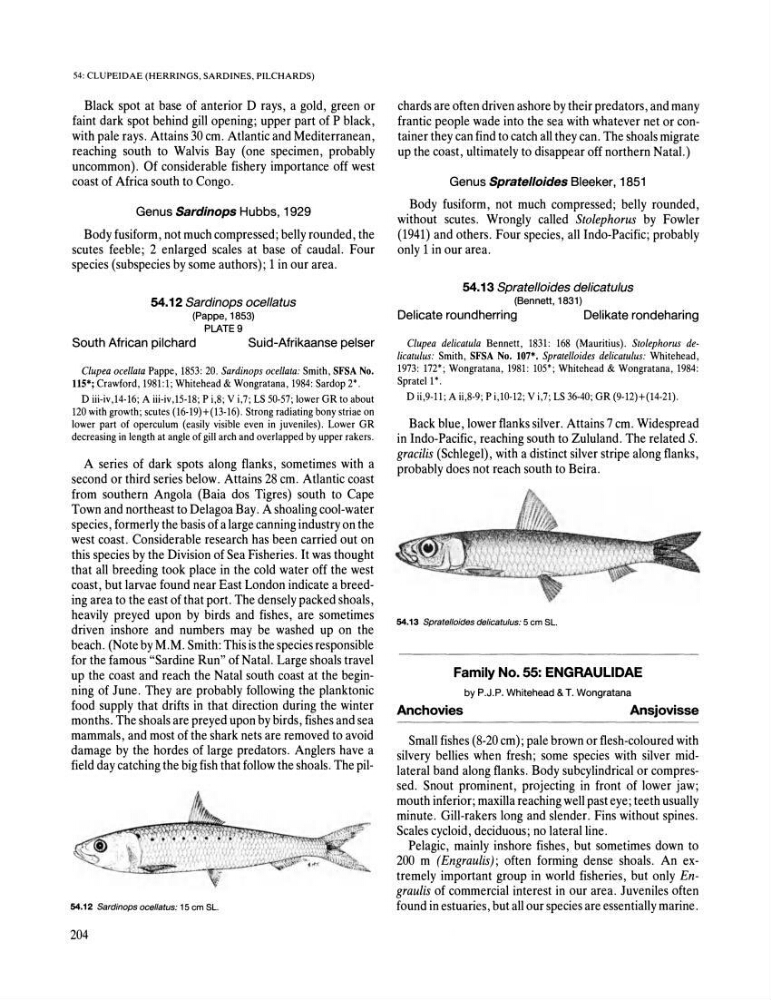
field day catching the big fish that follow the shoals. The pil54.12 Sardinops ocel/atus: 15 em SL.
204
chards are often driven ashore by their predators, and many
frantic people wade into the sea with whatever net or container they can find to catch all they can. The shoals migrate
up the coast, ultimately to disappear off northern Natal.)
Genus Spratelloides Bleeker, 1851
Body fusiform, not much compressed; belly rounded,
without scutes. Wrongly called Stolephorus by Fowler
(1941) and others. Four species, all Indo-Pacific; probably
only 1 in our area.
54.13 Spratelloides delicatulus
(Bennett, 1831)
Delicate roundherring
Delikate rondeharing
Clupea delicatula Bennett, 1831: 168 (Mauritius). Stolephorus delicatulus: Smith, SFSA No. 107*. Spratelloides delicatulus: Whitehead,
1973: 172*; Wongratana, 1981: 105*; Whitehead & Wongratana, 1984:
Spratel1* .
D ii,9-11; A ii,8-9; P i,1O-12; V i,7; LS 36-40; GR (9-12)+(14-21).
Back blue, lower flanks silver. Attains 7 cm. Widespread
in Indo-Pacific, reaching south to Zululand. The related S.
gracilis (Schlegel), with a distinct silver stripe along flanks,
probably does not reach south to Beira.
54.13 Spratel/oides delicatulus: 5 em SL.
Family No. 55: ENGRAULIDAE
by P.J.P. Whitehead & T. Wongratana
Anchovies
Ansjovisse
Small fishes (8-20 cm); pale brown or flesh-coloured with
silvery bellies when fresh; some species with silver midlateral band along flanks. Body subcylindrical or compressed. Snout prominent, projecting in front of lower jaw;
mouth inferior; maxilla reaching well past eye; teeth usually
minute. Gill-rakers long and slender. Fins without spines.
Scales cycloid, deciduous; no lateral line.
Pelagic, mainly inshore fishes, but sometimes down to
200 m (Engraulis); often forming dense shoals. An extremely important group in world fisheries, but only Engraulis of commercial interest in our area. Juveniles often
found in estuaries, but all our species are essentially marine.
Black spot at base of anterior D rays, a gold, green or
faint dark spot behind gill opening; upper part of P black,
with pale rays. Attains 30 cm. Atlantic and Mediterranean,
reaching south to Walvis Bay (one specimen, probably
uncommon). Of considerable fishery importance off west
coast of Africa south to Congo.
Genus Sardinops Hubbs, 1929
Body fusiform, not much compressed; belly rounded, the
scutes feeble; 2 enlarged scales at base of caudal. Four
species (subspecies by some authors); 1 in our area.
54.12 Sardinops ocellatus
(Pappe, 1853)
PLATE 9
South African pilchard
Suid-Afrikaanse peiser
Clupea ocellata Pappe, 1853: 20. Sardinops ocellata: Smith, SFSA No.
115*; Crawford, 1981:1; Whitehead & Wongratana, 1984: Sardop 2*.
D iii-iv,14-16; A iii-iv,15-18; P i,8; V i,7; LS 50-57; lower GR to about
120 with growth; scutes (16-19)+(13-16). Strong radiating bony striae on
lower part of operculum (easily visible even in juveniles). Lower GR
decreasing in length at angle of gill arch and overlapped by upper rakers.
A series of dark spots along flanks, sometimes with a
second or third series below. Attains 28 cm. Atlantic coast
from southern Angola (Baia dos Tigres) south to Cape
Town and northeast to Delagoa Bay. A shoaling cool-water
species, formerly the basis of a large canning industry on the
west coast. Considerable research has been carried out on
this species by the Division of Sea Fisheries. It was thought
that all breeding took place in the cold water off the west
coast, but larvae found near East London indicate a breeding area to the east of that port. The densely packed shoals,
heavily preyed upon by birds and fishes, are sometimes
driven inshore and numbers may be washed up on the
beach. (Note by M.M. Smith: This is the species responsible
for the famous "Sardine Run" of Natal. Large shoals travel
up the coast and reach the Natal south coast at the beginning of June. They are probably following the planktonic
food supply that drifts in that direction during the winter
months. The shoals are preyed upon by birds, fishes and sea
mammals, and most of the shark nets are removed to avoid
damage by the hordes of large predators. Anglers have a
field day catching the big fish that follow the shoals. The pil54.12 Sardinops ocel/atus: 15 em SL.
204
chards are often driven ashore by their predators, and many
frantic people wade into the sea with whatever net or container they can find to catch all they can. The shoals migrate
up the coast, ultimately to disappear off northern Natal.)
Genus Spratelloides Bleeker, 1851
Body fusiform, not much compressed; belly rounded,
without scutes. Wrongly called Stolephorus by Fowler
(1941) and others. Four species, all Indo-Pacific; probably
only 1 in our area.
54.13 Spratelloides delicatulus
(Bennett, 1831)
Delicate roundherring
Delikate rondeharing
Clupea delicatula Bennett, 1831: 168 (Mauritius). Stolephorus delicatulus: Smith, SFSA No. 107*. Spratelloides delicatulus: Whitehead,
1973: 172*; Wongratana, 1981: 105*; Whitehead & Wongratana, 1984:
Spratel1* .
D ii,9-11; A ii,8-9; P i,1O-12; V i,7; LS 36-40; GR (9-12)+(14-21).
Back blue, lower flanks silver. Attains 7 cm. Widespread
in Indo-Pacific, reaching south to Zululand. The related S.
gracilis (Schlegel), with a distinct silver stripe along flanks,
probably does not reach south to Beira.
54.13 Spratel/oides delicatulus: 5 em SL.
Family No. 55: ENGRAULIDAE
by P.J.P. Whitehead & T. Wongratana
Anchovies
Ansjovisse
Small fishes (8-20 cm); pale brown or flesh-coloured with
silvery bellies when fresh; some species with silver midlateral band along flanks. Body subcylindrical or compressed. Snout prominent, projecting in front of lower jaw;
mouth inferior; maxilla reaching well past eye; teeth usually
minute. Gill-rakers long and slender. Fins without spines.
Scales cycloid, deciduous; no lateral line.
Pelagic, mainly inshore fishes, but sometimes down to
200 m (Engraulis); often forming dense shoals. An extremely important group in world fisheries, but only Engraulis of commercial interest in our area. Juveniles often
found in estuaries, but all our species are essentially marine.