

54.2 Etrumeus whiteheadi
Wongratana. 1983
Redeye roundherring
Rooi-oog-rondeharing
Etrumeus whiteheadi Wongratana, 1983: 387, Fig. 1 (Algoa Bay).
Etrumeus teres (non De Kay) : Whitehead, 1963: 321*.
D iv-v,14-16; A iii-iv,8-1O; P i,13-16; V i,7; LS 48-51; GR (16-18)+(3540). Premaxillae rectangular.
Back blue-green, flanks silvery. Attains 20 cm. An
endemic species, from Walvis Bay to Durban (where it
overlaps E. teres).
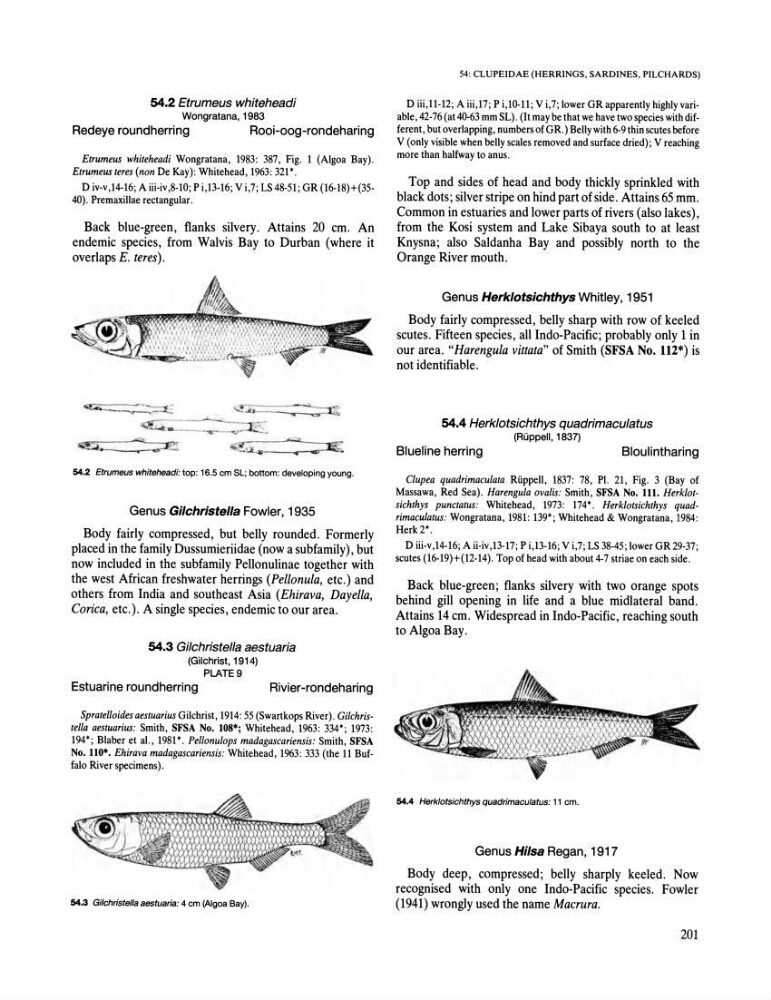
.--.54.2 Etrumeus whiteheadi: top: 16.5 em SL; bottom: developing young.
Genus Gi/christella Fowler, 1935
Body fairly compressed, but belly rounded. Formerly
placed in the family Dussumieriidae (now a subfamily), but
now included in the subfamily Pellonulinae together with
the west African freshwater herrings (Pellonula, etc.) and
others from India and southeast Asia (Ehirava, Dayella,
Co rica, etc.). A single species, endemic to our area.
54.3 Gilchristella aestuaria
(Gilchrist. 1914)
PLATE 9
Estuarine roundherring
Rivier-rondeharing
Spratelloides aestuarius Gilchrist, 1914: 55 (Swartkops River) . Gilchristella aestuarius: Smith, SFSA No. 108*; Whitehead, 1963: 334*; 1973:
194*; Blaber et aI., 1981*. Pellonulops madagascariensis: Smith, SFSA
No. 110*. Ehirava madagascariensis: Whitehead, 1963: 333 (the 11 Buffalo River specimens).
54.3 Gilchristella aestuaria: 4 em (Algoa Bay).
54: CLUPEIDAE (HERRINGS. SARDINES, PILCHARDS)
D iii,1l-12; A iii,17; P i,lO-l1; V i,7; lower GR apparently highly variable, 42-76 (at 40-63 mm SL). (It maybe that we have two species withdifferent, but overlapping, numbers of G R.) Belly with 6-9 thin scutes before
V (only visible when belly scales removed and surface dried); V reaching
more than halfway to anus.
Top and sides of head and body thickly sprinkled with
black dots; silver stripe on hind part of side. Attains 65 mm.
Common in estuaries and lower parts of rivers (also lakes),
from the Kosi system and Lake Sibaya south to at least
Knysna; also Saldanha Bay and possibly north to the
Orange River mouth.
Genus Herklotsichthys Whitley, 1951
Body fairly compressed, belly sharp with row of keeled
scutes. Fifteen species, all Indo-Pacific; probably only 1 in
our area. "Harengula vittata" of Smith (SFSA No. 112*) is
not identifiable.
54.4 Herklotsichthys quadrimaculatus
(Ruppell. 1837)
Blueline herring
Bloulintharing
Clupea quadrimaculata Riippell, 1837: 78, PI. 21, Fig. 3 (Bay of
Massawa, Red Sea) . Harengula ovalis: Smith, SFSA No. 111. Herklotsichthys punctatus: Whitehead , 1973: 174*. Herklotsichthys quadrimaculatus: Wongratana, 1981 : 139*; Whitehead & Wongratana, 1984:
Herk 2* .
D iii-v ,14-16; A ii-iv,13-17; P i,13-16; V i,7; LS 38-45; lower GR 29-37;
scutes (16-19)+(12-14) . Top of head with about 4-7 striae on each side.
Back blue-green; flanks silvery with two orange spots
behind gill opening in life and a blue midlateral band.
Attains 14 cm. Widespread in Indo-Pacific, reaching south
to Algoa Bay.
54.4 Herklotsichthys quadrimaculatus: 11 em.
Genus Hi/sa Regan, 1917
Body deep, compressed; belly sharply keeled. Now
recognised with only one Indo-Pacific species . Fowler
(1941) wrongly used the name Macrura.
201
Wongratana. 1983
Redeye roundherring
Rooi-oog-rondeharing
Etrumeus whiteheadi Wongratana, 1983: 387, Fig. 1 (Algoa Bay).
Etrumeus teres (non De Kay) : Whitehead, 1963: 321*.
D iv-v,14-16; A iii-iv,8-1O; P i,13-16; V i,7; LS 48-51; GR (16-18)+(3540). Premaxillae rectangular.
Back blue-green, flanks silvery. Attains 20 cm. An
endemic species, from Walvis Bay to Durban (where it
overlaps E. teres).
.--.54.2 Etrumeus whiteheadi: top: 16.5 em SL; bottom: developing young.
Genus Gi/christella Fowler, 1935
Body fairly compressed, but belly rounded. Formerly
placed in the family Dussumieriidae (now a subfamily), but
now included in the subfamily Pellonulinae together with
the west African freshwater herrings (Pellonula, etc.) and
others from India and southeast Asia (Ehirava, Dayella,
Co rica, etc.). A single species, endemic to our area.
54.3 Gilchristella aestuaria
(Gilchrist. 1914)
PLATE 9
Estuarine roundherring
Rivier-rondeharing
Spratelloides aestuarius Gilchrist, 1914: 55 (Swartkops River) . Gilchristella aestuarius: Smith, SFSA No. 108*; Whitehead, 1963: 334*; 1973:
194*; Blaber et aI., 1981*. Pellonulops madagascariensis: Smith, SFSA
No. 110*. Ehirava madagascariensis: Whitehead, 1963: 333 (the 11 Buffalo River specimens).
54.3 Gilchristella aestuaria: 4 em (Algoa Bay).
54: CLUPEIDAE (HERRINGS. SARDINES, PILCHARDS)
D iii,1l-12; A iii,17; P i,lO-l1; V i,7; lower GR apparently highly variable, 42-76 (at 40-63 mm SL). (It maybe that we have two species withdifferent, but overlapping, numbers of G R.) Belly with 6-9 thin scutes before
V (only visible when belly scales removed and surface dried); V reaching
more than halfway to anus.
Top and sides of head and body thickly sprinkled with
black dots; silver stripe on hind part of side. Attains 65 mm.
Common in estuaries and lower parts of rivers (also lakes),
from the Kosi system and Lake Sibaya south to at least
Knysna; also Saldanha Bay and possibly north to the
Orange River mouth.
Genus Herklotsichthys Whitley, 1951
Body fairly compressed, belly sharp with row of keeled
scutes. Fifteen species, all Indo-Pacific; probably only 1 in
our area. "Harengula vittata" of Smith (SFSA No. 112*) is
not identifiable.
54.4 Herklotsichthys quadrimaculatus
(Ruppell. 1837)
Blueline herring
Bloulintharing
Clupea quadrimaculata Riippell, 1837: 78, PI. 21, Fig. 3 (Bay of
Massawa, Red Sea) . Harengula ovalis: Smith, SFSA No. 111. Herklotsichthys punctatus: Whitehead , 1973: 174*. Herklotsichthys quadrimaculatus: Wongratana, 1981 : 139*; Whitehead & Wongratana, 1984:
Herk 2* .
D iii-v ,14-16; A ii-iv,13-17; P i,13-16; V i,7; LS 38-45; lower GR 29-37;
scutes (16-19)+(12-14) . Top of head with about 4-7 striae on each side.
Back blue-green; flanks silvery with two orange spots
behind gill opening in life and a blue midlateral band.
Attains 14 cm. Widespread in Indo-Pacific, reaching south
to Algoa Bay.
54.4 Herklotsichthys quadrimaculatus: 11 em.
Genus Hi/sa Regan, 1917
Body deep, compressed; belly sharply keeled. Now
recognised with only one Indo-Pacific species . Fowler
(1941) wrongly used the name Macrura.
201