

54: CLUPEIDAE (HERRINGS. SARDINES. PILCHARDS)
3b V base under last half of D; upper jaw deep .. .. ... ..... . Spratelloides
4a Strong radiating bony striae on lower part of
operculum; dark spots along flanks ........... ... ..... ..... .... Sardinops
4b Lower part of operculum smooth, at most with fleshy canals .... .. . 5
5a A long, with 34-42 rays; lower jaw projecting ....... ........... Pellona
5b A short, with fewer than 30 rays ........ ... ....... .... ... ... ...... .... .. ... 6
6a Upper jaw rounded in front; rear edge of gill-opening
with 2 fleshy projections ..... ... ... ....... .... ...... ... ... .. ... .... .......... 7
6a
6b Upper jaw with distinct median notch; rear edge of
gill-opening evenly rounded ... .... .... ... ........... ... .. .... .. ... ... ... ... 8
6b
7a Numerous striations on top of head; 2nd
supramaxilla symmetrically paddle-shaped .... ......... ...... Sardinella
7a
7b Few striations on top of head; 2nd supramaxilla
asymmetrical ...... ....... ........ .... ....... .... ............ . Herklotsichthys
7b
8a Mouth terminal; maxilla straight .... .. .. .......... .. .......... ...... . Hi/sa
8b Mouth inferior; maxilla curved downward .... .... ......... .. ........... 9
200
9a Last D ray greatly elongated; predorsal scales paired .. . Nematalosa
9b Last D ray not elongate; predorsal scales forming
a single median row .. ............................ .... .. .... Anodontostoma
(A juvenile of A . chacunda (Hamilton-Buchanan, 1822) in the 1.L.B
Smith Institute of Ichthyology is labelled "Natal (South coast?) 1952,
RUSI 1008" and was included in a revision by Nelson & Rothman (1973:
145). However, this gizzard shad genus is unknown in our area and the
locality must be suspect.)
Genus Etrumeus Bleeker, 1853
Body subcylindrical; A base very short, well behind D.
Formerly placed with Dussumieria (and other genera) in a
distinct family Dussumieriidae (Whitehead, 1963), which is
now considered merely a subfamily of herrings (the other
genera, e.g. Spratelloides and Gilchristella of our area, removed to other subfamilies). Nevertheless, the absence of
keeled scutes along the belly justifies the common name
roundherrings for all of the Dussumieriinae. Two species;
both in our area, one widespread, the other endemic and
much more common but only recently recognised as distinct.
KEY TO SPECIES
la Lower GR 31-35; V base at least 1;1 eye diameter
behind last D ray in adults ................ .. ......................... E. teres
Ib Lower GR 35-40; V base under or just behind
last D ray in adults .. ...... .. .. .. .. .. .. .. .. .. ...... .. .. .. .. .. .. E. whiteheadi
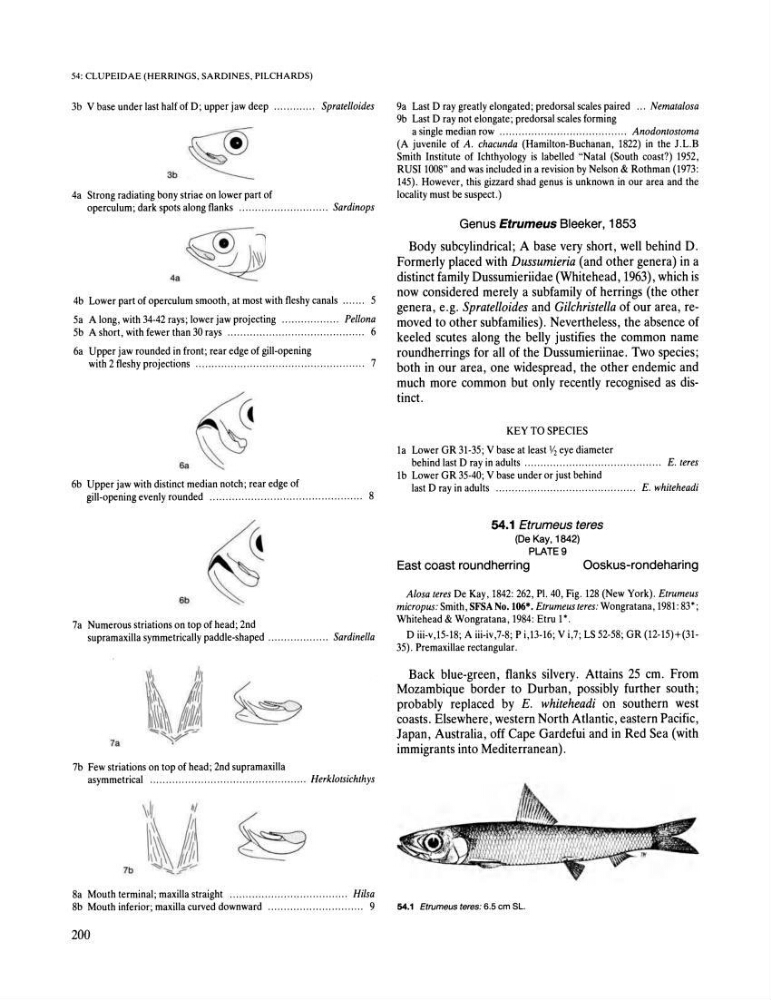
54.1 Etrumeus teres
(De Kay, 1842)
PLATE 9
East coast roundherring
Ooskus-rondeharing
Alosa teres De Kay, 1842: 262, PI. 40, Fig. 128 (New York) . Etrumeus
micropus: Smith, SFSA No. 106*. Etrumeus teres: Wongratana, 1981 : 83";
Whitehead & Wongratana, 1984: Etru 1*.
D iii-v,15-18; A iii-iv,7-8; P i,13-16; V i,7; LS 52-58; GR (12-15)+(3135). Premaxillae rectangular.
Back blue-green, flanks silvery. Attains 25 cm. From
Mozambique border to Durban, possibly further south;
probably replaced by E. whiteheadi on southern west
coasts. Elsewhere, western North Atlantic, eastern Pacific,
Japan, Australia, off Cape Gardefui and in Red Sea (with
immigrants into Mediterranean) .
54.1 Etrumeus teres: 6.5 em Sl.
3b V base under last half of D; upper jaw deep .. .. ... ..... . Spratelloides
4a Strong radiating bony striae on lower part of
operculum; dark spots along flanks ........... ... ..... ..... .... Sardinops
4b Lower part of operculum smooth, at most with fleshy canals .... .. . 5
5a A long, with 34-42 rays; lower jaw projecting ....... ........... Pellona
5b A short, with fewer than 30 rays ........ ... ....... .... ... ... ...... .... .. ... 6
6a Upper jaw rounded in front; rear edge of gill-opening
with 2 fleshy projections ..... ... ... ....... .... ...... ... ... .. ... .... .......... 7
6a
6b Upper jaw with distinct median notch; rear edge of
gill-opening evenly rounded ... .... .... ... ........... ... .. .... .. ... ... ... ... 8
6b
7a Numerous striations on top of head; 2nd
supramaxilla symmetrically paddle-shaped .... ......... ...... Sardinella
7a
7b Few striations on top of head; 2nd supramaxilla
asymmetrical ...... ....... ........ .... ....... .... ............ . Herklotsichthys
7b
8a Mouth terminal; maxilla straight .... .. .. .......... .. .......... ...... . Hi/sa
8b Mouth inferior; maxilla curved downward .... .... ......... .. ........... 9
200
9a Last D ray greatly elongated; predorsal scales paired .. . Nematalosa
9b Last D ray not elongate; predorsal scales forming
a single median row .. ............................ .... .. .... Anodontostoma
(A juvenile of A . chacunda (Hamilton-Buchanan, 1822) in the 1.L.B
Smith Institute of Ichthyology is labelled "Natal (South coast?) 1952,
RUSI 1008" and was included in a revision by Nelson & Rothman (1973:
145). However, this gizzard shad genus is unknown in our area and the
locality must be suspect.)
Genus Etrumeus Bleeker, 1853
Body subcylindrical; A base very short, well behind D.
Formerly placed with Dussumieria (and other genera) in a
distinct family Dussumieriidae (Whitehead, 1963), which is
now considered merely a subfamily of herrings (the other
genera, e.g. Spratelloides and Gilchristella of our area, removed to other subfamilies). Nevertheless, the absence of
keeled scutes along the belly justifies the common name
roundherrings for all of the Dussumieriinae. Two species;
both in our area, one widespread, the other endemic and
much more common but only recently recognised as distinct.
KEY TO SPECIES
la Lower GR 31-35; V base at least 1;1 eye diameter
behind last D ray in adults ................ .. ......................... E. teres
Ib Lower GR 35-40; V base under or just behind
last D ray in adults .. ...... .. .. .. .. .. .. .. .. .. ...... .. .. .. .. .. .. E. whiteheadi
54.1 Etrumeus teres
(De Kay, 1842)
PLATE 9
East coast roundherring
Ooskus-rondeharing
Alosa teres De Kay, 1842: 262, PI. 40, Fig. 128 (New York) . Etrumeus
micropus: Smith, SFSA No. 106*. Etrumeus teres: Wongratana, 1981 : 83";
Whitehead & Wongratana, 1984: Etru 1*.
D iii-v,15-18; A iii-iv,7-8; P i,13-16; V i,7; LS 52-58; GR (12-15)+(3135). Premaxillae rectangular.
Back blue-green, flanks silvery. Attains 25 cm. From
Mozambique border to Durban, possibly further south;
probably replaced by E. whiteheadi on southern west
coasts. Elsewhere, western North Atlantic, eastern Pacific,
Japan, Australia, off Cape Gardefui and in Red Sea (with
immigrants into Mediterranean) .
54.1 Etrumeus teres: 6.5 em Sl.