

Order CLUPEIFORMES
Characters as under Clupeomorpha. Four families are
currently recognised (Nelson, 1984); Denticipitidae (one
species only) is known from freshwaters of Nigeria.
KEY TO FAMILIES
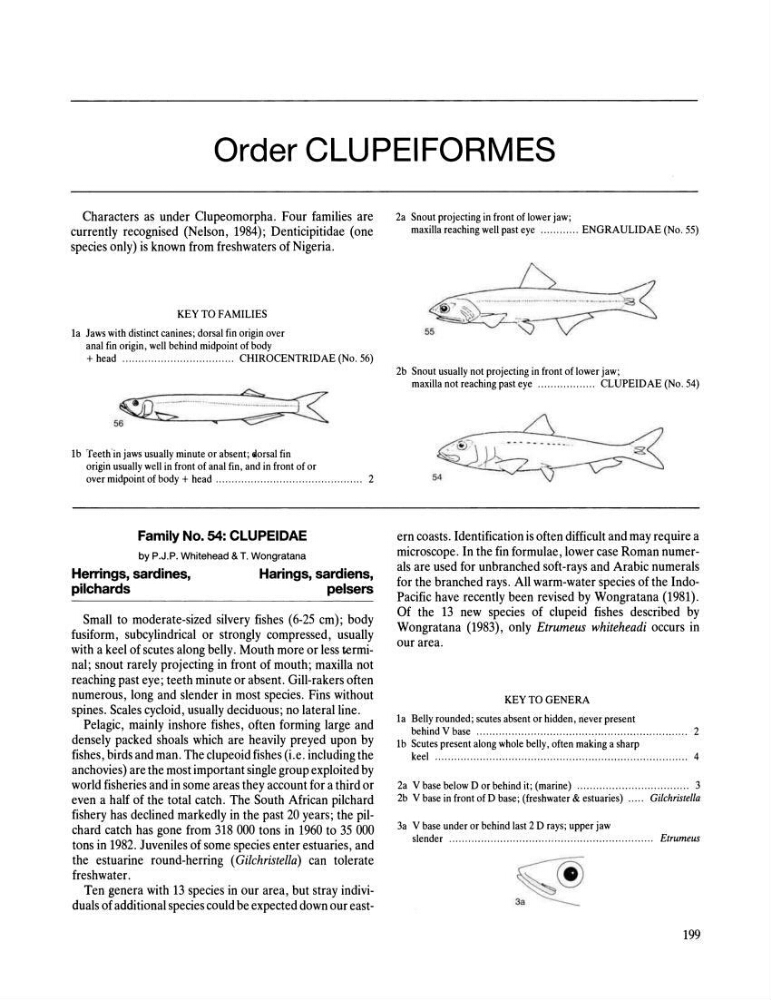
la Jaws with distinct canines; dorsal fin origin over
anal fin origin, well behind midpoint of body
+ head ................................... CHIROCENTRIDAE (No. 56)
5~' -""""""'~'-"""-~
Ib Teeth'in jaws usually minute or absent; 610rsal fin
origin usually well in front of anal fin, and in front of or
over midpoint of body + head .............................................. 2
Family No. 54: CLUPEIDAE
by P.J.P. Whitehead & T. Wongratana
Herrings, sardines,
Harings, sardiens,
pilchards
pelsers
Small to moderate-sized silvery fishes (6-25 cm); body
fusiform, subcylindrical or strongly compressed, usually
with a keel of scutes along belly. Mouth more or less terminal; snout rarely projecting in front of mouth; maxilla not
reaching past eye; teeth minute or absent. Gill-rakers often
numerous, long and slender in most species. Fins without
spines. Scales cycloid, usually deciduous; no lateral line.
Pelagic, mainly inshore fishes, often forming large and
densely packed shoals which are heavily preyed upon by
fishes, birds and man. The clupeoid fishes (i.e. including the
anchovies) are the most important single group exploited by
world fisheries and in some areas they account for a third or
even a half of the total catch. The South African pilchard
fishery has declined markedly in the past 20 years; the pilchard catch has gone from 318 000 tons in 1960 to 35 000
tons in 1982. Juveniles of some species enter estuaries, and
the estuarine round-herring (Gilchristella) can tolerate
freshwater.
Ten genera with 13 species in our area, but stray individuals of additional species could be expected down our east2a Snout projecting in front of lower jaw;
maxilla reaching well past eye ............ ENGRAULIDAE (No. 55)
"iI P~==--~
~
.55
2b Snout usually not projecting in front of lower jaw;
maxilla not reaching past eye .................. CLUPEIDAE (No. 54)
ern coasts. Identification is often difficult and may require a
microscope. In the fin formulae, lower case Roman numerals are used for unbranched soft-rays and Arabic numerals
for the branched rays. All warm-water species of the IndoPacific have recently been revised by Wongratana (1981).
Of the 13 new species of clupeid fishes described by
Wongratana (1983), only Etrumeus whiteheadi occurs in
our area.
KEY TO GENERA
la Belly rounded; scutes absent or hidden, never present
behind V base .................................................................. 2
Ib Scutes present along whole belly, often making a sharp
keel ............................................................................... 4
2a V base below D or behind it; (marine) ................................... 3
2b V base in front of D base; (freshwater & estuaries) ..... Gilchristella
3a V base under or behind last 2 D rays; upper jaw
slender ................................................................ Etrumeus
199
Characters as under Clupeomorpha. Four families are
currently recognised (Nelson, 1984); Denticipitidae (one
species only) is known from freshwaters of Nigeria.
KEY TO FAMILIES
la Jaws with distinct canines; dorsal fin origin over
anal fin origin, well behind midpoint of body
+ head ................................... CHIROCENTRIDAE (No. 56)
5~' -""""""'~'-"""-~
Ib Teeth'in jaws usually minute or absent; 610rsal fin
origin usually well in front of anal fin, and in front of or
over midpoint of body + head .............................................. 2
Family No. 54: CLUPEIDAE
by P.J.P. Whitehead & T. Wongratana
Herrings, sardines,
Harings, sardiens,
pilchards
pelsers
Small to moderate-sized silvery fishes (6-25 cm); body
fusiform, subcylindrical or strongly compressed, usually
with a keel of scutes along belly. Mouth more or less terminal; snout rarely projecting in front of mouth; maxilla not
reaching past eye; teeth minute or absent. Gill-rakers often
numerous, long and slender in most species. Fins without
spines. Scales cycloid, usually deciduous; no lateral line.
Pelagic, mainly inshore fishes, often forming large and
densely packed shoals which are heavily preyed upon by
fishes, birds and man. The clupeoid fishes (i.e. including the
anchovies) are the most important single group exploited by
world fisheries and in some areas they account for a third or
even a half of the total catch. The South African pilchard
fishery has declined markedly in the past 20 years; the pilchard catch has gone from 318 000 tons in 1960 to 35 000
tons in 1982. Juveniles of some species enter estuaries, and
the estuarine round-herring (Gilchristella) can tolerate
freshwater.
Ten genera with 13 species in our area, but stray individuals of additional species could be expected down our east2a Snout projecting in front of lower jaw;
maxilla reaching well past eye ............ ENGRAULIDAE (No. 55)
"iI P~==--~
~
.55
2b Snout usually not projecting in front of lower jaw;
maxilla not reaching past eye .................. CLUPEIDAE (No. 54)
ern coasts. Identification is often difficult and may require a
microscope. In the fin formulae, lower case Roman numerals are used for unbranched soft-rays and Arabic numerals
for the branched rays. All warm-water species of the IndoPacific have recently been revised by Wongratana (1981).
Of the 13 new species of clupeid fishes described by
Wongratana (1983), only Etrumeus whiteheadi occurs in
our area.
KEY TO GENERA
la Belly rounded; scutes absent or hidden, never present
behind V base .................................................................. 2
Ib Scutes present along whole belly, often making a sharp
keel ............................................................................... 4
2a V base below D or behind it; (marine) ................................... 3
2b V base in front of D base; (freshwater & estuaries) ..... Gilchristella
3a V base under or behind last 2 D rays; upper jaw
slender ................................................................ Etrumeus
199