

Order ELOPI FORM ES
Body elongate; pelvic fins abdominal; gill-openings unrestricted; scales cycloid; no fin spines; paired fins with a long
narrow axillary scale; no dorsal adipose fin; parasphenoid
bone (on roof of mouth) with teeth; leptocephalus (and
adult) with a forked caudal fin.
Three families are here recognised: Elopidae,
Megalopidae and Albulidae.
KEY TO FAMILIES
la Mouth terminal; median gular bone between
dentary bones present; upper jaw reaching
well past eye ............................................................... ..... 2
Ib Mouth subterminal, the snout and upper jaw
projecting in front of lower jaw; no median gular
bone on underside of lower jaw; upper jaw
not reaching eye .................................. ALBULIDAE (No. 38)
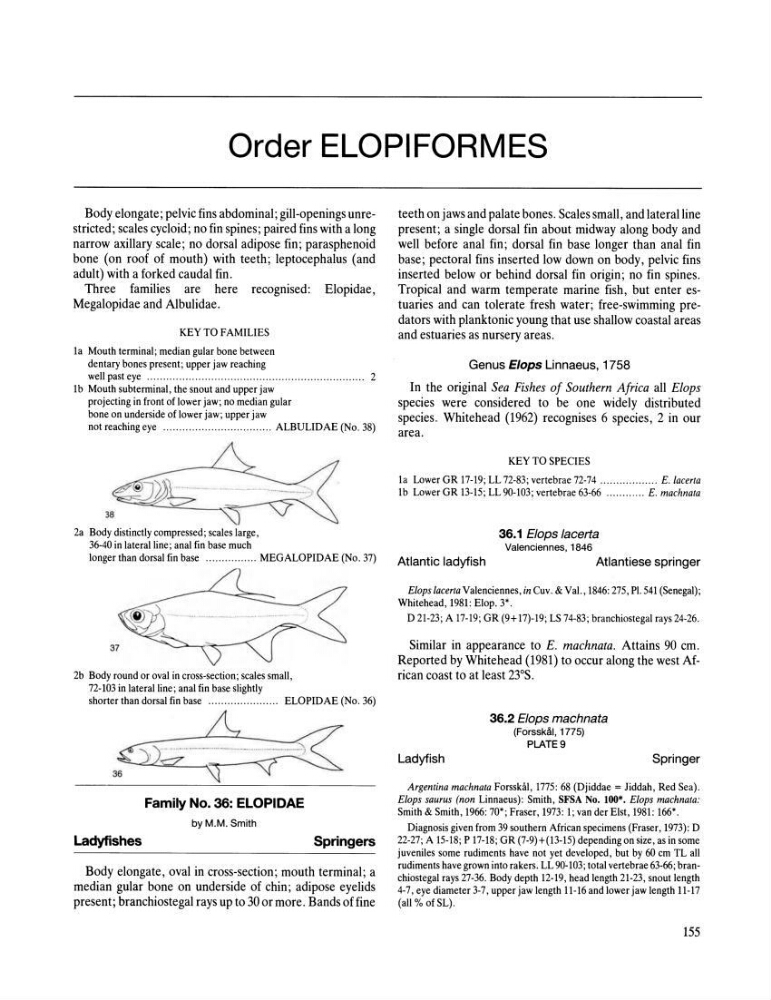
2a Body distinctly compressed; scales large,
36-40 in lateral line ; anal fin base much
longer than dorsal fin base .............. .. MEGALOPIDAE (No. 37)
2b Body round or oval in cross-section; scales small,
72-103 in lateral line ; anal fin base slightly
shorter than dorsal fin base ...................... ELOPIDAE (No. 36)
3 :G5c;~
Ladyfishes
Family No. 36: ELOPIDAE
by M.M. Smith
Springers
Body elongate, oval in cross-section; mouth terminal; a
median gular bone on underside of chin; adipose eyelids
present; branchiostegal rays up to 30 or more. Bands of fine
teeth on jaws and palate bones. Scales small, and lateral line
present; a single dorsal fin about midway along body and
well before anal fin; dorsal fin base longer than anal fin
base; pectoral fins inserted low down on body, pelvic fins
inserted below or behind dorsal fin origin; no fin spines.
Tropical and warm temperate marine fish, but enter estuaries and can tolerate fresh water; free-swimming predators with planktonic young that use shallow coastal areas
and estuaries as nursery areas.
Genus Elops Linnaeus, 1758
In the original Sea Fishes of Southern Africa all Elops
species were considered to be one widely distributed
species. Whitehead (1962) recognises 6 species, 2 in our
area.
KEY TO SPECIES
la Lower GR 17-19; LL 72-83; vertebrae 72-74 ....... ... ........ E. lacerta
Ib Lower GR 13-15; LL 90-103; vertebrae 63-66 ............ E. machnata
36.1 Elops lacerta
Valenciennes, 1846
Atlantic ladyfish
Atlantiese springer
Elops lacerta Valenciennes, in Cuv. & Val., 1846: 275, PI. 541 (Senegal);
Whitehead, 1981: Elop. 3*.
D 21-23; A 17-19; GR (9+ 17)-19; LS 74-83; branchiostegal rays 24-26.
Similar in appearance to E. machnata. Attains 90 cm.
Reported by Whitehead (1981) to occur along the west African coast to at least 23°S.
Ladyfish
36.2 Elops machnata
(Forsskal,1775)
PLATE 9
Springer
Argentina machnata Forsskal, 1775: 68 (Djiddae = Jiddah, Red Sea).
Elops saurus (non Linnaeus): Smith, SFSA No. 100*. Elops machnata:
Smith & Smith, 1966: 70*; Fraser, 1973: 1; van der Elst, 1981: 166* .
Diagnosis given from 39 southern African specimens (Fraser, 1973): D
22-27; A 15-18; P 17-18; GR (7-9)+(13-15) depending on size, as in some
juveniles some rudiments have not yet developed, but by 60 cm TL all
rudiments have grown into rakers. LL 90~ 103; total vertebrae 63-66; branchiostegal rays 27-36. Body depth 12-19, head length 21-23, snout length
4-7, eye diameter 3-7, upper jaw length 11-16 and lower jaw length 11-17
(all % ofSL).
155
Body elongate; pelvic fins abdominal; gill-openings unrestricted; scales cycloid; no fin spines; paired fins with a long
narrow axillary scale; no dorsal adipose fin; parasphenoid
bone (on roof of mouth) with teeth; leptocephalus (and
adult) with a forked caudal fin.
Three families are here recognised: Elopidae,
Megalopidae and Albulidae.
KEY TO FAMILIES
la Mouth terminal; median gular bone between
dentary bones present; upper jaw reaching
well past eye ............................................................... ..... 2
Ib Mouth subterminal, the snout and upper jaw
projecting in front of lower jaw; no median gular
bone on underside of lower jaw; upper jaw
not reaching eye .................................. ALBULIDAE (No. 38)
2a Body distinctly compressed; scales large,
36-40 in lateral line ; anal fin base much
longer than dorsal fin base .............. .. MEGALOPIDAE (No. 37)
2b Body round or oval in cross-section; scales small,
72-103 in lateral line ; anal fin base slightly
shorter than dorsal fin base ...................... ELOPIDAE (No. 36)
3 :G5c;~
Ladyfishes
Family No. 36: ELOPIDAE
by M.M. Smith
Springers
Body elongate, oval in cross-section; mouth terminal; a
median gular bone on underside of chin; adipose eyelids
present; branchiostegal rays up to 30 or more. Bands of fine
teeth on jaws and palate bones. Scales small, and lateral line
present; a single dorsal fin about midway along body and
well before anal fin; dorsal fin base longer than anal fin
base; pectoral fins inserted low down on body, pelvic fins
inserted below or behind dorsal fin origin; no fin spines.
Tropical and warm temperate marine fish, but enter estuaries and can tolerate fresh water; free-swimming predators with planktonic young that use shallow coastal areas
and estuaries as nursery areas.
Genus Elops Linnaeus, 1758
In the original Sea Fishes of Southern Africa all Elops
species were considered to be one widely distributed
species. Whitehead (1962) recognises 6 species, 2 in our
area.
KEY TO SPECIES
la Lower GR 17-19; LL 72-83; vertebrae 72-74 ....... ... ........ E. lacerta
Ib Lower GR 13-15; LL 90-103; vertebrae 63-66 ............ E. machnata
36.1 Elops lacerta
Valenciennes, 1846
Atlantic ladyfish
Atlantiese springer
Elops lacerta Valenciennes, in Cuv. & Val., 1846: 275, PI. 541 (Senegal);
Whitehead, 1981: Elop. 3*.
D 21-23; A 17-19; GR (9+ 17)-19; LS 74-83; branchiostegal rays 24-26.
Similar in appearance to E. machnata. Attains 90 cm.
Reported by Whitehead (1981) to occur along the west African coast to at least 23°S.
Ladyfish
36.2 Elops machnata
(Forsskal,1775)
PLATE 9
Springer
Argentina machnata Forsskal, 1775: 68 (Djiddae = Jiddah, Red Sea).
Elops saurus (non Linnaeus): Smith, SFSA No. 100*. Elops machnata:
Smith & Smith, 1966: 70*; Fraser, 1973: 1; van der Elst, 1981: 166* .
Diagnosis given from 39 southern African specimens (Fraser, 1973): D
22-27; A 15-18; P 17-18; GR (7-9)+(13-15) depending on size, as in some
juveniles some rudiments have not yet developed, but by 60 cm TL all
rudiments have grown into rakers. LL 90~ 103; total vertebrae 63-66; branchiostegal rays 27-36. Body depth 12-19, head length 21-23, snout length
4-7, eye diameter 3-7, upper jaw length 11-16 and lower jaw length 11-17
(all % ofSL).
155