

36: ELOPIDAE (LADYFISHES)
36.2 Elops machnata: 75 em (off Maputo).
E. machnata grows larger than the Atlantic E. saurus and
attains about 1 m. Mossel Bay in South Africa, to the Red
Sea and India, possibly to western Pacific. One of the bestknown angling fishes as it fights gamely and jumps repeatedly so that skill is required , and even then two out of
three fish escape. The bait is generally flesh (fish or squid)
or shrimp/prawn; lures are also used. In the southern Cape
caught in late summer, often well up tidal rivers and late at
night; in Natal frequently caught from the shore. In
Mozambique large breeding shoals congregate during
winter; the larvae resemble transparent eel leptocephali but
have a forked tail. Flesh rather insipid and full offine bones;
pressure cooking however softens the bones so the fish can
be minced to make a palatable dish.
Tarpons
Family No. 37: MEGALOPIDAE
by M.M. Smith
Tarponne
Mouth superior, lower jaw projecting; a median gular
bone on underside of chin; anal fin base much longer than
dorsal fin base. A single genus, Megalops Lacepede, 1803
with 2 species; sometimes placed in the Elopidae with which
it shares a leptocephalus larvae. These elongate, transparent larvae differ from eel leptocephali by having forked
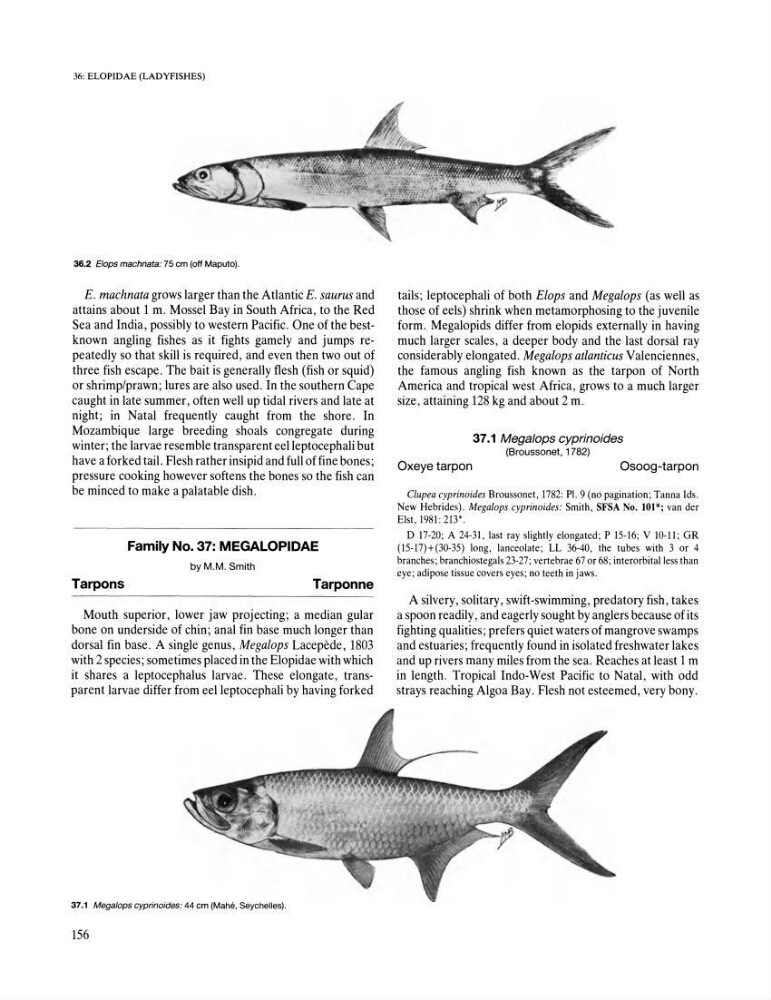
37.1 Mega/ops cyprinoides: 44 em (Mahe, Seychelles).
156
tails; leptocephali of both Elops and Megalops (as well as
those of eels) shrink when metamorphosing to the juvenile
form. Megalopids differ from elopids externally in having
much larger scales, a deeper body and the last dorsal ray
considerably elongated. Megalops atlanticus Valenciennes,
the famous angling fish known as the tarpon of North
America and tropical west Africa, grows to a much larger
size, attaining 128 kg and about 2 m.
Oxeye tarpon
37.1 Mega/ops cyprinoides
(Broussonet, 1782)
Osoog-tarpon
Clupea cyprinoides Broussonet , 1782: PI. 9 (no pagination; Tanna Ids.
New Hebrides). Megalops cyprinoides: Smith, SFSA No. 101*; van der
Elst , 1981 : 213*.
D 17·20; A 24·31, last ray slightly elongated; P 15·16; V 10·11; GR
(15·17)+(30·35) long, lanceolate; LL 36·40, the tubes with 3 or 4
branches; branchiostegals 23·27; vertebrae 67 or 68 ; interorbital less than
eye ; adipose tissue covers eyes ; no teeth in jaws.
A silvery, solitary, swift-swimming, predatory fish, takes
a spoon readily, and eagerly sought by anglers because of its
fighting qualities; prefers quiet waters of mangrove swamps
and estuaries; frequently found in isolated freshwater lakes
and up rivers many miles from the sea. Reaches at least 1 m
in length. Tropical Indo-West Pacific to Natal, with odd
strays reaching Algoa Bay. Flesh not esteemed, very bony.
36.2 Elops machnata: 75 em (off Maputo).
E. machnata grows larger than the Atlantic E. saurus and
attains about 1 m. Mossel Bay in South Africa, to the Red
Sea and India, possibly to western Pacific. One of the bestknown angling fishes as it fights gamely and jumps repeatedly so that skill is required , and even then two out of
three fish escape. The bait is generally flesh (fish or squid)
or shrimp/prawn; lures are also used. In the southern Cape
caught in late summer, often well up tidal rivers and late at
night; in Natal frequently caught from the shore. In
Mozambique large breeding shoals congregate during
winter; the larvae resemble transparent eel leptocephali but
have a forked tail. Flesh rather insipid and full offine bones;
pressure cooking however softens the bones so the fish can
be minced to make a palatable dish.
Tarpons
Family No. 37: MEGALOPIDAE
by M.M. Smith
Tarponne
Mouth superior, lower jaw projecting; a median gular
bone on underside of chin; anal fin base much longer than
dorsal fin base. A single genus, Megalops Lacepede, 1803
with 2 species; sometimes placed in the Elopidae with which
it shares a leptocephalus larvae. These elongate, transparent larvae differ from eel leptocephali by having forked
37.1 Mega/ops cyprinoides: 44 em (Mahe, Seychelles).
156
tails; leptocephali of both Elops and Megalops (as well as
those of eels) shrink when metamorphosing to the juvenile
form. Megalopids differ from elopids externally in having
much larger scales, a deeper body and the last dorsal ray
considerably elongated. Megalops atlanticus Valenciennes,
the famous angling fish known as the tarpon of North
America and tropical west Africa, grows to a much larger
size, attaining 128 kg and about 2 m.
Oxeye tarpon
37.1 Mega/ops cyprinoides
(Broussonet, 1782)
Osoog-tarpon
Clupea cyprinoides Broussonet , 1782: PI. 9 (no pagination; Tanna Ids.
New Hebrides). Megalops cyprinoides: Smith, SFSA No. 101*; van der
Elst , 1981 : 213*.
D 17·20; A 24·31, last ray slightly elongated; P 15·16; V 10·11; GR
(15·17)+(30·35) long, lanceolate; LL 36·40, the tubes with 3 or 4
branches; branchiostegals 23·27; vertebrae 67 or 68 ; interorbital less than
eye ; adipose tissue covers eyes ; no teeth in jaws.
A silvery, solitary, swift-swimming, predatory fish, takes
a spoon readily, and eagerly sought by anglers because of its
fighting qualities; prefers quiet waters of mangrove swamps
and estuaries; frequently found in isolated freshwater lakes
and up rivers many miles from the sea. Reaches at least 1 m
in length. Tropical Indo-West Pacific to Natal, with odd
strays reaching Algoa Bay. Flesh not esteemed, very bony.