

Subclass ACTINOPTERYGII
Rayfin fishes
With over 22000 species, the Actinopterygii or rayfin
fishes are the largest and most diverse group of vertebrate
animals. Most species have two paired fins (pectoral and
pelvic), one or more median dorsal fins on the back, a median anal fin on the ventral surface near the tail and a terminal tailor caudal fin. These fins are supported by bilaterally
paired, segmented, horny soft-rays (lepidotrichia) or unsegmented spines. The spines are usually stiff and sharp,
but in some fishes (e.g. blennies) the spines are soft and
flexible. The fin spines are not bilaterally paired or segmented (jointed) like the soft-rays; another difference is
that soft-rays are often branched, but spines are not. The internal skeletal supports of the median fins do not extend
into the fins.
The Subclass Actinopterygii includes the advanced bony
fishes (Infraclass Teleostei), several groups of fossil fishes
of uncertain relationship, and four groups of primitive living fishes: the Cladistia (Family Polypteridae, freshwaters
of tropical Africa), the Chondrostei (sturgeons and
paddlefishes, northern hemisphere, mainly freshwaters),
the Ginglymodi (Family Lepisosteidae, the gars of North
American waters) and the Halecostomi (Family Amiidae,
the bowfin offreshwaters in North America).
Subdivision TELEOSTEI
Teleosts
Teleosts
The teleosts or modern bony fishes are the largest and
most diverse group of fishes. Comprising about 20 800
species (Nelson, 1984), the teleosts have radiated into every
aquatic niche of our planet, from high mountain streams to
the greatest depths of the oceans, from deep caves and
tropical swamps to the polar seas. The tremendous diversity
of size, body shape, fin development, feeding adaptations,
eye structure, scale morphology, skeletal modifications,
Straalvin-visse
sound production, bioluminesence, production and detection of electrical currents, behaviour and reproduction is
unparalleled among the vertebrates.
Teleosts are of great importance economically and as
members of the aquatic ecosystems of the world. The most
common food-fishes (sardines, anchovies, trout, bass,
perch, tunas, mackerels, catfishes, snoek, gurnards, soles,
etc.) are all teleosts.
Teleosts range in size from minute gobies that are adult at
a length of 10 mm to the giant blue marlin, which reaches a
length of 5 m and a mass of 820 kg.
The interrelationships of the teleost fishes are the subject
of much recent and current research (Lauder & Liem,
1983), but we are still far from a definitive picture of the
phylogeny of this incredibly diverse assemblage. Four
major groups are currently (G. J. Nelson, 1973; Patterson
& Rosen, 1977; Lauder & Liem, 1983; J. S. Nelson, 1984)
recognised: Osteoglossomorpha (freshwater fishes, generally regarded as the most primitive of the teleosts),
Elopomorpha, Clupeomorpha and the Euteleostei.
Infradivision ELOPOMORPHA
Primitive teleosts in which the angular and retroarticular
bones of the lower jaw are fused, the rostral and pre nasal
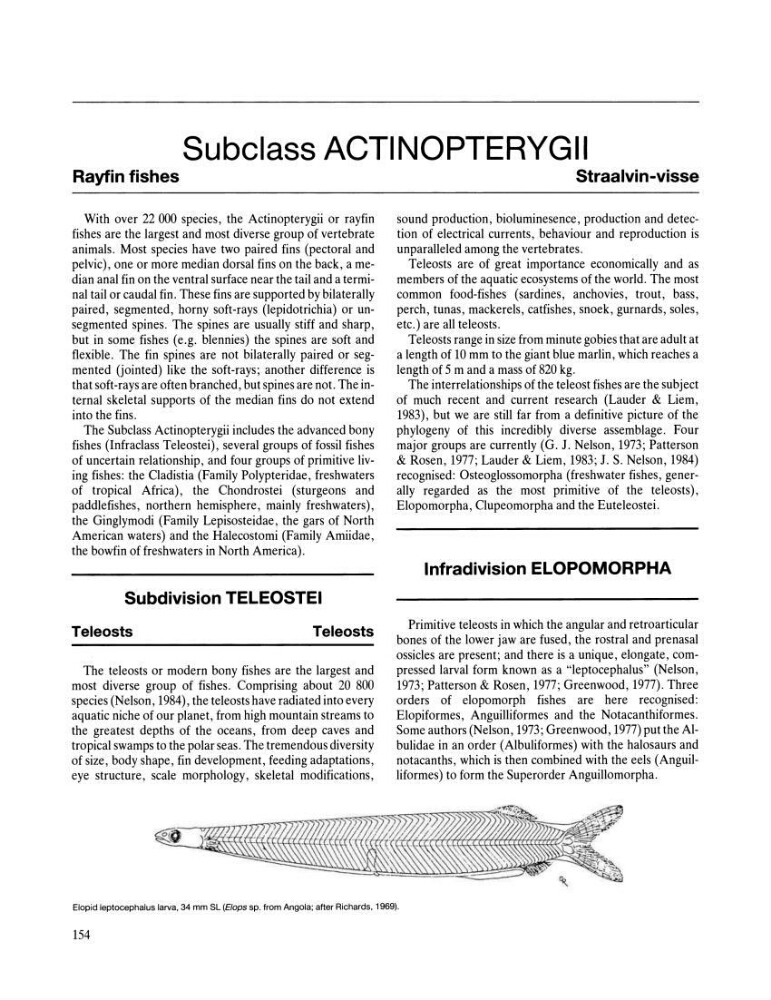
ossicles are present; and there is a unique, elongate, compressed larval form known as a "leptocephalus" (Nelson,
1973; Patterson & Rosen, 1977; Greenwood, 1977). Three
orders of elopomorph fishes are here recognised:
Elopiformes, Anguilliformes and the Notacanthiformes.
Some authors (Nelson, 1973; Greenwood, 1977) put the Albulidae in an order (Albuliformes) with the halosaurs and
notacanths, which is then combined with the eels (Anguilliformes) to form the Superorder Anguillomorpha.
Elapid leptocephalus larva, 34 mm SL (E/ops sp. from Angola; after Richards, 1969).
154
Rayfin fishes
With over 22000 species, the Actinopterygii or rayfin
fishes are the largest and most diverse group of vertebrate
animals. Most species have two paired fins (pectoral and
pelvic), one or more median dorsal fins on the back, a median anal fin on the ventral surface near the tail and a terminal tailor caudal fin. These fins are supported by bilaterally
paired, segmented, horny soft-rays (lepidotrichia) or unsegmented spines. The spines are usually stiff and sharp,
but in some fishes (e.g. blennies) the spines are soft and
flexible. The fin spines are not bilaterally paired or segmented (jointed) like the soft-rays; another difference is
that soft-rays are often branched, but spines are not. The internal skeletal supports of the median fins do not extend
into the fins.
The Subclass Actinopterygii includes the advanced bony
fishes (Infraclass Teleostei), several groups of fossil fishes
of uncertain relationship, and four groups of primitive living fishes: the Cladistia (Family Polypteridae, freshwaters
of tropical Africa), the Chondrostei (sturgeons and
paddlefishes, northern hemisphere, mainly freshwaters),
the Ginglymodi (Family Lepisosteidae, the gars of North
American waters) and the Halecostomi (Family Amiidae,
the bowfin offreshwaters in North America).
Subdivision TELEOSTEI
Teleosts
Teleosts
The teleosts or modern bony fishes are the largest and
most diverse group of fishes. Comprising about 20 800
species (Nelson, 1984), the teleosts have radiated into every
aquatic niche of our planet, from high mountain streams to
the greatest depths of the oceans, from deep caves and
tropical swamps to the polar seas. The tremendous diversity
of size, body shape, fin development, feeding adaptations,
eye structure, scale morphology, skeletal modifications,
Straalvin-visse
sound production, bioluminesence, production and detection of electrical currents, behaviour and reproduction is
unparalleled among the vertebrates.
Teleosts are of great importance economically and as
members of the aquatic ecosystems of the world. The most
common food-fishes (sardines, anchovies, trout, bass,
perch, tunas, mackerels, catfishes, snoek, gurnards, soles,
etc.) are all teleosts.
Teleosts range in size from minute gobies that are adult at
a length of 10 mm to the giant blue marlin, which reaches a
length of 5 m and a mass of 820 kg.
The interrelationships of the teleost fishes are the subject
of much recent and current research (Lauder & Liem,
1983), but we are still far from a definitive picture of the
phylogeny of this incredibly diverse assemblage. Four
major groups are currently (G. J. Nelson, 1973; Patterson
& Rosen, 1977; Lauder & Liem, 1983; J. S. Nelson, 1984)
recognised: Osteoglossomorpha (freshwater fishes, generally regarded as the most primitive of the teleosts),
Elopomorpha, Clupeomorpha and the Euteleostei.
Infradivision ELOPOMORPHA
Primitive teleosts in which the angular and retroarticular
bones of the lower jaw are fused, the rostral and pre nasal
ossicles are present; and there is a unique, elongate, compressed larval form known as a "leptocephalus" (Nelson,
1973; Patterson & Rosen, 1977; Greenwood, 1977). Three
orders of elopomorph fishes are here recognised:
Elopiformes, Anguilliformes and the Notacanthiformes.
Some authors (Nelson, 1973; Greenwood, 1977) put the Albulidae in an order (Albuliformes) with the halosaurs and
notacanths, which is then combined with the eels (Anguilliformes) to form the Superorder Anguillomorpha.
Elapid leptocephalus larva, 34 mm SL (E/ops sp. from Angola; after Richards, 1969).
154