

26: ANACANTHOBATIDAE (SMOOTH SKATES)
26.1 Anacanthobatis marmoratus
Von Bonde & Swart, 1923
Anacanthobatis marmoratus Von Bonde & Swart, 1923: 18, PI. 23
(30009'45"S, 30 0 8'02"E); Smith, SFSA No. 84*; Wallace, 1967: 43*; Hulley, 1973: 133*. Anacanthobatis dubius Von Bonde & Swart, 1923: 19
(26°00' 45"S, 33°9'50"E).
Disc 1.2 times as broad as long, with maximum angle from base of filament to level of spiracles about 102°; tail slender, about twice in TL, with
narrow lateral folds; V completely fused along entire length with root of
tail. Mouth slightly arched; nasal curtain fringed; 29-35 rows of teeth in
upper jaw. Skin naked, without dermal denticles, but alar spines at outer
angles of disc in mature males; dorsal surface with dermal papillae.
Dorsally mottled light brown and white, with scattered
ocelli; papillae and rostral filament dark brown; ventrally
uniform pale. Attains 25 cm TL. Known only from Durban
to southern Mozambique in 230 - 320 m.
26.2 Anacanthobatis ori
(Wallace, 1967)
Springeria ori Wallace, 1967: 46, Fig. 24 (21°18'S, 36°18'E). Anacanthobatis ori: Hulley, 1973: 153.
Disc 1.1 times as broad as long, with maximum angle from base of filament to level of spiracles about 93°; tail slender, about 1.6 in TL; V completely fused with root oftail. Mouth slightly arched; 20-24 rows of teeth in
upper jaw. Skin naked, without dermal denticles; dorsal surface with dermal papillae.
Dorsally and ventrally uniform grey-black. Attains 206
mm TL. Known from a single locality east of Bazaruto Id. in
about 1 500 - 1 600 m.
..
0
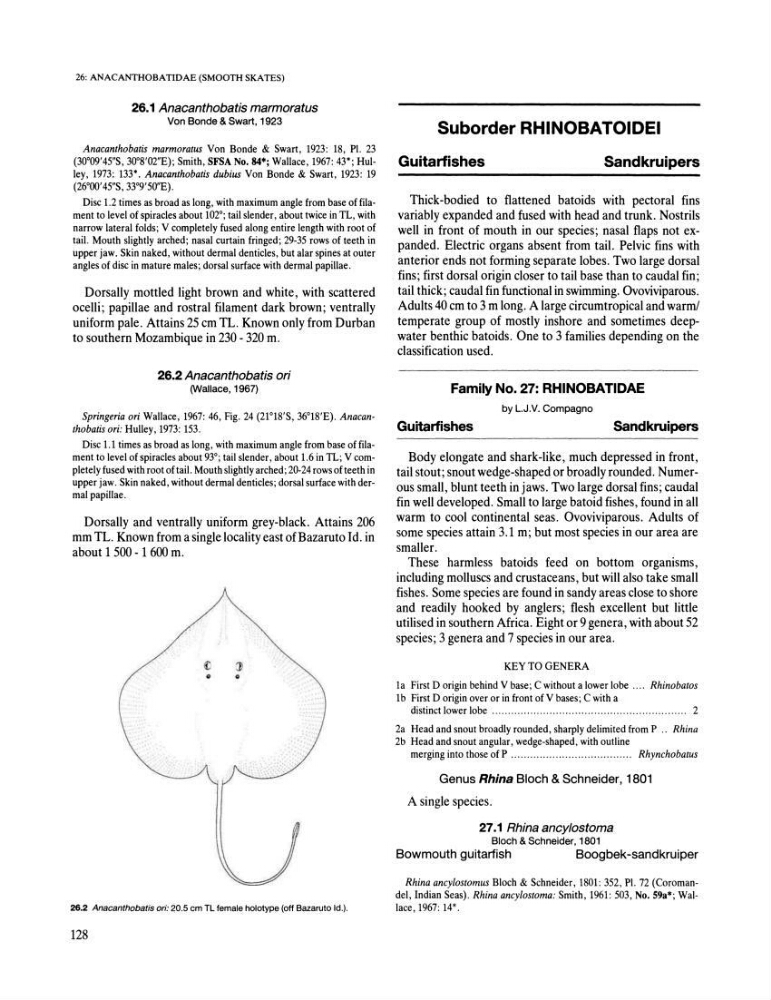
26.2 Anacanthobatis ori: 20.5 cm TL female holotype (off Bazaruto Id.).
128
Suborder RHINOBATOIDEI
Guitarfishes
Sandkruipers
Thick-bodied to flattened batoids with pectoral fins
variably expanded and fused with head and trunk. Nostrils
well in front of mouth in our species; nasal flaps not expanded. Electric organs absent from tail. Pelvic fins with
anterior ends not forming separate lobes. Two large dorsal
fins; first dorsal origin closer to tail base than to caudal fin;
tail thick; caudal fin functional in swimming. Ovoviviparous.
Adults 40 cm to 3 m long. A large circumtropical and warm/
temperate group of mostly inshore and sometimes deepwater benthic batoids. One to 3 families depending on the
classification used.
Family No. 27: RHINOBATIDAE
by L.J.V. Compagno
Guitarfishes
Sandkruipers
Body elongate and shark-like, much depressed in front,
tail stout; snout wedge-shaped or broadly rounded. Numerous small, blunt teeth in jaws. Two large dorsal fins; caudal
fin well developed. Small to large batoid fishes, found in all
warm to cool continental seas. Ovoviviparous. Adults of
some species attain 3.1 m; but most species in our area are
smaller.
These harmless batoids feed on bottom organisms,
including molluscs and crustaceans, but will also take small
fishes. Some species are found in sandy areas close to shore
and readily hooked by anglers; flesh excellent but little
utilised in southern Africa. Eight or 9 genera, with about 52
species; 3 genera and 7 species in our area.
KEY TO GENERA
la First D origin behind V base; C without a lower lobe .... Rhinobatos
1 b First D origin over or in front of V bases; C with a
distinct lower lobe ............................................................. 2
2a Head and snout broadly rounded, sharply delimited from P .. Rhina
2b Head and snout angular, wedge-shaped, with outline
merging into those of P ...................................... Rhynchobatus
Genus Rhina Bloch & Schneider, 1801
A single species.
27.1 Rhina ancylostoma
Bloch & Schneider, 1801
Bowmouth guitarfish
Boogbek-sandkruiper
Rhina ancylostomus Bloch & Schneider, 1801: 352, PI. 72 (Co romandel, Indian Seas). Rhina ancylostoma: Smith, 1961: 503, No. 59a*; Wallace, 1967: 14*.
26.1 Anacanthobatis marmoratus
Von Bonde & Swart, 1923
Anacanthobatis marmoratus Von Bonde & Swart, 1923: 18, PI. 23
(30009'45"S, 30 0 8'02"E); Smith, SFSA No. 84*; Wallace, 1967: 43*; Hulley, 1973: 133*. Anacanthobatis dubius Von Bonde & Swart, 1923: 19
(26°00' 45"S, 33°9'50"E).
Disc 1.2 times as broad as long, with maximum angle from base of filament to level of spiracles about 102°; tail slender, about twice in TL, with
narrow lateral folds; V completely fused along entire length with root of
tail. Mouth slightly arched; nasal curtain fringed; 29-35 rows of teeth in
upper jaw. Skin naked, without dermal denticles, but alar spines at outer
angles of disc in mature males; dorsal surface with dermal papillae.
Dorsally mottled light brown and white, with scattered
ocelli; papillae and rostral filament dark brown; ventrally
uniform pale. Attains 25 cm TL. Known only from Durban
to southern Mozambique in 230 - 320 m.
26.2 Anacanthobatis ori
(Wallace, 1967)
Springeria ori Wallace, 1967: 46, Fig. 24 (21°18'S, 36°18'E). Anacanthobatis ori: Hulley, 1973: 153.
Disc 1.1 times as broad as long, with maximum angle from base of filament to level of spiracles about 93°; tail slender, about 1.6 in TL; V completely fused with root oftail. Mouth slightly arched; 20-24 rows of teeth in
upper jaw. Skin naked, without dermal denticles; dorsal surface with dermal papillae.
Dorsally and ventrally uniform grey-black. Attains 206
mm TL. Known from a single locality east of Bazaruto Id. in
about 1 500 - 1 600 m.
..
0
26.2 Anacanthobatis ori: 20.5 cm TL female holotype (off Bazaruto Id.).
128
Suborder RHINOBATOIDEI
Guitarfishes
Sandkruipers
Thick-bodied to flattened batoids with pectoral fins
variably expanded and fused with head and trunk. Nostrils
well in front of mouth in our species; nasal flaps not expanded. Electric organs absent from tail. Pelvic fins with
anterior ends not forming separate lobes. Two large dorsal
fins; first dorsal origin closer to tail base than to caudal fin;
tail thick; caudal fin functional in swimming. Ovoviviparous.
Adults 40 cm to 3 m long. A large circumtropical and warm/
temperate group of mostly inshore and sometimes deepwater benthic batoids. One to 3 families depending on the
classification used.
Family No. 27: RHINOBATIDAE
by L.J.V. Compagno
Guitarfishes
Sandkruipers
Body elongate and shark-like, much depressed in front,
tail stout; snout wedge-shaped or broadly rounded. Numerous small, blunt teeth in jaws. Two large dorsal fins; caudal
fin well developed. Small to large batoid fishes, found in all
warm to cool continental seas. Ovoviviparous. Adults of
some species attain 3.1 m; but most species in our area are
smaller.
These harmless batoids feed on bottom organisms,
including molluscs and crustaceans, but will also take small
fishes. Some species are found in sandy areas close to shore
and readily hooked by anglers; flesh excellent but little
utilised in southern Africa. Eight or 9 genera, with about 52
species; 3 genera and 7 species in our area.
KEY TO GENERA
la First D origin behind V base; C without a lower lobe .... Rhinobatos
1 b First D origin over or in front of V bases; C with a
distinct lower lobe ............................................................. 2
2a Head and snout broadly rounded, sharply delimited from P .. Rhina
2b Head and snout angular, wedge-shaped, with outline
merging into those of P ...................................... Rhynchobatus
Genus Rhina Bloch & Schneider, 1801
A single species.
27.1 Rhina ancylostoma
Bloch & Schneider, 1801
Bowmouth guitarfish
Boogbek-sandkruiper
Rhina ancylostomus Bloch & Schneider, 1801: 352, PI. 72 (Co romandel, Indian Seas). Rhina ancylostoma: Smith, 1961: 503, No. 59a*; Wallace, 1967: 14*.