

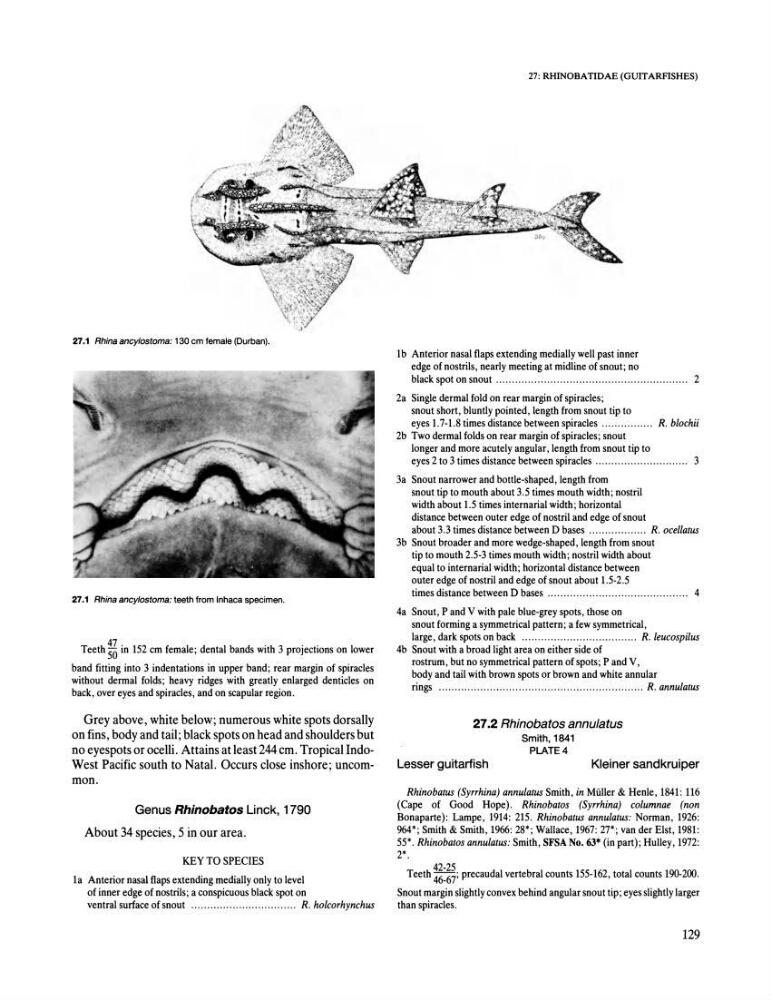
27.1 Rhina ancylostoma: 130 em female (Durban).
27.1 Rhina ancylostoma: teeth from Inhaea specimen.
Teeth ~ in 152 cm female; dental bands with 3 projections on lower
band fitting into 3 indentations in upper band; rear margin of spiracles
without dermal folds; heavy ridges with greatly enlarged denticles on
back, over eyes and spiracles, and on scapular region.
Grey above, white below; numerous white spots dorsally
on fins, body and tail; black spots on head and shoulders but
no eyespots or ocelli. Attains at least 244 cm. Tropical IndoWest Pacific south to Natal. Occurs close inshore; uncommon.
Genus Rhinobatos Linck, 1790
About 34 species, 5 in our area.
KEY TO SPECIES
1a Anterior nasal flaps extending medially only to level
of inner edge of nostrils; a conspicuous black spot on
ventral surface of snout ................................. R. holcorhynchus
27: RHINOBATIDAE (GUITARFISHES)
1b Anterior nasal flaps extending medially well past inner
edge of nostrils, nearly meeting at midline of sno.ut; no
black spot on snout ............................................................ 2
2a Single dermal fold on rear margin of spiracles;
snout short, bluntly pointed, length from snout tip to
eyes 1.7-1.8 times distance between spiracles ................ R. blochii
2b Two dermal folds on rear margin of spiracles; snout
longer and more acutely angular, length from snout tip to
eyes 2 to 3 times distance between spiracles ............................. 3
3a Snout narrower and bottle-shaped, length from
snout tip to mouth about 3.5 times mouth width; nostril
width about 1.5 times internarial width; horizontal
distance between outer edge of nostril and edge of snout
about 3.3 times distance between D bases .................. R. ocellatus
3b Snout broader and more wedge-shaped, length from snout
tip to mouth 2.5-3 times mouth width; nostril width about
equal to internarial width; horizontal distance between
outer edge of nostril and edge of snout about 1.5-2.5
times distance between D bases ............................................ 4
4a Snout, P and V with pale blue-grey spots, those on
snout forming a symmetrical pattern; a few symmetrical,
large, dark spots on back .................................... R. leucospilus
4b Snout with a broad light area on either side of
rostrum, but no symmetrical pattern of spots; P and V,
body and tail with brown spots or brown and white annular
rings . . . . . . . . . . . . . . . . . . . . . . . . . . . . . . . . . . . . . . . . . . . . . . . . . . . . . . . . . . . . . . .. R. annulatus
27.2 Rhinobatos annulatus
Smith, 1841
PLATE 4
Lesser guitarfish
Kleiner sandkruiper
Rhinobatus (Syrrhina) annulatus Smith, in Miiller & Henle, 1841: 116
(Cape of Good Hope). Rhinobatos (Syrrhina) columnae (non
Bonaparte): Lampe, 1914: 215. Rhinobatus annulatus: Norman, 1926:
964*; Smith & Smith, 1966: 28*; Wallace, 1967: 27*; van der Elst, 1981:
55*. Rhinobatos annulatus: Smith, SFSA No. 63* (in part); Hulley, 1972:
2*.
42-25
Teeth 46-67; precaudal vertebral counts 155-162, total counts 190-200.
Snout margin slightly convex behind angular snout tip; eyes slightly larger
than spiracles.
129
27.1 Rhina ancylostoma: teeth from Inhaea specimen.
Teeth ~ in 152 cm female; dental bands with 3 projections on lower
band fitting into 3 indentations in upper band; rear margin of spiracles
without dermal folds; heavy ridges with greatly enlarged denticles on
back, over eyes and spiracles, and on scapular region.
Grey above, white below; numerous white spots dorsally
on fins, body and tail; black spots on head and shoulders but
no eyespots or ocelli. Attains at least 244 cm. Tropical IndoWest Pacific south to Natal. Occurs close inshore; uncommon.
Genus Rhinobatos Linck, 1790
About 34 species, 5 in our area.
KEY TO SPECIES
1a Anterior nasal flaps extending medially only to level
of inner edge of nostrils; a conspicuous black spot on
ventral surface of snout ................................. R. holcorhynchus
27: RHINOBATIDAE (GUITARFISHES)
1b Anterior nasal flaps extending medially well past inner
edge of nostrils, nearly meeting at midline of sno.ut; no
black spot on snout ............................................................ 2
2a Single dermal fold on rear margin of spiracles;
snout short, bluntly pointed, length from snout tip to
eyes 1.7-1.8 times distance between spiracles ................ R. blochii
2b Two dermal folds on rear margin of spiracles; snout
longer and more acutely angular, length from snout tip to
eyes 2 to 3 times distance between spiracles ............................. 3
3a Snout narrower and bottle-shaped, length from
snout tip to mouth about 3.5 times mouth width; nostril
width about 1.5 times internarial width; horizontal
distance between outer edge of nostril and edge of snout
about 3.3 times distance between D bases .................. R. ocellatus
3b Snout broader and more wedge-shaped, length from snout
tip to mouth 2.5-3 times mouth width; nostril width about
equal to internarial width; horizontal distance between
outer edge of nostril and edge of snout about 1.5-2.5
times distance between D bases ............................................ 4
4a Snout, P and V with pale blue-grey spots, those on
snout forming a symmetrical pattern; a few symmetrical,
large, dark spots on back .................................... R. leucospilus
4b Snout with a broad light area on either side of
rostrum, but no symmetrical pattern of spots; P and V,
body and tail with brown spots or brown and white annular
rings . . . . . . . . . . . . . . . . . . . . . . . . . . . . . . . . . . . . . . . . . . . . . . . . . . . . . . . . . . . . . . .. R. annulatus
27.2 Rhinobatos annulatus
Smith, 1841
PLATE 4
Lesser guitarfish
Kleiner sandkruiper
Rhinobatus (Syrrhina) annulatus Smith, in Miiller & Henle, 1841: 116
(Cape of Good Hope). Rhinobatos (Syrrhina) columnae (non
Bonaparte): Lampe, 1914: 215. Rhinobatus annulatus: Norman, 1926:
964*; Smith & Smith, 1966: 28*; Wallace, 1967: 27*; van der Elst, 1981:
55*. Rhinobatos annulatus: Smith, SFSA No. 63* (in part); Hulley, 1972:
2*.
42-25
Teeth 46-67; precaudal vertebral counts 155-162, total counts 190-200.
Snout margin slightly convex behind angular snout tip; eyes slightly larger
than spiracles.
129