

25.23 Raja wallacei
Hulley, 1970
Blancmange skate
Witpoeding-rog
Raja barnardi (non Norman): Wallace, 1967: 39* . Raja wallacei Hulley ,
1970: 210, PI. 12B, Fig. 19 (34°1O'S, 17°45'E). Raja (Leucoraja) wallacei:
Hulley, 1972: 77*.
Disc 1.2-1.3 times as broad as long; maximum angle in front of spiracles
about 110°; distancefrom middle of vent to 1st D origin 1.1-1.2 in length
from tip of snout to middle of vent; D (fins) separate. Snout length in front
of orbits 2.3-3.1 times interorbital distance. 59-67 rows of teeth in upper
jaw. 7-10 circumorbital, 2-3 supraspiracular, 0-1 interspiracular, 1-4
lateral nuchal and 1-2 scapular thorns on each side; 1-7 median nuchal
thorns; mid-dorsal thorn row absent or with about 34 thorns from nuchal
region to 1st D origin, flanked on each side by a row from nuchal region to
V axils, increasing to 2 rows to level of dorsal interspace; no interdorsal
thorns; spines on tip of snout, along front margins of disc and on tail; ventral surface with spinules on tip of snout and front margins of disc; otherwise smooth.
Dorsally uniform brown, with scattered, irregular lighter
spots; mottled ocellus at each P base; ventrally pale, with a
dark blotch on tip of anterior V lobe. Attains 92 cm TL, 53
cm DW. Cape to Limpopo River mouth, in 70 - 450 m.
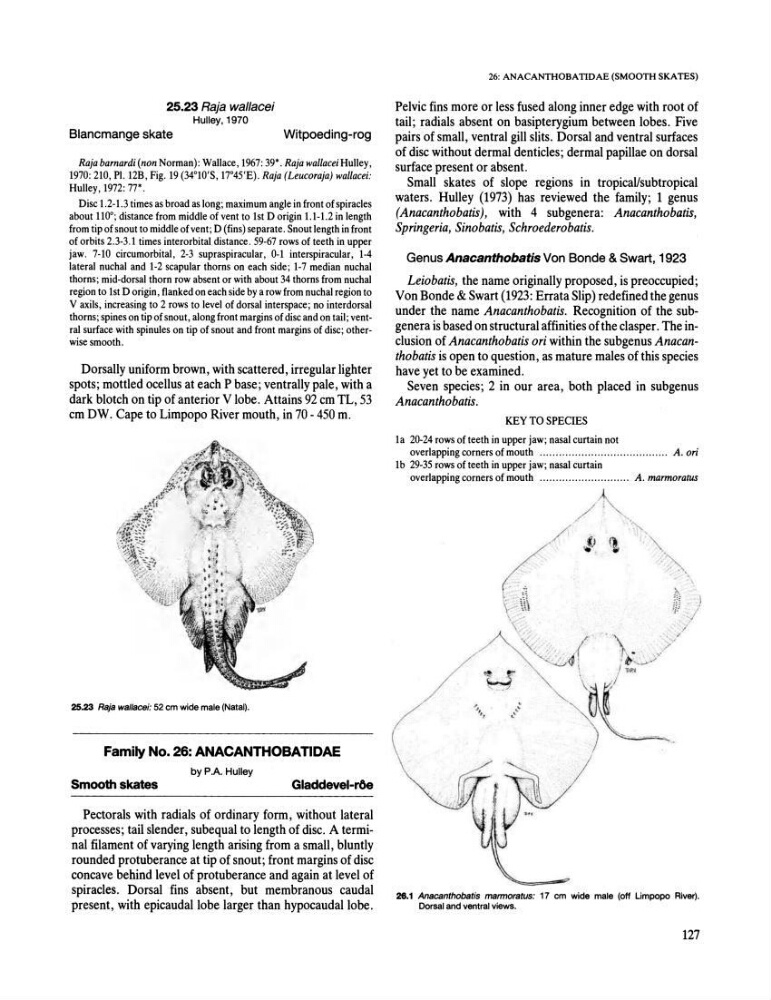
25.23 Raja wallacei: 52 em wide male (Natal).
Family No. 26: ANACANTHOBATIDAE
by PA Hulley
Smooth skates
Gladdevel-rOe
Pectorals with radials of ordinary form, without lateral
processes; tail slender, subequal to length of disc. A terminal filament of varying length arising from a small, bluntly
rounded protuberance at tip of snout; front margins of disc
concave behind level of protuberance and again at level of
spiracles. Dorsal fins absent, but membranous caudal
present, with epicaudallobe larger than hypocaudallobe.
26: ANACANTHOBATIDAE (SMOOTH SKATES)
Pelvic fins more or less fused along inner edge with root of
tail; radials absent on basipterygium between lobes. Five
pairs of small, ventral gill slits. Dorsal and ventral surfaces
of disc without dermal denticles; dermal papillae on dorsal
surface present or absent.
Small skates of slope regions in tropical/subtropical
waters. Hulley (1973) has reviewed the family; 1 genus
(Anacanthobatis), with 4 subgenera: Anacanthobatis,
Springeria, Sinobatis, Schroederobatis.
Genus Anacanthobatis Von Bonde & Swart, 1923
Leiobatis, the name originally proposed, is preoccupied;
Von Bonde & Swart (1923: Errata Slip) redefined the genus
under the name Anacanthobatis. Recognition of the subgenera is based on structural affinities of the clasper. The inclusion of Anacanthobatis ori within the subgenus Anacanthobatis is open to question, as mature males of this species
have yet to be examined.
Seven species; 2 in our area, both placed in subgenus
Anacanthobatis.
KEY TO SPECIES
1a 20-24 rows of teeth in upper jaw; nasal curtain not
overlapping corners of mouth ........................................ A. ori
1b 29-35 rows of teeth in upper jaw; nasal curtain
overlapping corners of mouth ............................ A. marmoratus
"
.'
-.... .. ,
. -.j',
26.1 Anacanthobatis marmoratus: 17 em wide male (off Limpopo River).
Dorsal and ventral views.
127
Hulley, 1970
Blancmange skate
Witpoeding-rog
Raja barnardi (non Norman): Wallace, 1967: 39* . Raja wallacei Hulley ,
1970: 210, PI. 12B, Fig. 19 (34°1O'S, 17°45'E). Raja (Leucoraja) wallacei:
Hulley, 1972: 77*.
Disc 1.2-1.3 times as broad as long; maximum angle in front of spiracles
about 110°; distancefrom middle of vent to 1st D origin 1.1-1.2 in length
from tip of snout to middle of vent; D (fins) separate. Snout length in front
of orbits 2.3-3.1 times interorbital distance. 59-67 rows of teeth in upper
jaw. 7-10 circumorbital, 2-3 supraspiracular, 0-1 interspiracular, 1-4
lateral nuchal and 1-2 scapular thorns on each side; 1-7 median nuchal
thorns; mid-dorsal thorn row absent or with about 34 thorns from nuchal
region to 1st D origin, flanked on each side by a row from nuchal region to
V axils, increasing to 2 rows to level of dorsal interspace; no interdorsal
thorns; spines on tip of snout, along front margins of disc and on tail; ventral surface with spinules on tip of snout and front margins of disc; otherwise smooth.
Dorsally uniform brown, with scattered, irregular lighter
spots; mottled ocellus at each P base; ventrally pale, with a
dark blotch on tip of anterior V lobe. Attains 92 cm TL, 53
cm DW. Cape to Limpopo River mouth, in 70 - 450 m.
25.23 Raja wallacei: 52 em wide male (Natal).
Family No. 26: ANACANTHOBATIDAE
by PA Hulley
Smooth skates
Gladdevel-rOe
Pectorals with radials of ordinary form, without lateral
processes; tail slender, subequal to length of disc. A terminal filament of varying length arising from a small, bluntly
rounded protuberance at tip of snout; front margins of disc
concave behind level of protuberance and again at level of
spiracles. Dorsal fins absent, but membranous caudal
present, with epicaudallobe larger than hypocaudallobe.
26: ANACANTHOBATIDAE (SMOOTH SKATES)
Pelvic fins more or less fused along inner edge with root of
tail; radials absent on basipterygium between lobes. Five
pairs of small, ventral gill slits. Dorsal and ventral surfaces
of disc without dermal denticles; dermal papillae on dorsal
surface present or absent.
Small skates of slope regions in tropical/subtropical
waters. Hulley (1973) has reviewed the family; 1 genus
(Anacanthobatis), with 4 subgenera: Anacanthobatis,
Springeria, Sinobatis, Schroederobatis.
Genus Anacanthobatis Von Bonde & Swart, 1923
Leiobatis, the name originally proposed, is preoccupied;
Von Bonde & Swart (1923: Errata Slip) redefined the genus
under the name Anacanthobatis. Recognition of the subgenera is based on structural affinities of the clasper. The inclusion of Anacanthobatis ori within the subgenus Anacanthobatis is open to question, as mature males of this species
have yet to be examined.
Seven species; 2 in our area, both placed in subgenus
Anacanthobatis.
KEY TO SPECIES
1a 20-24 rows of teeth in upper jaw; nasal curtain not
overlapping corners of mouth ........................................ A. ori
1b 29-35 rows of teeth in upper jaw; nasal curtain
overlapping corners of mouth ............................ A. marmoratus
"
.'
-.... .. ,
. -.j',
26.1 Anacanthobatis marmoratus: 17 em wide male (off Limpopo River).
Dorsal and ventral views.
127