

35 PRINS: Hybridization and Primed in Situ Labeling in One Step
465
more, the blocking of non-specific priming also allows for prolonged incubations with high concentrations of reagents, leading to saturation of
the hybridization targets, and a quantitative detection reaction (Krejci and
Koch 1998, Serakinci and Koch 1999).
Quantitative PRINS reactions can be evaluated in either of two ways.
The first is simply to measure the staining frequency (how many out of 100
potential targets are actually stained). The higher the staining frequency,
the larger the target (Therkelsen et al. 1995). With the dideoxy-PRINS, this
often becomes impractical as the staining efficiency in many cases is close
to 100%. In normal blood lymphocytes the main telomeric repeat is e.g.
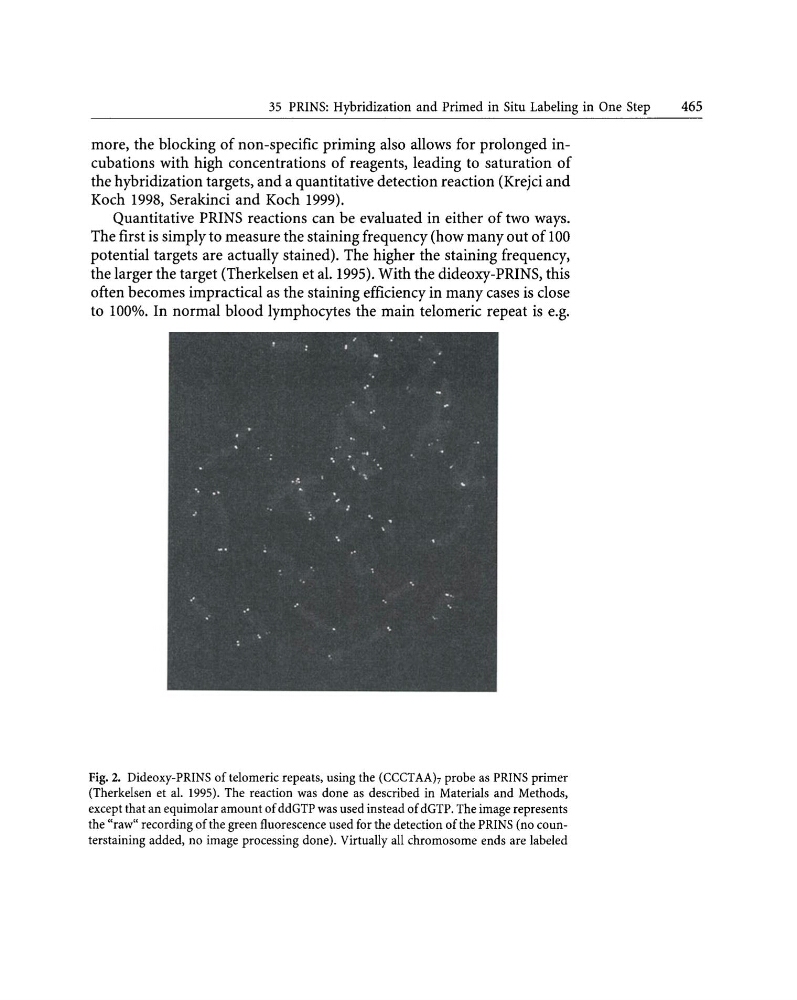
Fig. 2. Dideoxy-PRINS oftelomeric repeats, using the (CCCTAAh probe as PRINS primer
(Therkelsen et al. 1995). The reaction was done as described in Materials and Methods,
except that an equimolar amount ofddGTP was used instead ofdGTP. The image represents
the "raw" recording of the green fluorescence used for the detection of the PRINS (no counterstaining added, no image processing done). Virtually all chromosome ends are labeled
465
more, the blocking of non-specific priming also allows for prolonged incubations with high concentrations of reagents, leading to saturation of
the hybridization targets, and a quantitative detection reaction (Krejci and
Koch 1998, Serakinci and Koch 1999).
Quantitative PRINS reactions can be evaluated in either of two ways.
The first is simply to measure the staining frequency (how many out of 100
potential targets are actually stained). The higher the staining frequency,
the larger the target (Therkelsen et al. 1995). With the dideoxy-PRINS, this
often becomes impractical as the staining efficiency in many cases is close
to 100%. In normal blood lymphocytes the main telomeric repeat is e.g.
Fig. 2. Dideoxy-PRINS oftelomeric repeats, using the (CCCTAAh probe as PRINS primer
(Therkelsen et al. 1995). The reaction was done as described in Materials and Methods,
except that an equimolar amount ofddGTP was used instead ofdGTP. The image represents
the "raw" recording of the green fluorescence used for the detection of the PRINS (no counterstaining added, no image processing done). Virtually all chromosome ends are labeled