

464
TORN KOCH
tained when the probe is turned into a primer by a DNA polymerase, and
elongated with the DNA flanking the hybridization target as template for
the in situ synthesis of DNA. Feeding the DNA synthesis labeled nucleotides results in site-specific labeling where the probe was elongated by the
polymerase. In the dideoxy-PRINS, one or more of the normal nucleotides
fed to the polymerase has been replaced by dideoxynucleotides. Consequently, only oligonucleotides hybridizing at sites providing a template
for DNA synthesis that can be copied in the presence of this (these) dideoxynucleotide(s) will be elongated and induce labeling at the binding
site. Thus, if ddGTP e.g. is included in the reaction mixture, only probes
hybridizing next to DNA lacking C-residues can be copied. In general this
added selectivity increases the signal to noise ratio of the PRINS reaction
by about an order of magnitude.
The advantages of the dideoxy-PRINS approach is first of all that even
very small target sequences can be detected in situ (Koch, 2000). FurtherPrepare chromosome spreads
add probe (primer) and enzyme under
denaturing conditions
~
transfer to annealing
labellod nucleotides
0[00 f
polymerase
<:> 03
condition and incubate
stop reaction
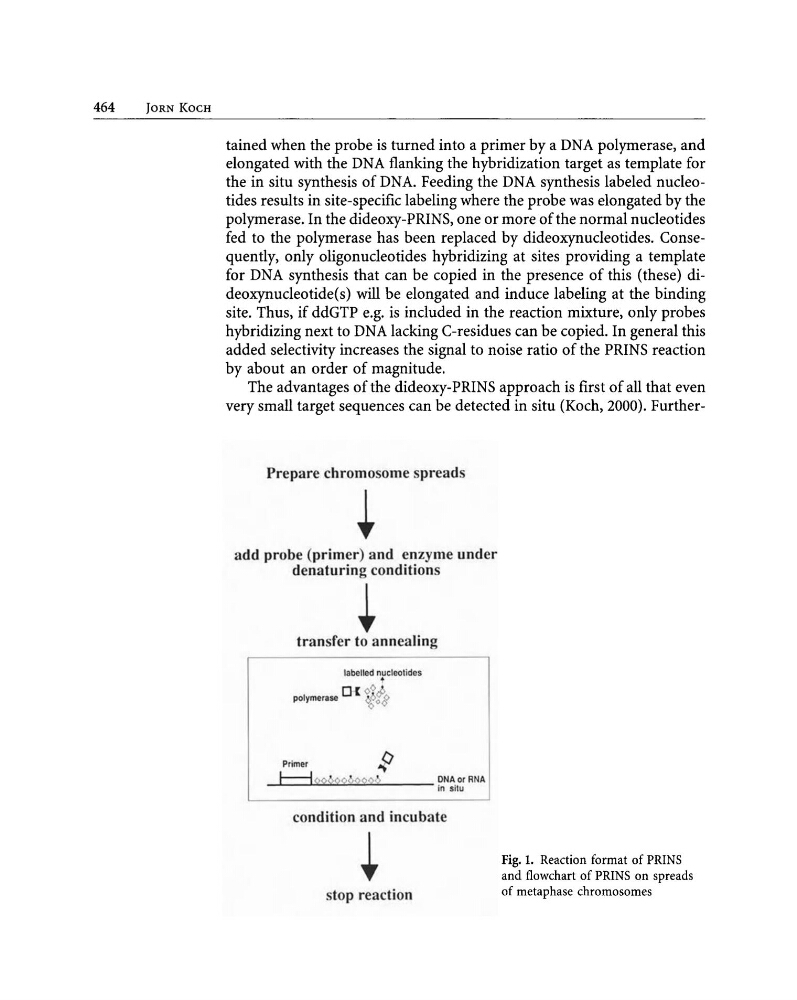
Fig.!. Reaction format of PRINS
and flowchart of PRINS on spreads
of metaphase chromosomes
TORN KOCH
tained when the probe is turned into a primer by a DNA polymerase, and
elongated with the DNA flanking the hybridization target as template for
the in situ synthesis of DNA. Feeding the DNA synthesis labeled nucleotides results in site-specific labeling where the probe was elongated by the
polymerase. In the dideoxy-PRINS, one or more of the normal nucleotides
fed to the polymerase has been replaced by dideoxynucleotides. Consequently, only oligonucleotides hybridizing at sites providing a template
for DNA synthesis that can be copied in the presence of this (these) dideoxynucleotide(s) will be elongated and induce labeling at the binding
site. Thus, if ddGTP e.g. is included in the reaction mixture, only probes
hybridizing next to DNA lacking C-residues can be copied. In general this
added selectivity increases the signal to noise ratio of the PRINS reaction
by about an order of magnitude.
The advantages of the dideoxy-PRINS approach is first of all that even
very small target sequences can be detected in situ (Koch, 2000). FurtherPrepare chromosome spreads
add probe (primer) and enzyme under
denaturing conditions
~
transfer to annealing
labellod nucleotides
0[00 f
polymerase
<:> 03
condition and incubate
stop reaction
Fig.!. Reaction format of PRINS
and flowchart of PRINS on spreads
of metaphase chromosomes