

298
SUSANN NEUBAUER
on the one hand as the number of breaks per mitosis corrected for the
breaks per mitosis in the unirradiated sample, or on the other hand as
the number of complex aberrations. Complex aberrations are defined
as exchange aberrations involving three or more breaks in two or
more chromosomes (Savage and Simpson 1994).
Results
As mentioned in the protocol we do the three-color FISH studies for the
detection of increased radiosensitivity using two different doses of X-rays
(0.7 and 2.0Gy). As shown by Neubauer et al. (1996,1997), intrinsic radiosensitivity can be detected and quantified by the three-color FISH technique (Fig. 1).
Genetic factors may determine increased radiosensitivity, as is wellknown in patients suffering from Ataxia telangiectasia (AT), an autosomal
recessively inherited disease characterized by a hypersensitivity to ionizing radiation. Thus cells from these patients might show the strongest sensitivity to ionizing radiation.
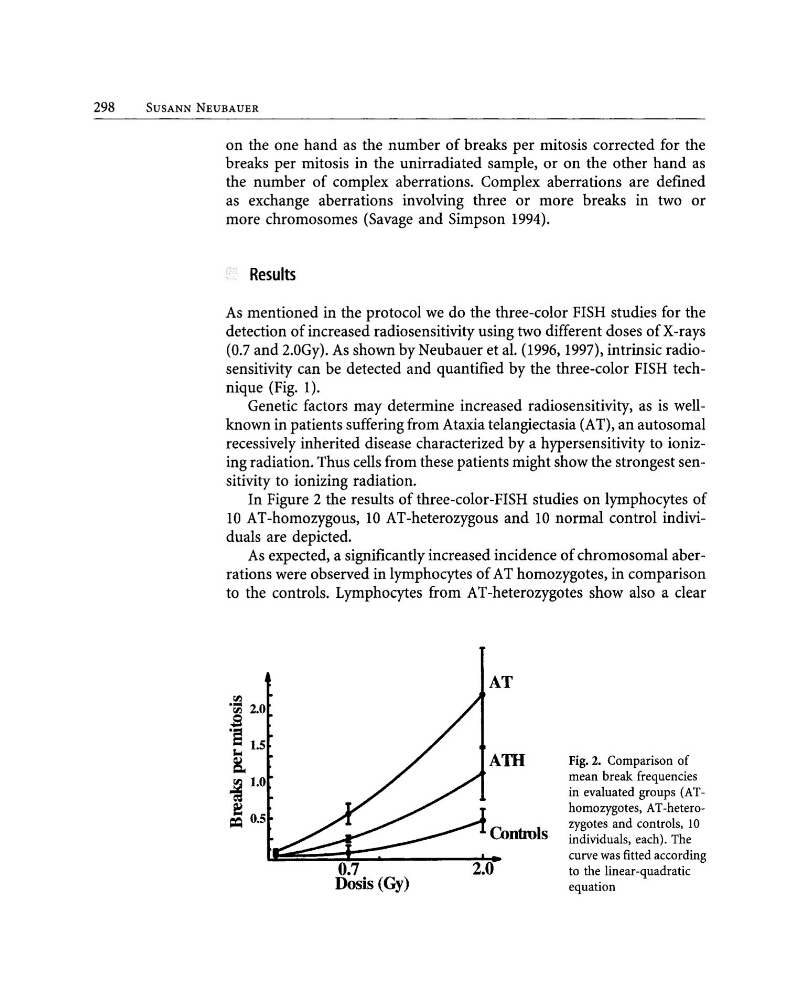
In Figure 2 the results of three-color-FISH studies on lymphocytes of
10 AT-homozygous, 10 AT-heterozygous and 10 normal control individuals are depicted.
As expected, a significantly increased incidence of chromosomal aberrations were observed in lymphocytes of AT homozygotes, in comparison
to the controls. Lymphocytes from AT-heterozygotes show also a clear
AT
fI1
.~ 2.0
S
·s
'" 1.5
~
~ 1.0
~
~ 0.5
0.7
Dosis (Gy)
Am
Controls
2.0
Fig. 2. Comparison of
mean break frequencies
in evaluated groups (AThomozygotes, AT-heterozygotes and controls, 10
individuals, each). The
curve was fitted according
to the linear-quadratic
equation
SUSANN NEUBAUER
on the one hand as the number of breaks per mitosis corrected for the
breaks per mitosis in the unirradiated sample, or on the other hand as
the number of complex aberrations. Complex aberrations are defined
as exchange aberrations involving three or more breaks in two or
more chromosomes (Savage and Simpson 1994).
Results
As mentioned in the protocol we do the three-color FISH studies for the
detection of increased radiosensitivity using two different doses of X-rays
(0.7 and 2.0Gy). As shown by Neubauer et al. (1996,1997), intrinsic radiosensitivity can be detected and quantified by the three-color FISH technique (Fig. 1).
Genetic factors may determine increased radiosensitivity, as is wellknown in patients suffering from Ataxia telangiectasia (AT), an autosomal
recessively inherited disease characterized by a hypersensitivity to ionizing radiation. Thus cells from these patients might show the strongest sensitivity to ionizing radiation.
In Figure 2 the results of three-color-FISH studies on lymphocytes of
10 AT-homozygous, 10 AT-heterozygous and 10 normal control individuals are depicted.
As expected, a significantly increased incidence of chromosomal aberrations were observed in lymphocytes of AT homozygotes, in comparison
to the controls. Lymphocytes from AT-heterozygotes show also a clear
AT
fI1
.~ 2.0
S
·s
'" 1.5
~
~ 1.0
~
~ 0.5
0.7
Dosis (Gy)
Am
Controls
2.0
Fig. 2. Comparison of
mean break frequencies
in evaluated groups (AThomozygotes, AT-heterozygotes and controls, 10
individuals, each). The
curve was fitted according
to the linear-quadratic
equation