

344
G. di Prisco
(in their absence). In addition, the moderate effect of temperature on Hb 2
in the pH range 7.0-8.0 and on Hb 3 at pH 7.0 is indicative of energysaving mechanisms of oxygen loading and unloading.
From a thermodynamic standpoint, the oxygen-transport system of P.
antarcticum is one of the most specialized ever found in fish. It appears
designed to fit its unusual pelagic life style through refined molecular
adaptation in the thermodynamic features of each Hb. Rather than the
response to face acidosis, this Hb system may have developed, as the main
adaptive feature, the response to the need to optimize oxygen loading and
unloading during seasonal migrations through water masses which can
have different and fluctuating temperatures.
Thus P. antarcticum relies on three Hbs, which differ functionally
mainly in thermodynamic behavior, rather than pH and organophosphate
regulation.
Pagothenia borchgrevinki
This cryopelagic nototheniid has a higher Hb amount than other
notothenioids [22], which could be linked to the mode of life of this
species, which has a more active behavior than most notothenioids. It has
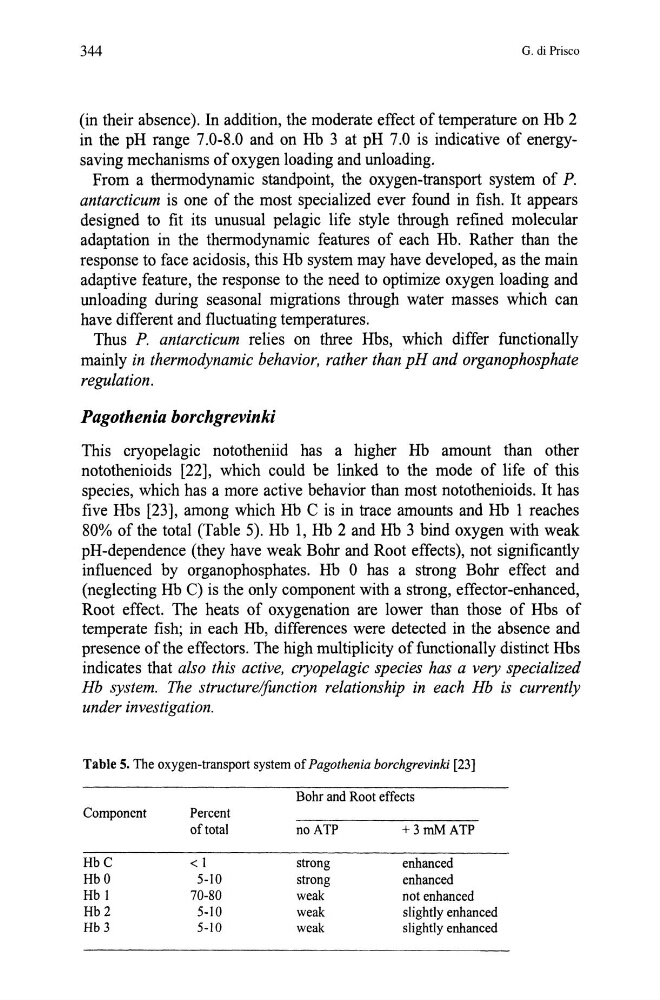
five Hbs [23], among which Hb C is in trace amounts and Hb 1 reaches
80% of the total (Table 5). Hb 1, Hb 2 and Hb 3 bind oxygen with weak
pH-dependence (they have weak Bohr and Root effects), not significantly
influenced by organophosphates. Hb 0 has a strong Bohr effect and
(neglecting Hb C) is the only component with a strong, effector-enhanced,
Root effect. The heats of oxygenation are lower than those of Hbs of
temperate fish; in each Hb' differences were detected in the absence and
presence of the effectors. The high multiplicity of functionally distinct Hbs
indicates that also this active, cryopelagic species has a very specialized
Hb system. The structure!junction relationship in each Hb is currently
under investigation.
Table 5. The oxygen-transport system of Pagothenia borchgrevinki [23]
Bohr and Root effects
Component
Percent
of total
noATP
+3mMATP
HbC
< 1
strong
enhanced
HbO
5-10
strong
enhanced
Hbl
70-80
weak
not enhanced
Hb2
5-10
weak
slightly enhanced
Hb3
5-10
weak
slightly enhanced
G. di Prisco
(in their absence). In addition, the moderate effect of temperature on Hb 2
in the pH range 7.0-8.0 and on Hb 3 at pH 7.0 is indicative of energysaving mechanisms of oxygen loading and unloading.
From a thermodynamic standpoint, the oxygen-transport system of P.
antarcticum is one of the most specialized ever found in fish. It appears
designed to fit its unusual pelagic life style through refined molecular
adaptation in the thermodynamic features of each Hb. Rather than the
response to face acidosis, this Hb system may have developed, as the main
adaptive feature, the response to the need to optimize oxygen loading and
unloading during seasonal migrations through water masses which can
have different and fluctuating temperatures.
Thus P. antarcticum relies on three Hbs, which differ functionally
mainly in thermodynamic behavior, rather than pH and organophosphate
regulation.
Pagothenia borchgrevinki
This cryopelagic nototheniid has a higher Hb amount than other
notothenioids [22], which could be linked to the mode of life of this
species, which has a more active behavior than most notothenioids. It has
five Hbs [23], among which Hb C is in trace amounts and Hb 1 reaches
80% of the total (Table 5). Hb 1, Hb 2 and Hb 3 bind oxygen with weak
pH-dependence (they have weak Bohr and Root effects), not significantly
influenced by organophosphates. Hb 0 has a strong Bohr effect and
(neglecting Hb C) is the only component with a strong, effector-enhanced,
Root effect. The heats of oxygenation are lower than those of Hbs of
temperate fish; in each Hb' differences were detected in the absence and
presence of the effectors. The high multiplicity of functionally distinct Hbs
indicates that also this active, cryopelagic species has a very specialized
Hb system. The structure!junction relationship in each Hb is currently
under investigation.
Table 5. The oxygen-transport system of Pagothenia borchgrevinki [23]
Bohr and Root effects
Component
Percent
of total
noATP
+3mMATP
HbC
< 1
strong
enhanced
HbO
5-10
strong
enhanced
Hbl
70-80
weak
not enhanced
Hb2
5-10
weak
slightly enhanced
Hb3
5-10
weak
slightly enhanced