

Molecular Adaptations of Antarctic Fish Hemoglobins
345
Artedidraconidae
In the adult stage, these benthic fish have a single Hb. The amino acid
sequences of Artedidraco orianae and Pogonophryne scotti Hbs have very
high identity with the major Hbs of species of other families.
The Hbs of several artedidraconids (Tamburrini et al., unpublished; [24])
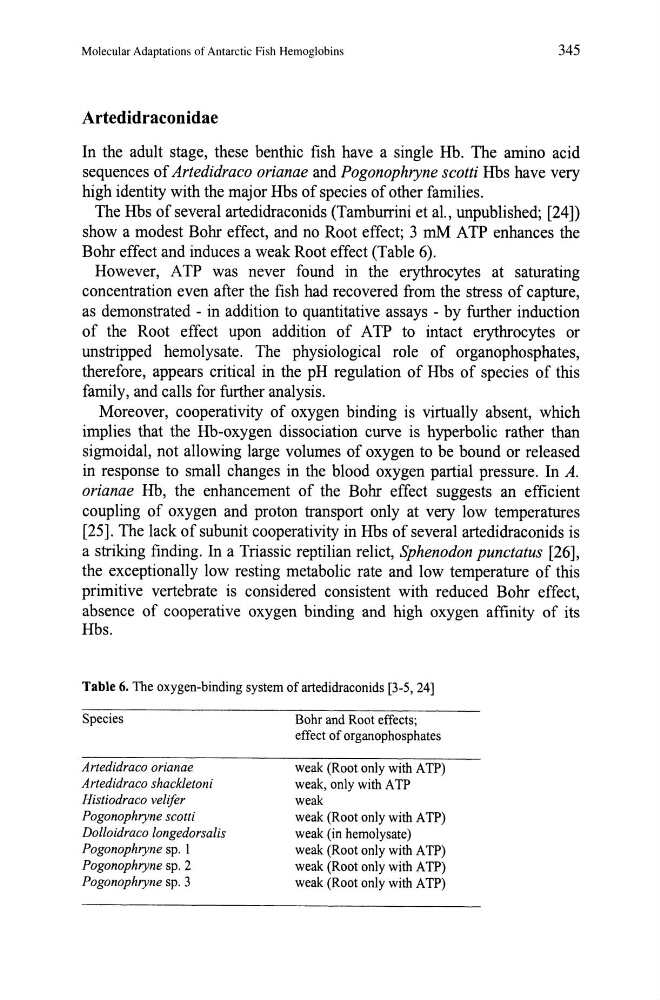
show a modest Bohr effect, and no Root effect; 3 mM ATP enhances the
Bohr effect and induces a weak Root effect (Table 6).
However, ATP was never found in the erythrocytes at saturating
concentration even after the fish had recovered from the stress of capture,
as demonstrated - in addition to quantitative assays - by further induction
of the Root effect upon addition of A TP to intact erythrocytes or
unstripped hemolysate. The physiological role of organophosphates,
therefore, appears critical in the pH regulation of Hbs of species of this
family, and calls for further analysis.
Moreover, cooperativity of oxygen binding is virtually absent, which
implies that the Hb-oxygen dissociation curve is hyperbolic rather than
sigmoidal, not allowing large volumes of oxygen to be bound or released
in response to small changes in the blood oxygen partial pressure. In A.
orianae Hb, the enhancement of the Bohr effect suggests an efficient
coupling of oxygen and proton transport only at very low temperatures
[25]. The lack of subunit cooperativity in Hbs of several artedidraconids is
a striking finding. In a Triassic reptilian relict, Sphenodon punctatus [26],
the exceptionally low resting metabolic rate and low temperature of this
primitive vertebrate is considered consistent with reduced Bohr effect,
absence of cooperative oxygen binding and high oxygen affinity of its
Hbs.
Table 6. The oxygen-binding system of artedidraconids [3-5, 24]
Species
Artedidraco orianae
Artedidraco shackletoni
Histiodraco velifer
Pogonophryne scotti
Dolloidraco longedorsalis
Pogonophryne sp. I
Pogonophrynesp.2
Pogonophrynesp.3
Bohr and Root effects;
effect of organophosphates
weak (Root only with A TP)
weak, only with A TP
weak
weak (Root only with A TP)
weak (in hemolysate)
weak (Root only with A TP)
weak (Root only with A TP)
weak (Root only with ATP)
345
Artedidraconidae
In the adult stage, these benthic fish have a single Hb. The amino acid
sequences of Artedidraco orianae and Pogonophryne scotti Hbs have very
high identity with the major Hbs of species of other families.
The Hbs of several artedidraconids (Tamburrini et al., unpublished; [24])
show a modest Bohr effect, and no Root effect; 3 mM ATP enhances the
Bohr effect and induces a weak Root effect (Table 6).
However, ATP was never found in the erythrocytes at saturating
concentration even after the fish had recovered from the stress of capture,
as demonstrated - in addition to quantitative assays - by further induction
of the Root effect upon addition of A TP to intact erythrocytes or
unstripped hemolysate. The physiological role of organophosphates,
therefore, appears critical in the pH regulation of Hbs of species of this
family, and calls for further analysis.
Moreover, cooperativity of oxygen binding is virtually absent, which
implies that the Hb-oxygen dissociation curve is hyperbolic rather than
sigmoidal, not allowing large volumes of oxygen to be bound or released
in response to small changes in the blood oxygen partial pressure. In A.
orianae Hb, the enhancement of the Bohr effect suggests an efficient
coupling of oxygen and proton transport only at very low temperatures
[25]. The lack of subunit cooperativity in Hbs of several artedidraconids is
a striking finding. In a Triassic reptilian relict, Sphenodon punctatus [26],
the exceptionally low resting metabolic rate and low temperature of this
primitive vertebrate is considered consistent with reduced Bohr effect,
absence of cooperative oxygen binding and high oxygen affinity of its
Hbs.
Table 6. The oxygen-binding system of artedidraconids [3-5, 24]
Species
Artedidraco orianae
Artedidraco shackletoni
Histiodraco velifer
Pogonophryne scotti
Dolloidraco longedorsalis
Pogonophryne sp. I
Pogonophrynesp.2
Pogonophrynesp.3
Bohr and Root effects;
effect of organophosphates
weak (Root only with A TP)
weak, only with A TP
weak
weak (Root only with A TP)
weak (in hemolysate)
weak (Root only with A TP)
weak (Root only with A TP)
weak (Root only with ATP)