

Molecular Adaptations of Antarctic Fish Hemoglobins
343
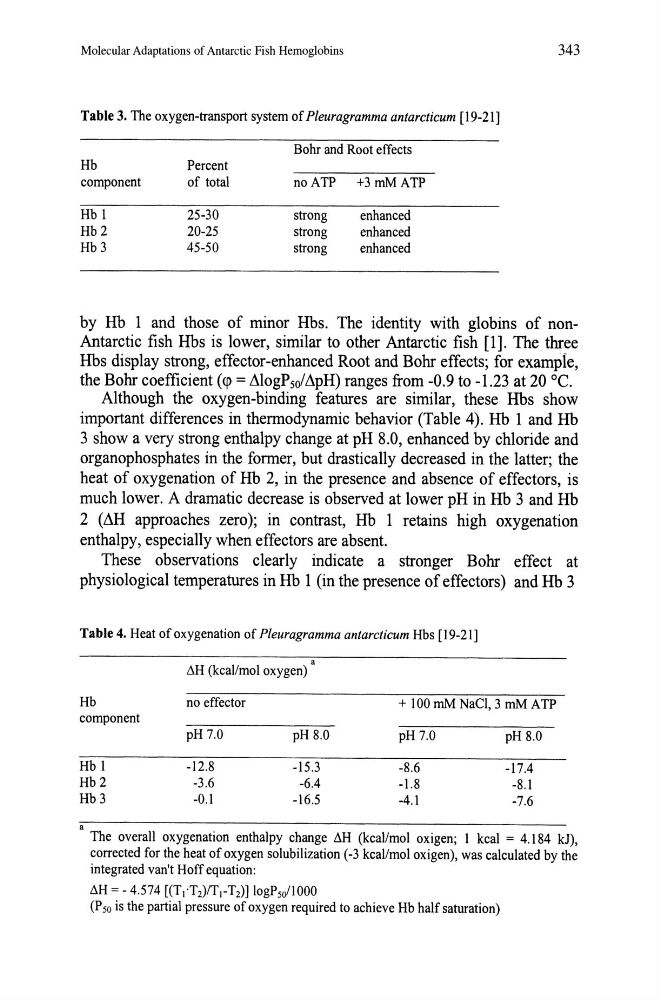
Table 3. The oxygen-transport system of Pleuragramma antarcticum [19-21]
Bohr and Root effects
Hb
Percent
component
of total
noATP +3mMATP
Hb 1
25-30
strong
enhanced
Hb2
20-25
strong
enhanced
Hb3
45-50
strong
enhanced
by Hb 1 and those of minor Hbs. The identity with globins of nonAntarctic fish Hbs is lower, similar to other Antarctic fish [1]. The three
Hbs display strong, effector-enhanced Root and Bohr effects; for example,
the Bohr coefficient (q> = ~logP50/~pH) ranges from -0.9 to -1.23 at 20 °e.
Although the oxygen-binding features are similar, these Hbs show
important differences in thermodynamic behavior (Table 4). Hb 1 and Hb
3 show a very strong enthalpy change at pH 8.0, enhanced by chloride and
organophosphates in the former, but drastically decreased in the latter; the
heat of oxygenation of Hb 2, in the presence and absence of effectors, is
much lower. A dramatic decrease is observed at lower pH in Hb 3 and Hb
2 (~H approaches zero); in contrast, Hb 1 retains high oxygenation
enthalpy, especially when effectors are absent.
These observations clearly indicate a stronger Bohr effect at
physiological temperatures in Hb 1 (in the presence of effectors) and Hb 3
Table 4. Heat of oxygenation of Pleuragramma antarcticum Hbs [19-21]
6H (kcallmol oxygen)
a
Hb
no effector
+ 100 mM NaCI, 3 mM ATP
component
pH 7.0
pH 8.0
pH 7.0
pH 8.0
Hb 1
-12.8
-15.3
-8.6
-17.4
Hb2
-3.6
-6.4
-1.8
-8.1
Hb3
-0.1
-16.5
-4.1
-7.6
The overall oxygenation enthalpy change 6H (kcal/mol oxigen; 1 kcal = 4.184 kJ),
corrected for the heat of oxygen solubilization (-3 kcal/mol oxigen), was calculated by the
integrated van't Hoff equation:
6H = - 4.574 [(T 1'T2)/T 1-T2)] logPsollOOO
(Pso is the partial pressure of oxygen required to achieve Hb half saturation)
343
Table 3. The oxygen-transport system of Pleuragramma antarcticum [19-21]
Bohr and Root effects
Hb
Percent
component
of total
noATP +3mMATP
Hb 1
25-30
strong
enhanced
Hb2
20-25
strong
enhanced
Hb3
45-50
strong
enhanced
by Hb 1 and those of minor Hbs. The identity with globins of nonAntarctic fish Hbs is lower, similar to other Antarctic fish [1]. The three
Hbs display strong, effector-enhanced Root and Bohr effects; for example,
the Bohr coefficient (q> = ~logP50/~pH) ranges from -0.9 to -1.23 at 20 °e.
Although the oxygen-binding features are similar, these Hbs show
important differences in thermodynamic behavior (Table 4). Hb 1 and Hb
3 show a very strong enthalpy change at pH 8.0, enhanced by chloride and
organophosphates in the former, but drastically decreased in the latter; the
heat of oxygenation of Hb 2, in the presence and absence of effectors, is
much lower. A dramatic decrease is observed at lower pH in Hb 3 and Hb
2 (~H approaches zero); in contrast, Hb 1 retains high oxygenation
enthalpy, especially when effectors are absent.
These observations clearly indicate a stronger Bohr effect at
physiological temperatures in Hb 1 (in the presence of effectors) and Hb 3
Table 4. Heat of oxygenation of Pleuragramma antarcticum Hbs [19-21]
6H (kcallmol oxygen)
a
Hb
no effector
+ 100 mM NaCI, 3 mM ATP
component
pH 7.0
pH 8.0
pH 7.0
pH 8.0
Hb 1
-12.8
-15.3
-8.6
-17.4
Hb2
-3.6
-6.4
-1.8
-8.1
Hb3
-0.1
-16.5
-4.1
-7.6
The overall oxygenation enthalpy change 6H (kcal/mol oxigen; 1 kcal = 4.184 kJ),
corrected for the heat of oxygen solubilization (-3 kcal/mol oxigen), was calculated by the
integrated van't Hoff equation:
6H = - 4.574 [(T 1'T2)/T 1-T2)] logPsollOOO
(Pso is the partial pressure of oxygen required to achieve Hb half saturation)