

342
G. di Prisco
Trematomus newnesi
The Hb system of T. newnesi [17] is made ofHb C, Hb 1 (with the a chain
in common) and Hb 2 (having the ~ chain in common with Hb 1). This
notothenioid is the only species having two major Hbs, only one of which
(Hb C, intriguingly but a trace component in all other notothenioids
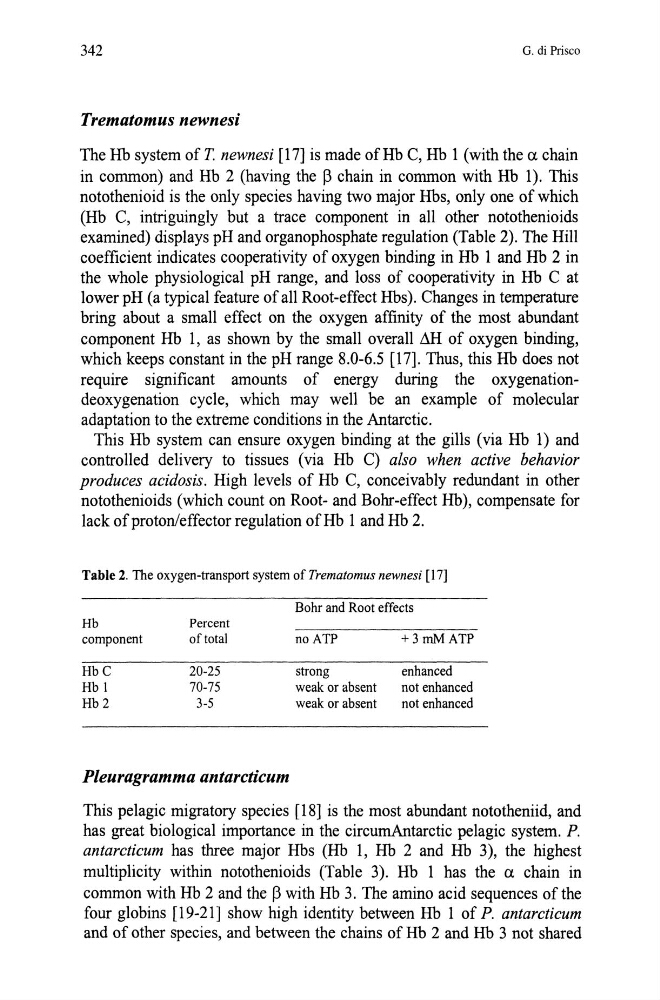
examined) displays pH and organophosphate regulation (Table 2). The Hill
coefficient indicates cooperativity of oxygen binding in Hb 1 and Hb 2 in
the whole physiological pH range, and loss of cooperativity in Hb C at
lower pH (a typical feature of all Root-effect Hbs). Changes in temperature
bring about a small effect on the oxygen affinity of the most abundant
component Hb 1, as shown by the small overall LlH of oxygen binding,
which keeps constant in the pH range 8.0-6.5 [17]. Thus, this Hb does not
require significant amounts of energy during the oxygenationdeoxygenation cycle, which may well be an example of molecular
adaptation to the extreme conditions in the Antarctic.
This Hb system can ensure oxygen binding at the gills (via Hb 1) and
controlled delivery to tissues (via Hb C) also when active behavior
produces acidosis. High levels of Hb C, conceivably redundant in other
notothenioids (which count on Root- and Bohr-effect Hb), compensate for
lack of proton/effector regulation ofHb I and Hb 2.
Table 2. The oxygen-transport system of Trematomus newnesi [17]
Bohr and Root effects
Hb
Percent
component
of total
noATP
+3mMATP
HbC
20-25
strong
enhanced
Hb 1
70-75
weak or absent
not enhanced
Hb2
3-5
weak or absent
not enhanced
Pleuragramma antarcticum
This pelagic migratory species [18] is the most abundant nototheniid, and
has great biological importance in the circumAntarctic pelagic system. P.
antarcticum has three major Hbs (Hb 1, Hb 2 and Hb 3), the highest
multiplicity within notothenioids (Table 3). Hb 1 has the a chain in
common with Hb 2 and the ~ with Hb 3. The amino acid sequences of the
four globins [19-21] show high identity between Hb 1 of P. antarcticum
and of other species, and between the chains of Hb 2 and Hb 3 not shared
G. di Prisco
Trematomus newnesi
The Hb system of T. newnesi [17] is made ofHb C, Hb 1 (with the a chain
in common) and Hb 2 (having the ~ chain in common with Hb 1). This
notothenioid is the only species having two major Hbs, only one of which
(Hb C, intriguingly but a trace component in all other notothenioids
examined) displays pH and organophosphate regulation (Table 2). The Hill
coefficient indicates cooperativity of oxygen binding in Hb 1 and Hb 2 in
the whole physiological pH range, and loss of cooperativity in Hb C at
lower pH (a typical feature of all Root-effect Hbs). Changes in temperature
bring about a small effect on the oxygen affinity of the most abundant
component Hb 1, as shown by the small overall LlH of oxygen binding,
which keeps constant in the pH range 8.0-6.5 [17]. Thus, this Hb does not
require significant amounts of energy during the oxygenationdeoxygenation cycle, which may well be an example of molecular
adaptation to the extreme conditions in the Antarctic.
This Hb system can ensure oxygen binding at the gills (via Hb 1) and
controlled delivery to tissues (via Hb C) also when active behavior
produces acidosis. High levels of Hb C, conceivably redundant in other
notothenioids (which count on Root- and Bohr-effect Hb), compensate for
lack of proton/effector regulation ofHb I and Hb 2.
Table 2. The oxygen-transport system of Trematomus newnesi [17]
Bohr and Root effects
Hb
Percent
component
of total
noATP
+3mMATP
HbC
20-25
strong
enhanced
Hb 1
70-75
weak or absent
not enhanced
Hb2
3-5
weak or absent
not enhanced
Pleuragramma antarcticum
This pelagic migratory species [18] is the most abundant nototheniid, and
has great biological importance in the circumAntarctic pelagic system. P.
antarcticum has three major Hbs (Hb 1, Hb 2 and Hb 3), the highest
multiplicity within notothenioids (Table 3). Hb 1 has the a chain in
common with Hb 2 and the ~ with Hb 3. The amino acid sequences of the
four globins [19-21] show high identity between Hb 1 of P. antarcticum
and of other species, and between the chains of Hb 2 and Hb 3 not shared