

Molecular Adaptations of Antarctic Fish Hemoglobins
341
In the first stages of our research, the Antarctic fish fauna seemed a
rather uniform and simplified community - even somewhat dull. The fish
[1-5] had a single major Hb (Hb 1) and often a minor one (Hb 2, generally
having the ~ chain in common) both displaying - with some exceptions -
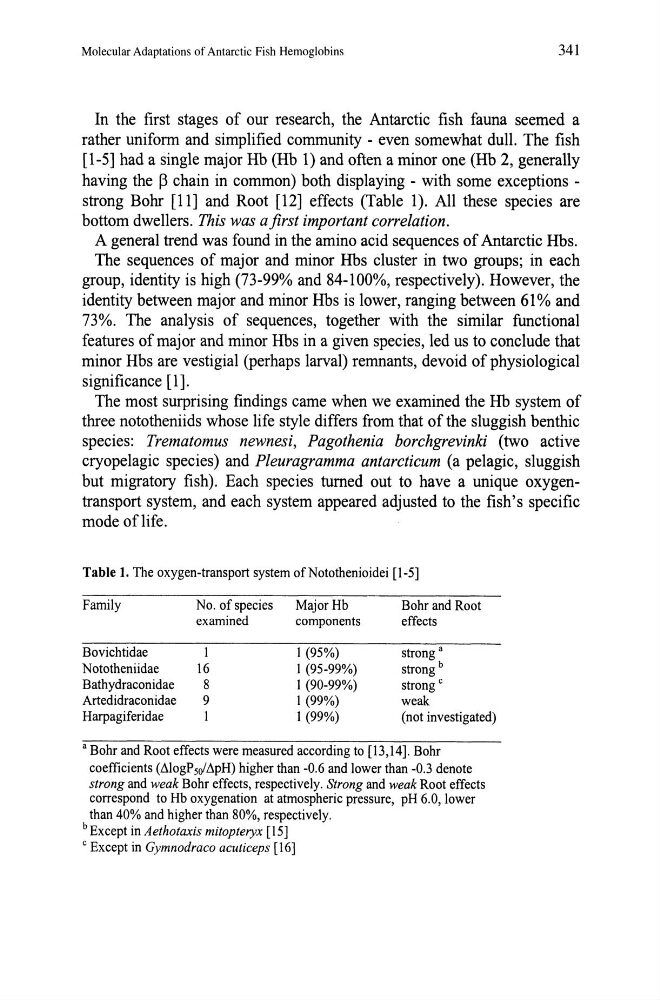
strong Bohr [11] and Root [12] effects (Table 1). All these species are
bottom dwellers. This was a first important correlation.
A general trend was found in the amino acid sequences of Antarctic Hbs.
The sequences of major and minor Hbs cluster in two groups; in each
group, identity is high (73-99% and 84-100%, respectively). However, the
identity between major and minor Hbs is lower, ranging between 61 % and
73%. The analysis of sequences, together with the similar functional
features of major and minor Hbs in a given species, led us to conclude that
minor Hbs are vestigial (perhaps larval) remnants, devoid of physiological
significance [1].
The most surprising findings came when we examined the Hb system of
three nototheniids whose life style differs from that of the sluggish benthic
species: Trematomus newnesi, Pagothenia borchgrevinki (two active
cryopelagic species) and Pleuragramma antarcticum (a pelagic, sluggish
but migratory fish). Each species turned out to have a unique oxygentransport system, and each system appeared adjusted to the fish's specific
mode of life.
Table 1. The oxygen-transport system of Notothenioidei [1-5]
Family
No. of species
MajorHb
Bohr and Root
examined
components
effects
Bovichtidae
1
1 (95%)
strong a
N ototheniidae
16
1 (95-99%)
strong b
Bathydraconidae
8
1 (90-99%)
strong C
Artedidraconidae
9
1 (99%)
weak
Harpagiferidae
1
1 (99%)
(not investigated)
a Bohr and Root effects were measured according to [13,14]. Bohr
coefficients (L\logPsolL\pH) higher than -0.6 and lower than -OJ denote
strong and weak Bohr effects, respectively. Strong and weak Root effects
correspond to Hb oxygenation at atmospheric pressure, pH 6.0, lower
than 40% and higher than 80%, respectively.
b Except in Aethotaxis mitopteryx [15]
C Except in Gymnodraco acuticeps [16]
341
In the first stages of our research, the Antarctic fish fauna seemed a
rather uniform and simplified community - even somewhat dull. The fish
[1-5] had a single major Hb (Hb 1) and often a minor one (Hb 2, generally
having the ~ chain in common) both displaying - with some exceptions -
strong Bohr [11] and Root [12] effects (Table 1). All these species are
bottom dwellers. This was a first important correlation.
A general trend was found in the amino acid sequences of Antarctic Hbs.
The sequences of major and minor Hbs cluster in two groups; in each
group, identity is high (73-99% and 84-100%, respectively). However, the
identity between major and minor Hbs is lower, ranging between 61 % and
73%. The analysis of sequences, together with the similar functional
features of major and minor Hbs in a given species, led us to conclude that
minor Hbs are vestigial (perhaps larval) remnants, devoid of physiological
significance [1].
The most surprising findings came when we examined the Hb system of
three nototheniids whose life style differs from that of the sluggish benthic
species: Trematomus newnesi, Pagothenia borchgrevinki (two active
cryopelagic species) and Pleuragramma antarcticum (a pelagic, sluggish
but migratory fish). Each species turned out to have a unique oxygentransport system, and each system appeared adjusted to the fish's specific
mode of life.
Table 1. The oxygen-transport system of Notothenioidei [1-5]
Family
No. of species
MajorHb
Bohr and Root
examined
components
effects
Bovichtidae
1
1 (95%)
strong a
N ototheniidae
16
1 (95-99%)
strong b
Bathydraconidae
8
1 (90-99%)
strong C
Artedidraconidae
9
1 (99%)
weak
Harpagiferidae
1
1 (99%)
(not investigated)
a Bohr and Root effects were measured according to [13,14]. Bohr
coefficients (L\logPsolL\pH) higher than -0.6 and lower than -OJ denote
strong and weak Bohr effects, respectively. Strong and weak Root effects
correspond to Hb oxygenation at atmospheric pressure, pH 6.0, lower
than 40% and higher than 80%, respectively.
b Except in Aethotaxis mitopteryx [15]
C Except in Gymnodraco acuticeps [16]