

182
M.R. Coscia and U. Oreste
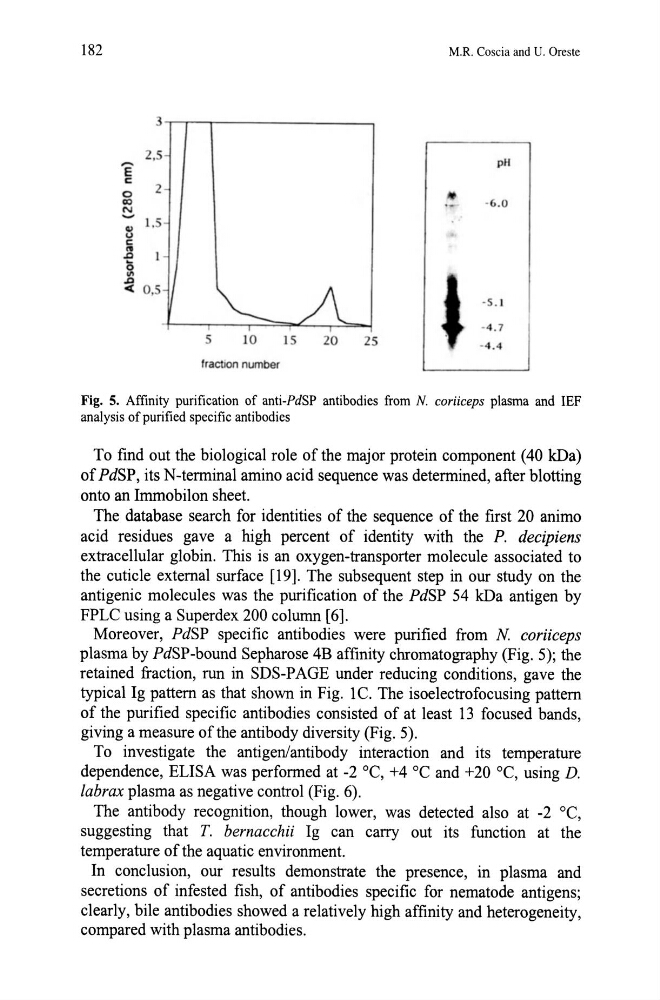
Fig. 5. Affinity purification of anti-PdSP antibodies from N. coriiceps plasma and IEF
analysis of purified specific antibodies
To find out the biological role of the major protein component (40 kDa)
of PdSP, its N-terminal amino acid sequence was determined, after blotting
onto an Immobilon sheet.
The database search for identities of the sequence of the first 20 animo
acid residues gave a high percent of identity with the P. decipiens
extracellular globin. This is an oxygen-transporter molecule associated to
the cuticle external surface [19]. The subsequent step in our study on the
antigenic molecules was the purification of the PdSP 54 kDa antigen by
FPLC using a Superdex 200 column [6].
Moreover, PdSP specific antibodies were purified from N coriiceps
plasma by PdSP-bound Sepharose 4B affinity chromatography (Fig. 5); the
retained fraction, run in SDS-PAGE under reducing conditions, gave the
typical Ig pattern as that shown in Fig. 1 C. The isoelectrofocusing pattern
of the purified specific antibodies consisted of at least 13 focused bands,
giving a measure of the antibody diversity (Fig. 5).
To investigate the antigen/antibody interaction and its temperature
dependence, ELISA was performed at -2°C, +4 °C and +20 °C, using D.
labrax plasma as negative control (Fig. 6).
The antibody recognition, though lower, was detected also at -2°C,
suggesting that T. bernacchii Ig can carry out its function at the
temperature of the aquatic environment.
In conclusion, our results demonstrate the presence, in plasma and
secretions of infested fish, of antibodies specific for nematode antigens;
clearly, bile antibodies showed a relatively high affinity and heterogeneity,
compared with plasma antibodies.
M.R. Coscia and U. Oreste
Fig. 5. Affinity purification of anti-PdSP antibodies from N. coriiceps plasma and IEF
analysis of purified specific antibodies
To find out the biological role of the major protein component (40 kDa)
of PdSP, its N-terminal amino acid sequence was determined, after blotting
onto an Immobilon sheet.
The database search for identities of the sequence of the first 20 animo
acid residues gave a high percent of identity with the P. decipiens
extracellular globin. This is an oxygen-transporter molecule associated to
the cuticle external surface [19]. The subsequent step in our study on the
antigenic molecules was the purification of the PdSP 54 kDa antigen by
FPLC using a Superdex 200 column [6].
Moreover, PdSP specific antibodies were purified from N coriiceps
plasma by PdSP-bound Sepharose 4B affinity chromatography (Fig. 5); the
retained fraction, run in SDS-PAGE under reducing conditions, gave the
typical Ig pattern as that shown in Fig. 1 C. The isoelectrofocusing pattern
of the purified specific antibodies consisted of at least 13 focused bands,
giving a measure of the antibody diversity (Fig. 5).
To investigate the antigen/antibody interaction and its temperature
dependence, ELISA was performed at -2°C, +4 °C and +20 °C, using D.
labrax plasma as negative control (Fig. 6).
The antibody recognition, though lower, was detected also at -2°C,
suggesting that T. bernacchii Ig can carry out its function at the
temperature of the aquatic environment.
In conclusion, our results demonstrate the presence, in plasma and
secretions of infested fish, of antibodies specific for nematode antigens;
clearly, bile antibodies showed a relatively high affinity and heterogeneity,
compared with plasma antibodies.