

180
M.R. Coscia and U. Oreste
2500~----------------------~
2000
I 1500 .
to
~
- o 1000
o
500
O+-~~~--~~~~~~
o 10 20 30 40 50 60 70 80 90
plasma dilution
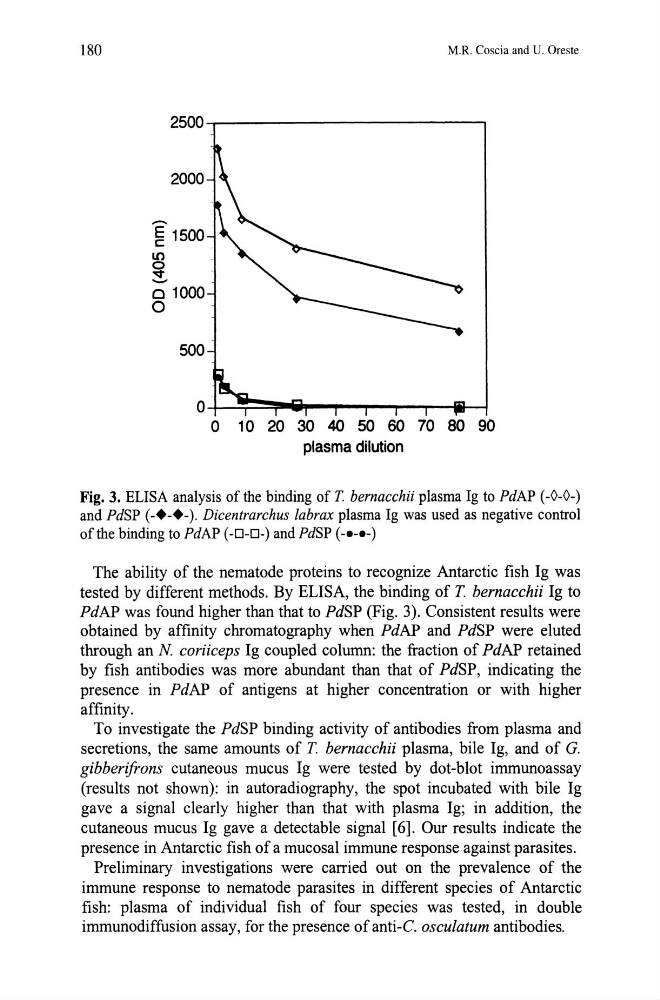
Fig. 3. ELISA analysis of the binding of T. bernacchii plasma Ig to PdAP (-0-0-)
and PdSP (-+-+-). Dicentrarchus labrax plasma Ig was used as negative control
of the binding to PdAP (-0-0-) and PdSP (-e-e-)
The ability of the nematode proteins to recognize Antarctic fish Ig was
tested by different methods. By ELISA, the binding of T. bernacchii Ig to
PdAP was found higher than that to PdSP (Fig. 3). Consistent results were
obtained by affinity chromatography when PdAP and PdSP were eluted
through an N. coriiceps Ig coupled column: the fraction of PdAP retained
by fish antibodies was more abundant than that of PdSP, indicating the
presence in PdAP of antigens at higher concentration or with higher
affinity.
To investigate the PdSP binding activity of antibodies from plasma and
secretions, the same amounts of T. bernacchii plasma, bile Ig, and of G.
gibberifrons cutaneous mucus Ig were tested by dot-blot immunoassay
(results not shown): in autoradiography, the spot incubated with bile Ig
gave a signal clearly higher than that with plasma Ig; in addition, the
cutaneous mucus Ig gave a detectable signal [6]. Our results indicate the
presence in Antarctic fish of a mucosal immune response against parasites.
Preliminary investigations were carried out on the prevalence of the
immune response to nematode parasites in different species of Antarctic
fish: plasma of individual fish of four species was tested, in double
immunodiffusion assay, for the presence of anti-C. osculatum antibodies.
M.R. Coscia and U. Oreste
2500~----------------------~
2000
I 1500 .
to
~
- o 1000
o
500
O+-~~~--~~~~~~
o 10 20 30 40 50 60 70 80 90
plasma dilution
Fig. 3. ELISA analysis of the binding of T. bernacchii plasma Ig to PdAP (-0-0-)
and PdSP (-+-+-). Dicentrarchus labrax plasma Ig was used as negative control
of the binding to PdAP (-0-0-) and PdSP (-e-e-)
The ability of the nematode proteins to recognize Antarctic fish Ig was
tested by different methods. By ELISA, the binding of T. bernacchii Ig to
PdAP was found higher than that to PdSP (Fig. 3). Consistent results were
obtained by affinity chromatography when PdAP and PdSP were eluted
through an N. coriiceps Ig coupled column: the fraction of PdAP retained
by fish antibodies was more abundant than that of PdSP, indicating the
presence in PdAP of antigens at higher concentration or with higher
affinity.
To investigate the PdSP binding activity of antibodies from plasma and
secretions, the same amounts of T. bernacchii plasma, bile Ig, and of G.
gibberifrons cutaneous mucus Ig were tested by dot-blot immunoassay
(results not shown): in autoradiography, the spot incubated with bile Ig
gave a signal clearly higher than that with plasma Ig; in addition, the
cutaneous mucus Ig gave a detectable signal [6]. Our results indicate the
presence in Antarctic fish of a mucosal immune response against parasites.
Preliminary investigations were carried out on the prevalence of the
immune response to nematode parasites in different species of Antarctic
fish: plasma of individual fish of four species was tested, in double
immunodiffusion assay, for the presence of anti-C. osculatum antibodies.