

122
A.P.A. Wohnnann
Since the whole metabolism is controlled by the central nervous system
one expects a significant temperature correlated adaptation of the
glycosphingolipid composition of the synaptic membranes. The
ganglioside composition of all investigated endemic Antarctic teleosts is
characterized by extreme polar brain gangliosides, which contain fractions
with five or even more sialic acid residues. Brains of bathydraconids and
artedidraconids contain up to 5% of pentasialogangliosides, which are the
highest concentration of these highly sialylated gangliosides that have
been found in any vertebrate brain. For example, European perches
contain only 1 % (or less) pentasialsogangliosides. This speaks in favor of
a temperature correlated brain ganglioside adaptation in the eNS of
Antarctic fishes [4].
Generally, in fishes there are far more polar fractions with up to 5 or
more neuraminic acid residues, but the composition deviates considerably
between groups of fish. Nevertheless, the pattern within related species is
quite similar. This becomes evident when ranging the brain gangliosides
of the various species of fish according to their composition of fractions
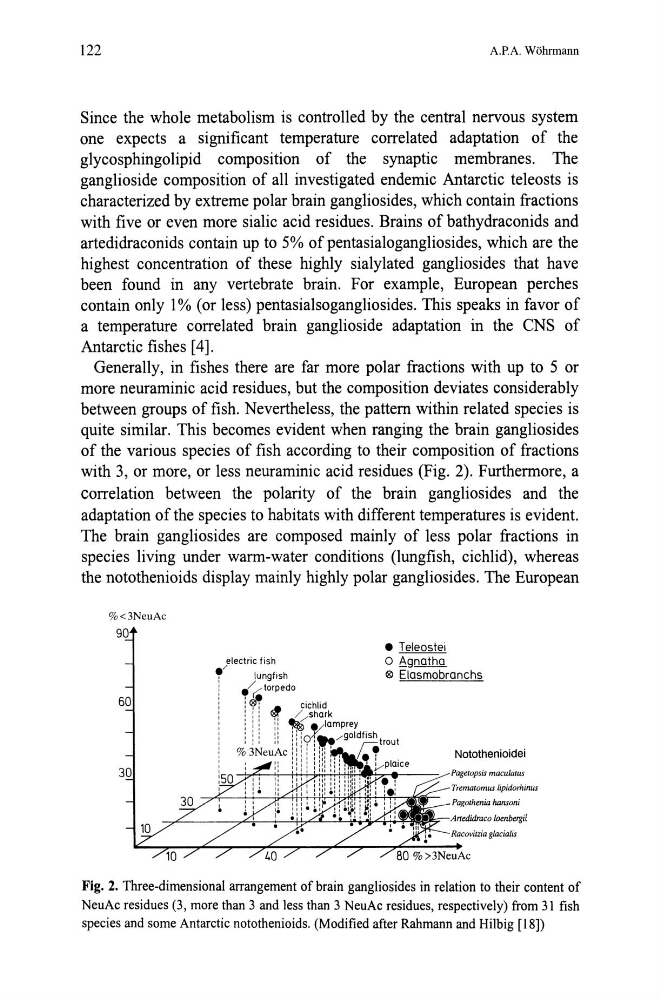
with 3, or more, or less neuraminic acid residues (Fig. 2). Furthermore, a
correlation between the polarity of the brain gangliosides and the
adaptation of the species to habitats with different temperatures is evident.
The brain gangliosides are composed mainly of less polar fractions in
species living under warm-water conditions (lungfish, cichlid), whereas
the notothenioids display mainly highly polar gangliosides. The European
% <3NeuAc
90
60
30
10
electric fish
,/
,
, , , , , , ,
• Teleostei
o 6gnatha
® Elasmobranchs
Notothenioidei
~":-+---t+i-+-:J.."-H.+i-+tlH-. .. l-z:-; __ - - ..----Pagetopsis maculatus
Tremalomus lipidorhinus
Pa/:othenia hansoni
Artemdtaco loenbergil
Racovitzia glada/is
Fig. 2. Three-dimensional arrangement of brain gangliosides in relation to their content of
NeuAc residues (3, more than 3 and less than 3 NeuAc residues, respectively) from 31 fish
species and some Antarctic notothenioids. (Modified after Rahmann and Hilbig [18])
A.P.A. Wohnnann
Since the whole metabolism is controlled by the central nervous system
one expects a significant temperature correlated adaptation of the
glycosphingolipid composition of the synaptic membranes. The
ganglioside composition of all investigated endemic Antarctic teleosts is
characterized by extreme polar brain gangliosides, which contain fractions
with five or even more sialic acid residues. Brains of bathydraconids and
artedidraconids contain up to 5% of pentasialogangliosides, which are the
highest concentration of these highly sialylated gangliosides that have
been found in any vertebrate brain. For example, European perches
contain only 1 % (or less) pentasialsogangliosides. This speaks in favor of
a temperature correlated brain ganglioside adaptation in the eNS of
Antarctic fishes [4].
Generally, in fishes there are far more polar fractions with up to 5 or
more neuraminic acid residues, but the composition deviates considerably
between groups of fish. Nevertheless, the pattern within related species is
quite similar. This becomes evident when ranging the brain gangliosides
of the various species of fish according to their composition of fractions
with 3, or more, or less neuraminic acid residues (Fig. 2). Furthermore, a
correlation between the polarity of the brain gangliosides and the
adaptation of the species to habitats with different temperatures is evident.
The brain gangliosides are composed mainly of less polar fractions in
species living under warm-water conditions (lungfish, cichlid), whereas
the notothenioids display mainly highly polar gangliosides. The European
% <3NeuAc
90
60
30
10
electric fish
,/
,
, , , , , , ,
• Teleostei
o 6gnatha
® Elasmobranchs
Notothenioidei
~":-+---t+i-+-:J.."-H.+i-+tlH-. .. l-z:-; __ - - ..----Pagetopsis maculatus
Tremalomus lipidorhinus
Pa/:othenia hansoni
Artemdtaco loenbergil
Racovitzia glada/is
Fig. 2. Three-dimensional arrangement of brain gangliosides in relation to their content of
NeuAc residues (3, more than 3 and less than 3 NeuAc residues, respectively) from 31 fish
species and some Antarctic notothenioids. (Modified after Rahmann and Hilbig [18])