

Aspects of Eco-Physiological Adaptations in Antarctic Fis.h
121
Trematomus
eulepidotus female
70
70
spring
,.
summer
60
60
E
m 50
f-- 50
'Ii
;;:
~
'0 40
t-- 40
>' !.
iii
0
Cl
'0 30
30
;g.
iii 20
, .$
20
!!
... ........... 0
0
$
10
10
0
-=
(l
0
:!;
~
'0
iii
:!;
~
'0
iii
c
~
.. Cl C ~ .. Cl
r:::
r:::
0
0
m
m
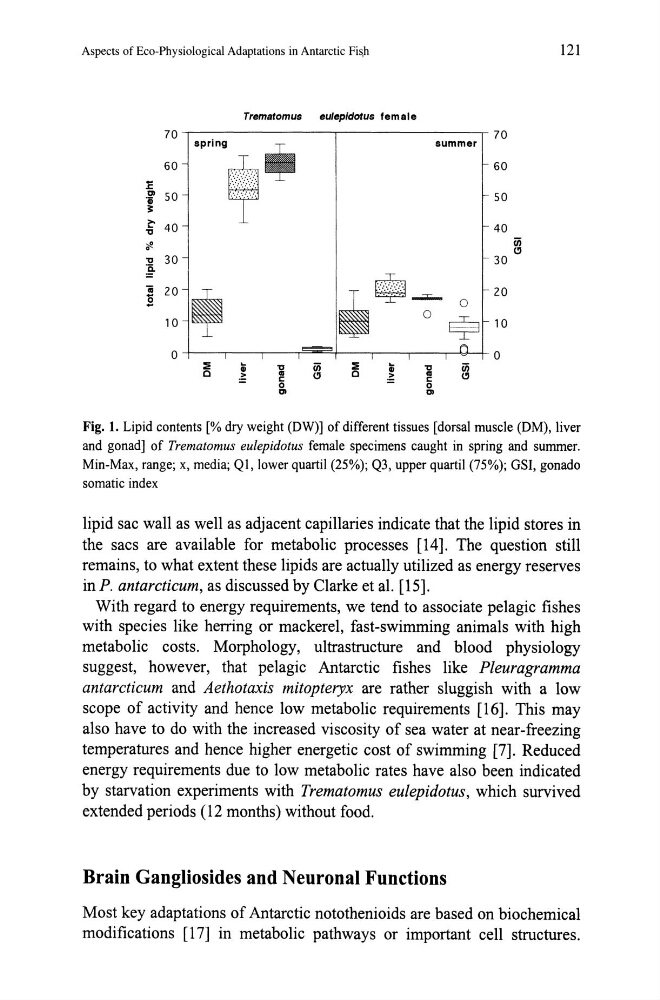
Fig. 1. Lipid contents [% dry weight (DW)] of different tissues [dorsal muscle (DM), liver
and gonad] of Trematomus eulepidotus female specimens caught in spring and summer.
Min-Max, range; x, media; QI, lower quartil (25%); Q3, upper quartil (75%); GSI, gonado
somatic index
lipid sac wall as well as adjacent capillaries indicate that the lipid stores in
the sacs are available for metabolic processes [14]. The question still
remains, to what extent these lipids are actually utilized as energy reserves
in P. antarcticum, as discussed by Clarke et al. [15].
With regard to energy requirements, we tend to associate pelagic fishes
with species like herring or mackerel, fast-swimming animals with high
metabolic costs. Morphology, ultrastructure and blood physiology
suggest, however, that pelagic Antarctic fishes like Pleuragramma
antarcticum and Aethotaxis mitopteryx are rather sluggish with a low
scope of activity and hence low metabolic requirements [16]. This may
also have to do with the increased viscosity of sea water at near-freezing
temperatures and hence higher energetic cost of swimming [7]. Reduced
energy requirements due to low metabolic rates have also been indicated
by starvation experiments with Trematomus eulepidotus, which survived
extended periods (12 months) without food.
Brain Gangliosides and Neuronal Functions
Most key adaptations of Antarctic notothenioids are based on biochemical
modifications [17] in metabolic pathways or important cell structures.
121
Trematomus
eulepidotus female
70
70
spring
,.
summer
60
60
E
m 50
f-- 50
'Ii
;;:
~
'0 40
t-- 40
>' !.
iii
0
Cl
'0 30
30
;g.
iii 20
, .$
20
!!
... ........... 0
0
$
10
10
0
-=
(l
0
:!;
~
'0
iii
:!;
~
'0
iii
c
~
.. Cl C ~ .. Cl
r:::
r:::
0
0
m
m
Fig. 1. Lipid contents [% dry weight (DW)] of different tissues [dorsal muscle (DM), liver
and gonad] of Trematomus eulepidotus female specimens caught in spring and summer.
Min-Max, range; x, media; QI, lower quartil (25%); Q3, upper quartil (75%); GSI, gonado
somatic index
lipid sac wall as well as adjacent capillaries indicate that the lipid stores in
the sacs are available for metabolic processes [14]. The question still
remains, to what extent these lipids are actually utilized as energy reserves
in P. antarcticum, as discussed by Clarke et al. [15].
With regard to energy requirements, we tend to associate pelagic fishes
with species like herring or mackerel, fast-swimming animals with high
metabolic costs. Morphology, ultrastructure and blood physiology
suggest, however, that pelagic Antarctic fishes like Pleuragramma
antarcticum and Aethotaxis mitopteryx are rather sluggish with a low
scope of activity and hence low metabolic requirements [16]. This may
also have to do with the increased viscosity of sea water at near-freezing
temperatures and hence higher energetic cost of swimming [7]. Reduced
energy requirements due to low metabolic rates have also been indicated
by starvation experiments with Trematomus eulepidotus, which survived
extended periods (12 months) without food.
Brain Gangliosides and Neuronal Functions
Most key adaptations of Antarctic notothenioids are based on biochemical
modifications [17] in metabolic pathways or important cell structures.