

Aspects of Eco-Physiological Adaptations in Antarctic Fish
123
species living in temperate waters (carp, plaice, trout) have an
intermediate position.
Gangliosides, in contrast to other membrane lipids, exhibit specific
properties in the presence of calcium [19]. Gangliosides seem to be able to
influence the fluidity and/or the charge (dipole) of the membrane. Due to
their specific interaction with calcium, gangliosides are assumed to
modulate functional membraneous proteins (ATPase, kinase, receptors).
Furthermore, calcium is known to be essential for all neuronal functions.
Gangliosides, on the other hand, were shown to possess a pronounced
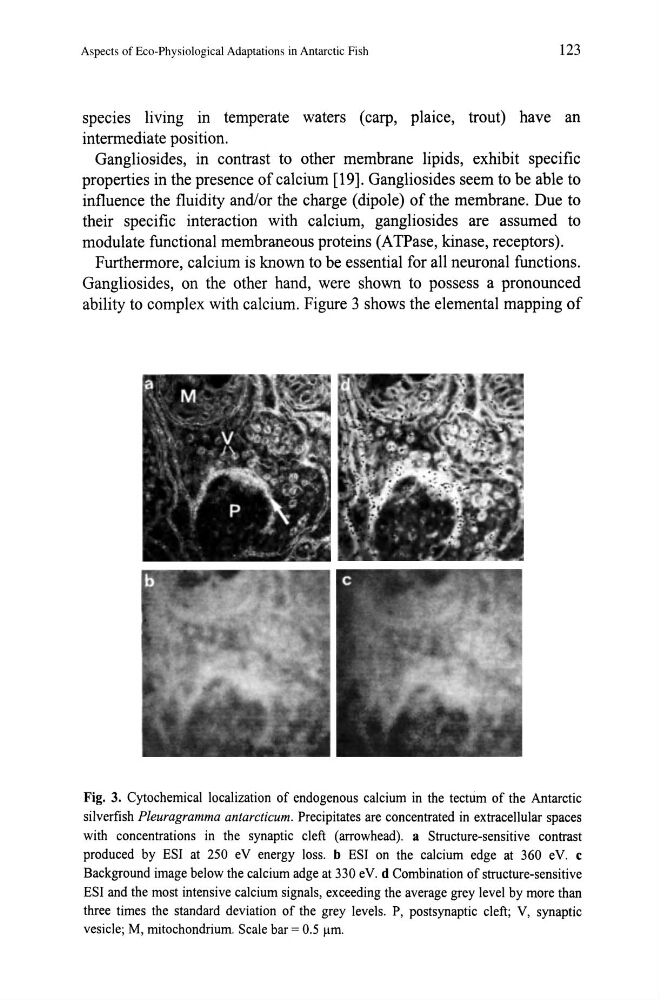
ability to complex with calcium. Figure 3 shows the elemental mapping of
Fig. 3. Cytochemical localization of endogenous calcium in the tectum of the Antarctic
silverfish Pleuragramma antarcticum. Precipitates are concentrated in extracellular spaces
with concentrations in the synaptic cleft (arrowhead). a Structure-sensitive contrast
produced by ESI at 250 eV energy loss. b ESI on the calcium edge at 360 eV. c
Background image below the calcium adge at 330 eV. d Combination of structure-sensitive
ESI and the most intensive calcium signals, exceeding the average grey level by more than
three times the standard deviation of the grey levels. P, postsynaptic cleft; V, synaptic
vesicle; M, mitochondrium. Scale bar = 0.5 11m.
123
species living in temperate waters (carp, plaice, trout) have an
intermediate position.
Gangliosides, in contrast to other membrane lipids, exhibit specific
properties in the presence of calcium [19]. Gangliosides seem to be able to
influence the fluidity and/or the charge (dipole) of the membrane. Due to
their specific interaction with calcium, gangliosides are assumed to
modulate functional membraneous proteins (ATPase, kinase, receptors).
Furthermore, calcium is known to be essential for all neuronal functions.
Gangliosides, on the other hand, were shown to possess a pronounced
ability to complex with calcium. Figure 3 shows the elemental mapping of
Fig. 3. Cytochemical localization of endogenous calcium in the tectum of the Antarctic
silverfish Pleuragramma antarcticum. Precipitates are concentrated in extracellular spaces
with concentrations in the synaptic cleft (arrowhead). a Structure-sensitive contrast
produced by ESI at 250 eV energy loss. b ESI on the calcium edge at 360 eV. c
Background image below the calcium adge at 330 eV. d Combination of structure-sensitive
ESI and the most intensive calcium signals, exceeding the average grey level by more than
three times the standard deviation of the grey levels. P, postsynaptic cleft; V, synaptic
vesicle; M, mitochondrium. Scale bar = 0.5 11m.