

Hydrobiologia 298: 93-104, 1995.
D. Belk, H. 1. Dumont & G. Maier (eds), Studies on Large Branchiopod Biology and Aquaculture II.
©1995 Kluwer Academic Publishers.
The description and preliminary prediction of the inundation pattern
in a temporary habitat of Anostraca, Notostraca and Conchostraca in
South Africa
M. T. Seaman, D. J. Kok & S. Meintjes
Department of Zoo logy and Entomology, University of the Orange Free State, Bloemfontein 9300,
Republic of South Africa
Key words: temporary water, pans, southern Africa, model, branchiopod
Abstract
93
To explain the life-history strategies of temporary-water fauna, one must be able to describe the temporary habitat.
It is necessary to know when it will be wet, how often this occurs, for what period each inundation lasts and
what variability there is in this pattern. For logistic reasons one cannot follow each inundation in a pan for the ten
years or more needed to establish a pattern. Based on the available inundation data for two seasons at Bain's Vlei
Pan in a semi-arid part of South Africa, a model has been developed, using the rainfall pattern over ten years at
nearby Bloemfontein, to predict inundation. Over a ten-year period predicted inundations ranged up to 87 days as
a result of repeat-rain, with a mean period of 18.8 days, while a rain-episode of less than 20 mm was insufficient to
inundate the pans. There was an average of 5.8 inundations per season. Single inundations do not exceed 20 days
due to evaporation. When successive showers fall before periods of inundation are over, a specific extension of
inundation is predictable. The precise implications of the inundation pattern on organisms requires much analysis.
However, there are strong indications based on the growth, survival and pattern of egg-production among three
species (Anostracan - Branchipodopsis tridens, Conchostracan - Leptestheriella inermis, and Notostracan - Triops
granarius) from the pan and one species (Anostracan - Streptocephalus macrourus) from more permanent waters
nearby, that the pattern of inundation is selective of the community held by the pan.
Introduction
Pans are most common in semi-arid conditions (Le
Roux, 1978; Geldenhuys, 1982) where mean rainfall
is low, evaporation rate is at least three times the mean
rainfall, and a large degree of unpredictability of rainfall prevails. There is nevertheless a wide range of
pan types (Le Roux, 1978; Goudie & Thomas, 1985),
varying in size (area and maximum depth), salinity and
chemical composition, and in inundation regime.
Due to the temporary nature of inundation, distance
of pans from laboratories and apparent unpredictability of inundation very little precise information has
been gathered on period and pattern of inundation. It is
accepted that pans differ in their period of inundation
(Geldenhuys, 1982) and that this should influence the
biota. Geldenhuys, for instance found that vegetation
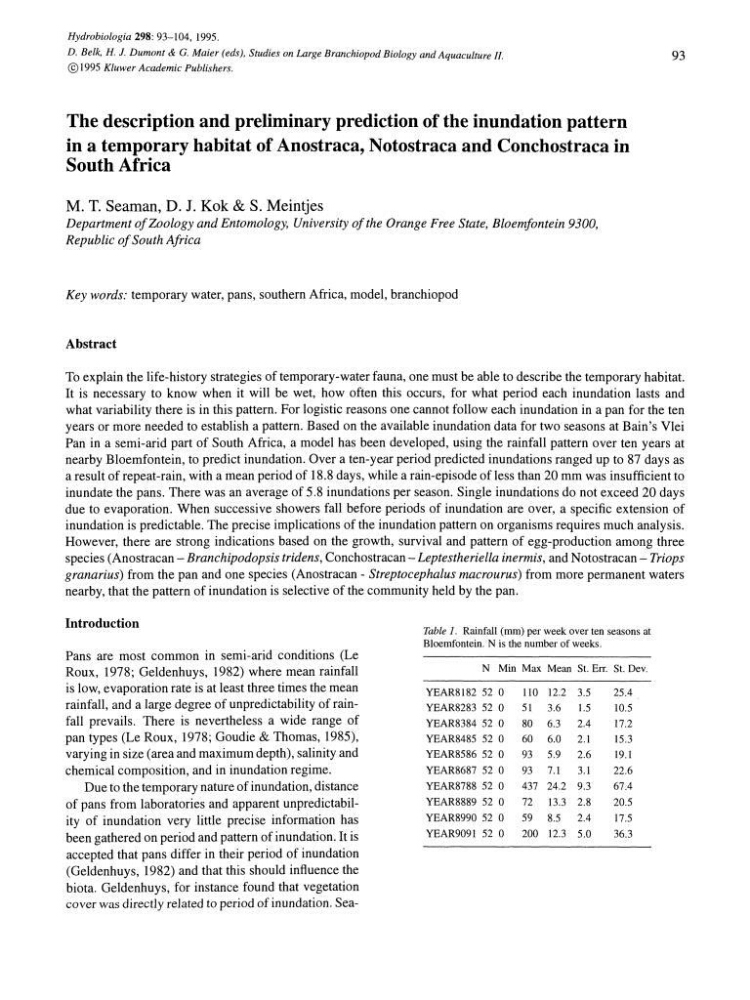
cover was directly related to period of inundation. SeaTable 1. Rainfall (mm) per week over ten seasons at
Bloemfontein. N is the number of weeks.
N Min Max Mean St. Err. St. Dev.
YEAR8182 52 0
110 12.2 3.5
25.4
YEAR8283 52 0
51 3.6
1.5
10.5
YEAR8384 52 0
80 6.3
2.4
17.2
YEAR8485 52 0
60 6.0
2.1
15.3
YEAR8586 52 0
93 5.9
2.6
19.1
YEAR8687 52 0
93 7.1
3.1
22.6
YEAR8788 52 0
437 24.2 9.3
67.4
YEAR8889 52 0
72 13.3 2.8
20.5
YEAR8990 52 0
59 8.5
2.4
17.5
YEAR9091 52 0
200 12.3 5.0
36.3
D. Belk, H. 1. Dumont & G. Maier (eds), Studies on Large Branchiopod Biology and Aquaculture II.
©1995 Kluwer Academic Publishers.
The description and preliminary prediction of the inundation pattern
in a temporary habitat of Anostraca, Notostraca and Conchostraca in
South Africa
M. T. Seaman, D. J. Kok & S. Meintjes
Department of Zoo logy and Entomology, University of the Orange Free State, Bloemfontein 9300,
Republic of South Africa
Key words: temporary water, pans, southern Africa, model, branchiopod
Abstract
93
To explain the life-history strategies of temporary-water fauna, one must be able to describe the temporary habitat.
It is necessary to know when it will be wet, how often this occurs, for what period each inundation lasts and
what variability there is in this pattern. For logistic reasons one cannot follow each inundation in a pan for the ten
years or more needed to establish a pattern. Based on the available inundation data for two seasons at Bain's Vlei
Pan in a semi-arid part of South Africa, a model has been developed, using the rainfall pattern over ten years at
nearby Bloemfontein, to predict inundation. Over a ten-year period predicted inundations ranged up to 87 days as
a result of repeat-rain, with a mean period of 18.8 days, while a rain-episode of less than 20 mm was insufficient to
inundate the pans. There was an average of 5.8 inundations per season. Single inundations do not exceed 20 days
due to evaporation. When successive showers fall before periods of inundation are over, a specific extension of
inundation is predictable. The precise implications of the inundation pattern on organisms requires much analysis.
However, there are strong indications based on the growth, survival and pattern of egg-production among three
species (Anostracan - Branchipodopsis tridens, Conchostracan - Leptestheriella inermis, and Notostracan - Triops
granarius) from the pan and one species (Anostracan - Streptocephalus macrourus) from more permanent waters
nearby, that the pattern of inundation is selective of the community held by the pan.
Introduction
Pans are most common in semi-arid conditions (Le
Roux, 1978; Geldenhuys, 1982) where mean rainfall
is low, evaporation rate is at least three times the mean
rainfall, and a large degree of unpredictability of rainfall prevails. There is nevertheless a wide range of
pan types (Le Roux, 1978; Goudie & Thomas, 1985),
varying in size (area and maximum depth), salinity and
chemical composition, and in inundation regime.
Due to the temporary nature of inundation, distance
of pans from laboratories and apparent unpredictability of inundation very little precise information has
been gathered on period and pattern of inundation. It is
accepted that pans differ in their period of inundation
(Geldenhuys, 1982) and that this should influence the
biota. Geldenhuys, for instance found that vegetation
cover was directly related to period of inundation. SeaTable 1. Rainfall (mm) per week over ten seasons at
Bloemfontein. N is the number of weeks.
N Min Max Mean St. Err. St. Dev.
YEAR8182 52 0
110 12.2 3.5
25.4
YEAR8283 52 0
51 3.6
1.5
10.5
YEAR8384 52 0
80 6.3
2.4
17.2
YEAR8485 52 0
60 6.0
2.1
15.3
YEAR8586 52 0
93 5.9
2.6
19.1
YEAR8687 52 0
93 7.1
3.1
22.6
YEAR8788 52 0
437 24.2 9.3
67.4
YEAR8889 52 0
72 13.3 2.8
20.5
YEAR8990 52 0
59 8.5
2.4
17.5
YEAR9091 52 0
200 12.3 5.0
36.3