

302
120
01 100
, _ _ 'V
U
c
T
--"1.
0
yO
0..
IUJ
80
..D
...... ......
I0
v
80
u
0..
(; 2 60
01
UJ
!
v >,
C
OlU
)(,
L
o c 40
0..
-+-' V
UJ
40
c
......
v
......
0
u
20
lV
0..
0
0
.1
10
15
20
25
30
35
10
15
20
25
30
35
2000
0 BMT
15
•
LMT
01
'V LTR
c
12
.~ 1500
UJ
UJ
U
'+0
9
......
0
0
L
_ 1000
.D
0
46
......
0
0
-+-'
===/I:::
500
3
•
0
0
10
15
20
25
30
35
10
15
20
25
30
35
temperature tC)
temperature tC)
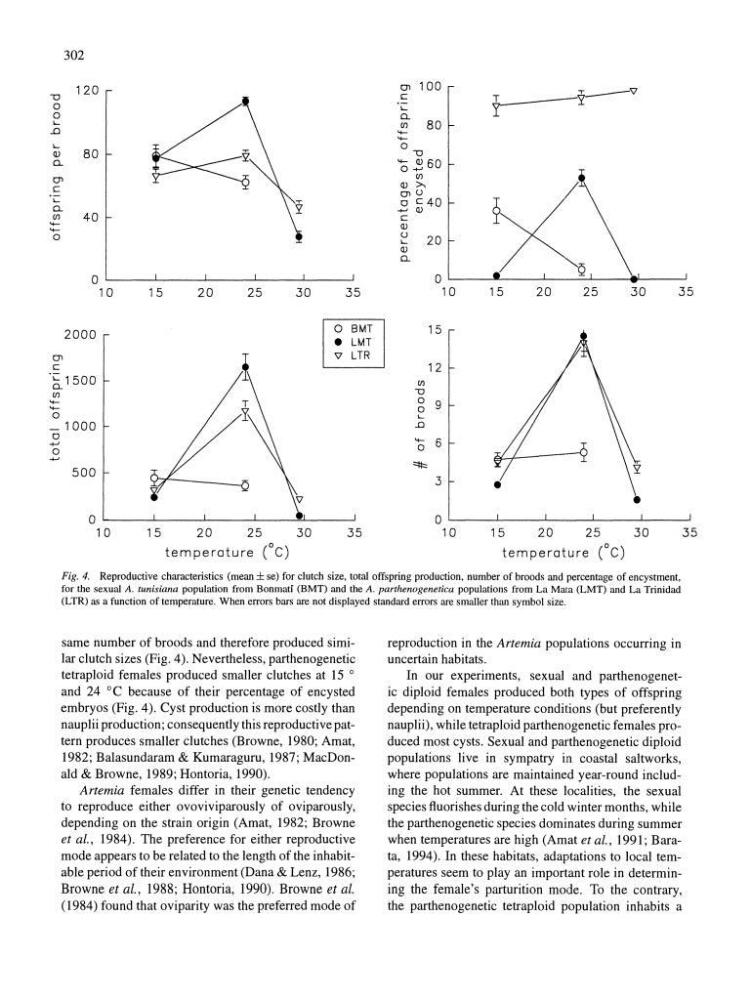
Fig. 4. Reproductive characteristics (mean ± se) for clutch size, total offspring production, number of broods and percentage of encystment,
for the sexual A. tunisiana population from Bonmati (BMT) and the A. parthenogenetica populations from La Mara (LMT) and La Trinidad
(LTR) as a function of temperature. When errors bars are not displayed standard errors are smaller than symbol size.
same number of broods and therefore produced similar clutch sizes (Fig. 4). Nevertheless, parthenogenetic
tetraploid females produced smaller clutches at 15 °
and 24°C because of their percentage of encysted
embryos (Fig. 4). Cyst production is more costly than
nauplii production; consequently this reproductive pattern produces smaller clutches (Browne, 1980; Amat,
1982; Balasundaram & Kumaraguru, 1987; MacDonald & Browne, 1989; Hontoria, 1990).
Artemia females differ in their genetic tendency
to reproduce either ovoviviparously of oviparously,
depending on the strain origin (Amat, 1982; Browne
et at., 1984). The preference for either reproductive
mode appears to be related to the length of the inhabitable period of their environment (Dana & Lenz, 1986;
Browne et at., 1988; Hontoria, 1990). Browne et at.
(1984) found that oviparity was the preferred mode of
reproduction in the Artemia populations occurring in
uncertain habitats.
In our experiments, sexual and parthenogenetic diploid females produced both types of offspring
depending on temperature conditions (but preferently
nauplii), while tetraploid parthenogenetic females produced most cysts. Sexual and parthenogenetic diploid
populations live in sympatry in coastal saltworks,
where populations are maintained year-round including the hot summer. At these localities, the sexual
species ftuorishes during the cold winter months, while
the parthenogenetic species dominates during summer
when temperatures are high (Amat et at., 1991; Barata, 1994). In these habitats, adaptations to local temperatures seem to play an important role in determining the female's parturition mode. To the contrary,
the parthenogenetic tetraploid population inhabits a
120
01 100
, _ _ 'V
U
c
T
--"1.
0
yO
0..
IUJ
80
..D
...... ......
I0
v
80
u
0..
(; 2 60
01
UJ
!
v >,
C
OlU
)(,
L
o c 40
0..
-+-' V
UJ
40
c
......
v
......
0
u
20
lV
0..
0
0
.1
10
15
20
25
30
35
10
15
20
25
30
35
2000
0 BMT
15
•
LMT
01
'V LTR
c
12
.~ 1500
UJ
UJ
U
'+0
9
......
0
0
L
_ 1000
.D
0
46
......
0
0
-+-'
===/I:::
500
3
•
0
0
10
15
20
25
30
35
10
15
20
25
30
35
temperature tC)
temperature tC)
Fig. 4. Reproductive characteristics (mean ± se) for clutch size, total offspring production, number of broods and percentage of encystment,
for the sexual A. tunisiana population from Bonmati (BMT) and the A. parthenogenetica populations from La Mara (LMT) and La Trinidad
(LTR) as a function of temperature. When errors bars are not displayed standard errors are smaller than symbol size.
same number of broods and therefore produced similar clutch sizes (Fig. 4). Nevertheless, parthenogenetic
tetraploid females produced smaller clutches at 15 °
and 24°C because of their percentage of encysted
embryos (Fig. 4). Cyst production is more costly than
nauplii production; consequently this reproductive pattern produces smaller clutches (Browne, 1980; Amat,
1982; Balasundaram & Kumaraguru, 1987; MacDonald & Browne, 1989; Hontoria, 1990).
Artemia females differ in their genetic tendency
to reproduce either ovoviviparously of oviparously,
depending on the strain origin (Amat, 1982; Browne
et at., 1984). The preference for either reproductive
mode appears to be related to the length of the inhabitable period of their environment (Dana & Lenz, 1986;
Browne et at., 1988; Hontoria, 1990). Browne et at.
(1984) found that oviparity was the preferred mode of
reproduction in the Artemia populations occurring in
uncertain habitats.
In our experiments, sexual and parthenogenetic diploid females produced both types of offspring
depending on temperature conditions (but preferently
nauplii), while tetraploid parthenogenetic females produced most cysts. Sexual and parthenogenetic diploid
populations live in sympatry in coastal saltworks,
where populations are maintained year-round including the hot summer. At these localities, the sexual
species ftuorishes during the cold winter months, while
the parthenogenetic species dominates during summer
when temperatures are high (Amat et at., 1991; Barata, 1994). In these habitats, adaptations to local temperatures seem to play an important role in determining the female's parturition mode. To the contrary,
the parthenogenetic tetraploid population inhabits a