

301
18
20
'"
0 BMT
\Y
(f)
• LMT >.
>.
0
15
I
'V LTR
0
-0
-0 16
'-../
L
(f)
Q)
-0
12
D..
0
01 12
0
c
!
L
..0
9
L
D..
C
(f)
8
Q)
4Q)
6
0
3:
-+-'
Q)
4
..0
3
Q)
E
-+-'
0
0
10
15
20
25
30
35
10
15
20
25
30
35
temperature (C)
temperature (C)
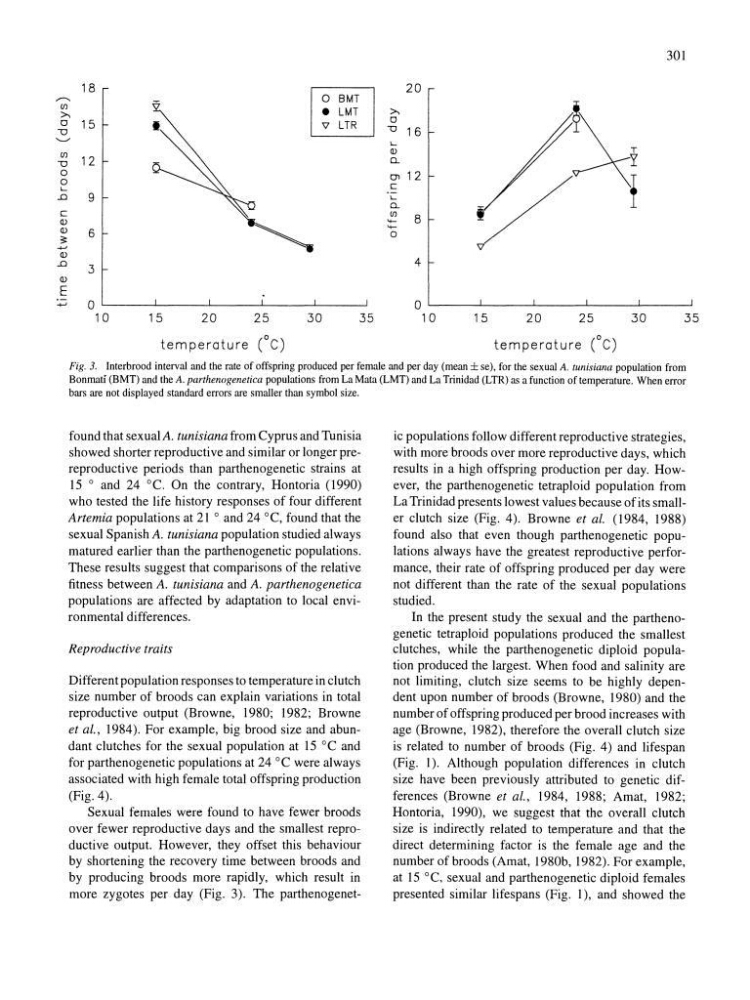
Fig. 3. Interbrood interval and the rate of offspring produced per female and per day (mean ± se), for the sexual A. tunisiana population from
Bonmatf (BMT) and the A. parthenogenetica populations from La Mata (LMT) and La Trinidad (LTR) as a function of temperature. When error
bars are not displayed standard errors are smaller than symbol size.
found that sexual A. tunisiana from Cyprus and Tunisia
showed shorter reproductive and similar or longer prereproductive periods than parthenogenetic strains at
15 a and 24 a C. On the contrary, Hontoria (1990)
who tested the life history responses of four different
Artemia populations at 21 a and 24 0c, found that the
sexual Spanish A. tunisiana population studied always
matured earlier than the parthenogenetic populations.
These results suggest that comparisons of the relative
fitness between A. tunisiana and A. parthenogenetica
populations are affected by adaptation to local environmental differences.
Reproductive traits
Different population responses to temperature in clutch
size number of broods can explain variations in total
reproductive output (Browne, 1980; 1982; Browne
et aI., 1984). For example, big brood size and abundant clutches for the sexual population at 15 °C and
for parthenogenetic populations at 24 °C were always
associated with high female total offspring production
(Fig. 4).
Sexual females were found to have fewer broods
over fewer reproductive days and the smallest reproductive output. However, they offset this behaviour
by shortening the recovery time between broods and
by producing broods more rapidly, which result in
more zygotes per day (Fig. 3). The parthenogenetic populations follow different reproductive strategies,
with more broods over more reproductive days, which
results in a high offspring production per day. However, the parthenogenetic tetraploid population from
La Trinidad presents lowest values because of its smaller clutch size (Fig. 4). Browne et al. (1984, 1988)
found also that even though parthenogenetic populations always have the greatest reproductive performance, their rate of offspring produced per day were
not different than the rate of the sexual populations
studied.
In the present study the sexual and the parthenogenetic tetraploid populations produced the smallest
clutches, while the parthenogenetic diploid population produced the largest. When food and salinity are
not limiting, clutch size seems to be highly dependent upon number of broods (Browne, 1980) and the
number of offspring produced per brood increases with
age (Browne, 1982), therefore the overall clutch size
is related to number of broods (Fig. 4) and lifespan
(Fig. 1). Although population differences in clutch
size have been previously attributed to genetic differences (Browne et aI., 1984, 1988; Amat, 1982;
Hontoria, 1990), we suggest that the overall clutch
size is indirectly related to temperature and that the
direct determining factor is the female age and the
number of broods (Amat, 1980b, 1982). For example,
at 15 0c, sexual and parthenogenetic diploid females
presented similar lifespans (Fig. 1), and showed the
18
20
'"
0 BMT
\Y
(f)
• LMT >.
>.
0
15
I
'V LTR
0
-0
-0 16
'-../
L
(f)
Q)
-0
12
D..
0
01 12
0
c
!
L
..0
9
L
D..
C
(f)
8
Q)
4Q)
6
0
3:
-+-'
Q)
4
..0
3
Q)
E
-+-'
0
0
10
15
20
25
30
35
10
15
20
25
30
35
temperature (C)
temperature (C)
Fig. 3. Interbrood interval and the rate of offspring produced per female and per day (mean ± se), for the sexual A. tunisiana population from
Bonmatf (BMT) and the A. parthenogenetica populations from La Mata (LMT) and La Trinidad (LTR) as a function of temperature. When error
bars are not displayed standard errors are smaller than symbol size.
found that sexual A. tunisiana from Cyprus and Tunisia
showed shorter reproductive and similar or longer prereproductive periods than parthenogenetic strains at
15 a and 24 a C. On the contrary, Hontoria (1990)
who tested the life history responses of four different
Artemia populations at 21 a and 24 0c, found that the
sexual Spanish A. tunisiana population studied always
matured earlier than the parthenogenetic populations.
These results suggest that comparisons of the relative
fitness between A. tunisiana and A. parthenogenetica
populations are affected by adaptation to local environmental differences.
Reproductive traits
Different population responses to temperature in clutch
size number of broods can explain variations in total
reproductive output (Browne, 1980; 1982; Browne
et aI., 1984). For example, big brood size and abundant clutches for the sexual population at 15 °C and
for parthenogenetic populations at 24 °C were always
associated with high female total offspring production
(Fig. 4).
Sexual females were found to have fewer broods
over fewer reproductive days and the smallest reproductive output. However, they offset this behaviour
by shortening the recovery time between broods and
by producing broods more rapidly, which result in
more zygotes per day (Fig. 3). The parthenogenetic populations follow different reproductive strategies,
with more broods over more reproductive days, which
results in a high offspring production per day. However, the parthenogenetic tetraploid population from
La Trinidad presents lowest values because of its smaller clutch size (Fig. 4). Browne et al. (1984, 1988)
found also that even though parthenogenetic populations always have the greatest reproductive performance, their rate of offspring produced per day were
not different than the rate of the sexual populations
studied.
In the present study the sexual and the parthenogenetic tetraploid populations produced the smallest
clutches, while the parthenogenetic diploid population produced the largest. When food and salinity are
not limiting, clutch size seems to be highly dependent upon number of broods (Browne, 1980) and the
number of offspring produced per brood increases with
age (Browne, 1982), therefore the overall clutch size
is related to number of broods (Fig. 4) and lifespan
(Fig. 1). Although population differences in clutch
size have been previously attributed to genetic differences (Browne et aI., 1984, 1988; Amat, 1982;
Hontoria, 1990), we suggest that the overall clutch
size is indirectly related to temperature and that the
direct determining factor is the female age and the
number of broods (Amat, 1980b, 1982). For example,
at 15 0c, sexual and parthenogenetic diploid females
presented similar lifespans (Fig. 1), and showed the