

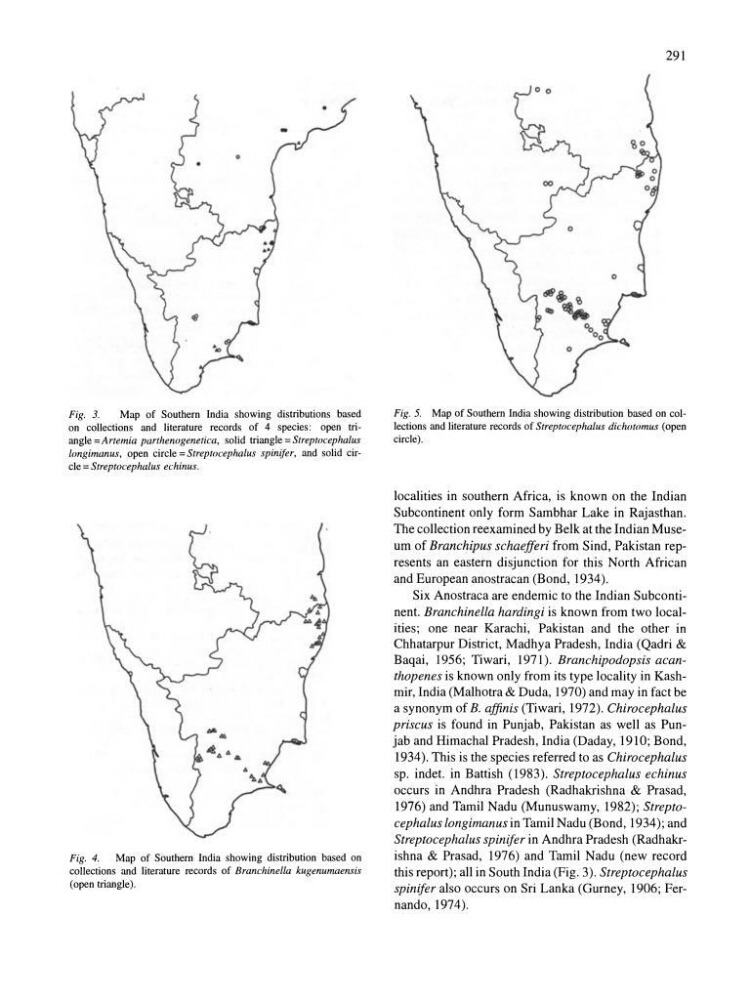
Fig. 3.
Map of Southern India showing distributions based
on collections and literature records of 4 species: open triangle = Artemia parthenogenetica, solid triangle = Streptocephaius
iongimanus, open circle=Streptocephaius spinif'er, and solid circle = Streptocephaius echinus.
Fig. 4.
Map of Southern India showing distribution based on
collections and literature records of Branchinella kugenumaensis
(open triangle).
291
Fig. 5. Map of Southern India showing distribution based on collections and literature records of Streptocephaius dichotomus (open
circle).
localities in southern Africa, is known on the Indian
Subcontinent only form Sambhar Lake in Rajasthan.
The collection reexamined by Belk at the Indian Museum of Branchipus schaefferi from Sind, Pakistan represents an eastern disjunction for this North African
and European anostracan (Bond, 1934).
Six Anostraca are endemic to the Indian Subcontinent. Branchinella hardingi is known from two localities; one near Karachi, Pakistan and the other in
Chhatarpur District, Madhya Pradesh, India (Qadri &
Baqai, 1956; Tiwari, 1971). Branchipodopsis acanthopenes is known only from its type locality in Kashmir, India (Malhotra & Duda, 1970) and may in fact be
a synonym of B. affinis (Tiwari, 1972). Chirocephalus
priscus is found in Punjab, Pakistan as well as Punjab and Himachal Pradesh, India (Daday, 1910; Bond,
1934). This is the species referred to as Chirocephalus
sp. indet. in Battish (1983). Streptocephalus echinus
occurs in Andhra Pradesh (Radhakrishna & Prasad,
1976) and Tamil Nadu (Munuswamy, 1982); Streptocephalus longimanus in Tamil Nadu (Bond, 1934); and
Streptocephalus spinifer in Andhra Pradesh (Radhakrishna & Prasad, 1976) and Tamil Nadu (new record
this report); all in South India (Fig. 3). Streptocephalus
spinifer also occurs on Sri Lanka (Gurney, 1906; Fernando,1974).
Map of Southern India showing distributions based
on collections and literature records of 4 species: open triangle = Artemia parthenogenetica, solid triangle = Streptocephaius
iongimanus, open circle=Streptocephaius spinif'er, and solid circle = Streptocephaius echinus.
Fig. 4.
Map of Southern India showing distribution based on
collections and literature records of Branchinella kugenumaensis
(open triangle).
291
Fig. 5. Map of Southern India showing distribution based on collections and literature records of Streptocephaius dichotomus (open
circle).
localities in southern Africa, is known on the Indian
Subcontinent only form Sambhar Lake in Rajasthan.
The collection reexamined by Belk at the Indian Museum of Branchipus schaefferi from Sind, Pakistan represents an eastern disjunction for this North African
and European anostracan (Bond, 1934).
Six Anostraca are endemic to the Indian Subcontinent. Branchinella hardingi is known from two localities; one near Karachi, Pakistan and the other in
Chhatarpur District, Madhya Pradesh, India (Qadri &
Baqai, 1956; Tiwari, 1971). Branchipodopsis acanthopenes is known only from its type locality in Kashmir, India (Malhotra & Duda, 1970) and may in fact be
a synonym of B. affinis (Tiwari, 1972). Chirocephalus
priscus is found in Punjab, Pakistan as well as Punjab and Himachal Pradesh, India (Daday, 1910; Bond,
1934). This is the species referred to as Chirocephalus
sp. indet. in Battish (1983). Streptocephalus echinus
occurs in Andhra Pradesh (Radhakrishna & Prasad,
1976) and Tamil Nadu (Munuswamy, 1982); Streptocephalus longimanus in Tamil Nadu (Bond, 1934); and
Streptocephalus spinifer in Andhra Pradesh (Radhakrishna & Prasad, 1976) and Tamil Nadu (new record
this report); all in South India (Fig. 3). Streptocephalus
spinifer also occurs on Sri Lanka (Gurney, 1906; Fernando,1974).