

290
Table 2. Number of individuals of Branchinella kugenumaensis with the indicated number of
fleshy processes on the left/right medial process
and number of medial spines at the proximal end
of the left/right primary branch of the frontal
appendage. Comparison of population samples
of 72 specimens from India and 73 from Japan.
Fleshy processes
Medial spines
India
Japan
India
Japan
6
0/0
0/1
0/0
1/0
7
9/9
1/1
2
21121
25128
8
34/30
15122
3
44/46
39/43
9
22129
29/35
4
4/4
711
10
7/3
23/12
5
3/1
1/1
11
0/1
512
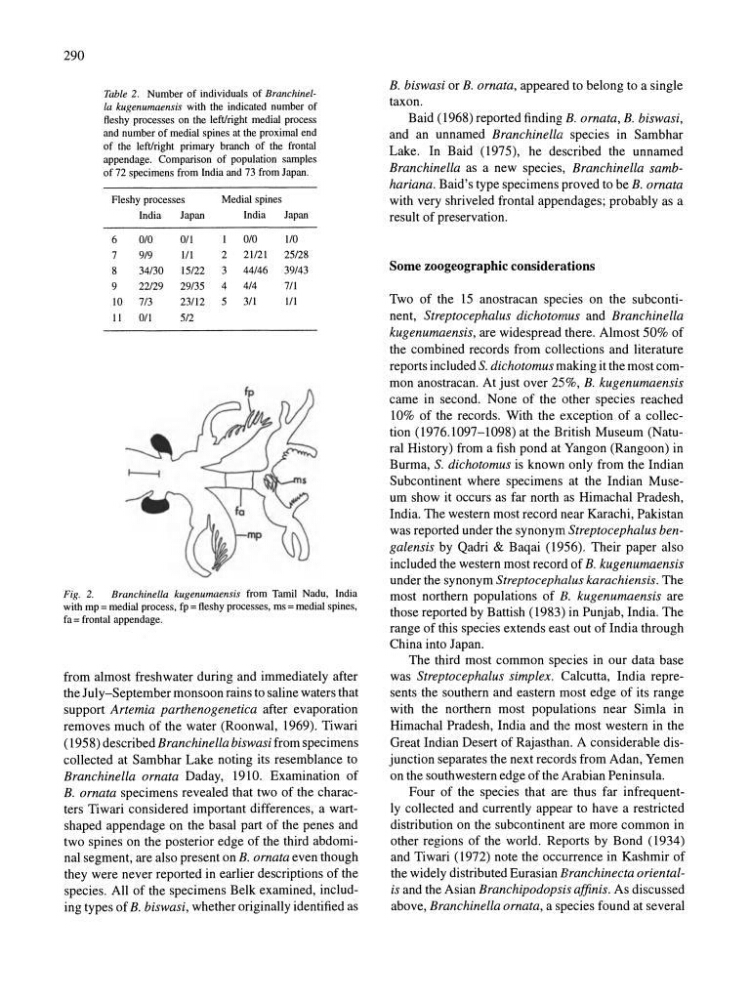
Fig. 2.
Branchinella kugenumaensis from Tamil Nadu, India
with mp = medial process, fp = fleshy processes, ms = medial spines,
fa = frontal appendage.
from almost freshwater during and immediately after
the July-September monsoon rains to saline waters that
support Artemia parthenogenetica after evaporation
removes much of the water (Roonwal, 1969). Tiwari
(1958) described Branchinella biswasi from specimens
collected at Sambhar Lake noting its resemblance to
Branchinella ornata Daday, 1910. Examination of
B. ornata specimens revealed that two of the characters Tiwari considered important differences, a wartshaped appendage on the basal part of the penes and
two spines on the posterior edge of the third abdominal segment, are also present on B. ornata even though
they were never reported in earlier descriptions of the
species. All of the specimens Belk examined, including types of B. biswasi, whether originally identified as
B. biswasi or B. ornata, appeared to belong to a single
taxon.
Baid (1968) reported finding B. ornata, B. biswasi,
and an unnamed Branchinella species in Sambhar
Lake. In Baid (1975), he described the unnamed
Branchinella as a new species, Branchinella sambhariana. Baid's type specimens proved to be B. ornata
with very shriveled frontal appendages; probably as a
result of preservation.
Some zoogeographic considerations
Two of the 15 anostracan species on the subcontinent, Streptocephalus dichotomus and Branchinella
kugenumaensis, are widespread there. Almost 50% of
the combined records from collections and literature
reports included S. dichotomus making it the most common anostracan. At just over 25%, B. kugenumaensis
came in second. None of the other species reached
10% of the records. With the exception of a collection (1976.1097-1098) at the British Museum (Natural History) from a fish pond at Yangon (Rangoon) in
Burma, S. dichotomus is known only from the Indian
Subcontinent where specimens at the Indian Museum show it occurs as far north as Himachal Pradesh,
India. The western most record near Karachi, Pakistan
was reported under the synonym Streptocephalus bengalensis by Qadri & Baqai (1956). Their paper also
included the western most record of B. kugenumaensis
under the synonym Streptocephalus karachiensis. The
most northern populations of B. kugenumaensis are
those reported by Battish (1983) in Punjab, India. The
range of this species extends east out of India through
China into Japan.
The third most common species in our data base
was Streptocephalus simplex. Calcutta, India represents the southern and eastern most edge of its range
with the northern most populations near Simla in
Himachal Pradesh, India and the most western in the
Great Indian Desert of Rajasthan. A considerable disjunction separates the next records from Adan, Yemen
on the southwestern edge of the Arabian Peninsula.
Four of the species that are thus far infrequently collected and currently appear to have a restricted
distribution on the subcontinent are more common in
other regions of the world. Reports by Bond (1934)
and Tiwari (1972) note the occurrence in Kashmir of
the widely distributed Eurasian Branchinecta orientalis and the Asian Branchipodopsis affinis. As discussed
above, Branchinella ornata, a species found at several
Table 2. Number of individuals of Branchinella kugenumaensis with the indicated number of
fleshy processes on the left/right medial process
and number of medial spines at the proximal end
of the left/right primary branch of the frontal
appendage. Comparison of population samples
of 72 specimens from India and 73 from Japan.
Fleshy processes
Medial spines
India
Japan
India
Japan
6
0/0
0/1
0/0
1/0
7
9/9
1/1
2
21121
25128
8
34/30
15122
3
44/46
39/43
9
22129
29/35
4
4/4
711
10
7/3
23/12
5
3/1
1/1
11
0/1
512
Fig. 2.
Branchinella kugenumaensis from Tamil Nadu, India
with mp = medial process, fp = fleshy processes, ms = medial spines,
fa = frontal appendage.
from almost freshwater during and immediately after
the July-September monsoon rains to saline waters that
support Artemia parthenogenetica after evaporation
removes much of the water (Roonwal, 1969). Tiwari
(1958) described Branchinella biswasi from specimens
collected at Sambhar Lake noting its resemblance to
Branchinella ornata Daday, 1910. Examination of
B. ornata specimens revealed that two of the characters Tiwari considered important differences, a wartshaped appendage on the basal part of the penes and
two spines on the posterior edge of the third abdominal segment, are also present on B. ornata even though
they were never reported in earlier descriptions of the
species. All of the specimens Belk examined, including types of B. biswasi, whether originally identified as
B. biswasi or B. ornata, appeared to belong to a single
taxon.
Baid (1968) reported finding B. ornata, B. biswasi,
and an unnamed Branchinella species in Sambhar
Lake. In Baid (1975), he described the unnamed
Branchinella as a new species, Branchinella sambhariana. Baid's type specimens proved to be B. ornata
with very shriveled frontal appendages; probably as a
result of preservation.
Some zoogeographic considerations
Two of the 15 anostracan species on the subcontinent, Streptocephalus dichotomus and Branchinella
kugenumaensis, are widespread there. Almost 50% of
the combined records from collections and literature
reports included S. dichotomus making it the most common anostracan. At just over 25%, B. kugenumaensis
came in second. None of the other species reached
10% of the records. With the exception of a collection (1976.1097-1098) at the British Museum (Natural History) from a fish pond at Yangon (Rangoon) in
Burma, S. dichotomus is known only from the Indian
Subcontinent where specimens at the Indian Museum show it occurs as far north as Himachal Pradesh,
India. The western most record near Karachi, Pakistan
was reported under the synonym Streptocephalus bengalensis by Qadri & Baqai (1956). Their paper also
included the western most record of B. kugenumaensis
under the synonym Streptocephalus karachiensis. The
most northern populations of B. kugenumaensis are
those reported by Battish (1983) in Punjab, India. The
range of this species extends east out of India through
China into Japan.
The third most common species in our data base
was Streptocephalus simplex. Calcutta, India represents the southern and eastern most edge of its range
with the northern most populations near Simla in
Himachal Pradesh, India and the most western in the
Great Indian Desert of Rajasthan. A considerable disjunction separates the next records from Adan, Yemen
on the southwestern edge of the Arabian Peninsula.
Four of the species that are thus far infrequently collected and currently appear to have a restricted
distribution on the subcontinent are more common in
other regions of the world. Reports by Bond (1934)
and Tiwari (1972) note the occurrence in Kashmir of
the widely distributed Eurasian Branchinecta orientalis and the Asian Branchipodopsis affinis. As discussed
above, Branchinella ornata, a species found at several