

• I
f ~. '. . - '
.~
S T R A C A
TR10PSIDA£
LEP1DU.~US : . APUS APU S
a
PI .':'
LUBBOCKI A ARCTICUS + C OI}t:5 11
~ : e CANCRIFORMIS CANCRI!"_
273
o CANCR . MAURrrAN1CUS . CANCR .
S!MPLEX Ii NUMIOICUS
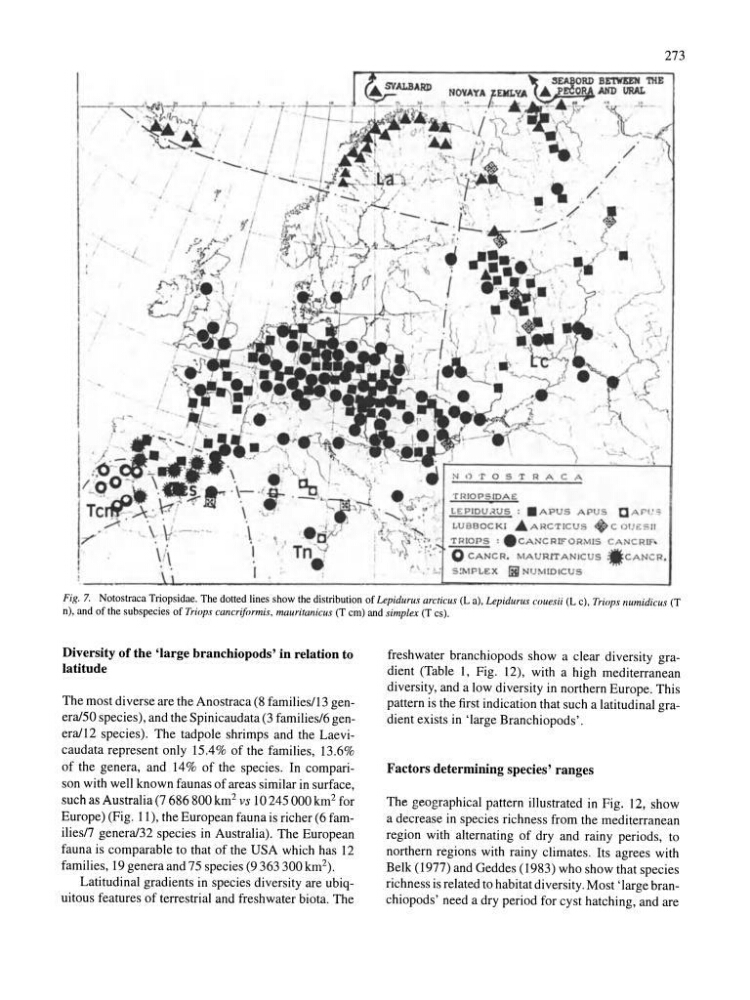
Fig. 7. Notostraca Triopsidae. The dotted lines show the distribution of Lepidurus arcticus (L a), Lepidurus couesii (L c), Triops numidicus (T
n), and of the subspecies of Triops cancrii'Jrmis, mauritanicus (T cm) and simplex (T cs).
Diversity of the 'large branchiopods' in relation to
latitude
The most diverse are the Anostraca (8 familiesl13 genera/50 species), and the Spinicaudata (3 families/6 genera/12 species). The tadpole shrimps and the Laevicaudata represent only 15.4% of the families, l3.6%
of the genera, and 14% of the species. In comparison with well known faunas of areas similar in surface,
such as Australia (7 686 800 km 2 vs 10245000 km 2 for
Europe)(Fig. I I), the European fauna is richer (6 fami1iesl7 genera/32 species in Australia). The European
fauna is comparable to that of the USA which has 12
families , 19 genera and 75 species (9363300 km 2 ).
Latitudinal gradients in species diversity are ubiquitous features of terrestrial and freshwater biota. The
freshwater branchiopods show a clear diversity gradient (Table I, Fig. 12), with a high mediterranean
diversity, and a low diversity in northern Europe. This
pattern is the first indication that such a latitudinal gradient exists in ' large Branchiopods'.
Factors determining species' ranges
The geographical pattern illustrated in Fig. 12, show
a decrease in species richness from the mediterranean
region with alternating of dry and rainy periods, to
northern regions with rainy climates. Its agrees with
Belk (1977) and Geddes (1983) who show that species
richness is related to habitat diversity. Most 'large branchiopods' need a dry period for cyst hatching, and are
f ~. '. . - '
.~
S T R A C A
TR10PSIDA£
LEP1DU.~US : . APUS APU S
a
PI .':'
LUBBOCKI A ARCTICUS + C OI}t:5 11
~ : e CANCRIFORMIS CANCRI!"_
273
o CANCR . MAURrrAN1CUS . CANCR .
S!MPLEX Ii NUMIOICUS
Fig. 7. Notostraca Triopsidae. The dotted lines show the distribution of Lepidurus arcticus (L a), Lepidurus couesii (L c), Triops numidicus (T
n), and of the subspecies of Triops cancrii'Jrmis, mauritanicus (T cm) and simplex (T cs).
Diversity of the 'large branchiopods' in relation to
latitude
The most diverse are the Anostraca (8 familiesl13 genera/50 species), and the Spinicaudata (3 families/6 genera/12 species). The tadpole shrimps and the Laevicaudata represent only 15.4% of the families, l3.6%
of the genera, and 14% of the species. In comparison with well known faunas of areas similar in surface,
such as Australia (7 686 800 km 2 vs 10245000 km 2 for
Europe)(Fig. I I), the European fauna is richer (6 fami1iesl7 genera/32 species in Australia). The European
fauna is comparable to that of the USA which has 12
families , 19 genera and 75 species (9363300 km 2 ).
Latitudinal gradients in species diversity are ubiquitous features of terrestrial and freshwater biota. The
freshwater branchiopods show a clear diversity gradient (Table I, Fig. 12), with a high mediterranean
diversity, and a low diversity in northern Europe. This
pattern is the first indication that such a latitudinal gradient exists in ' large Branchiopods'.
Factors determining species' ranges
The geographical pattern illustrated in Fig. 12, show
a decrease in species richness from the mediterranean
region with alternating of dry and rainy periods, to
northern regions with rainy climates. Its agrees with
Belk (1977) and Geddes (1983) who show that species
richness is related to habitat diversity. Most 'large branchiopods' need a dry period for cyst hatching, and are