

271
. j
d
_ _
_ _ _ _ _ _ _ _ _ _ _ _ _ _ _ _ _ _ _ _ ,
/ '--!-'~~J ~
I
I
..,
•
I
~
,
,
-~, i:
i.
"-- -~~,: . ......."
. .
ANOSTRA CA
C HIROCE:PHALIOAE:
C HIROCE:PHALINAE:
C H I ROC E PHALIJS :
O lAPHANIJS-GROIJP : e OlAPHA IJS O OlAPH.
CARINATUS W OlAPH . ROMANICIJS (f) MARCH E: -
SO:-lll $ PE:LAGON ICIJS + R E ISF:RI . RIJf'f'OI
O SALIN1J5 O SIBYLLA t::
S PIN1CAUOATIJS- GRO P : . CHYZERI '& CROA'T ICIJS
. HORRfBILIS + ROBU STUS 4 SLOVA -
C1CIJS ~ SPI . 'ICAliOATUS
". . ~
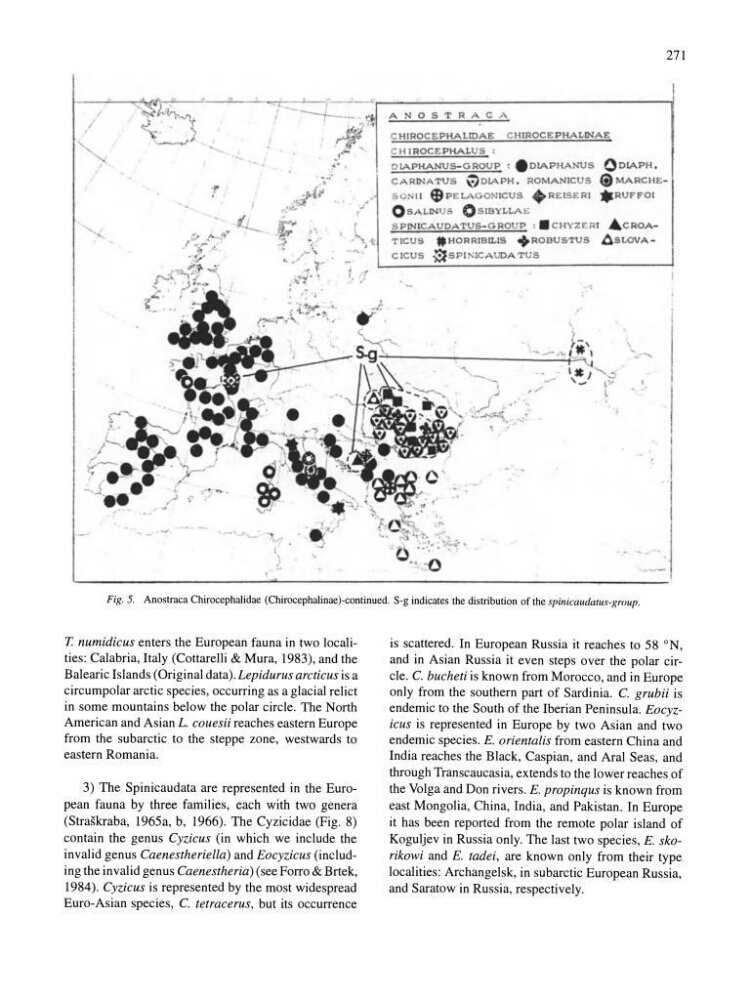
Fig. 5. Anostraca Chirocephalidae (Chirocephalinae)-continued. S-g indicates the distribution of the spinicaudatus-group.
T numidicus enters the European fauna in two localities: Calabria, Italy (Cottarelli & Mura, 1983), and the
Balearic Islands (Original data). Lepidurus arcticus is a
circumpolar arctic species, occurring as a glacial relict
in some mountains below the polar circle. The North
American and Asian L. couesii reaches eastern Europe
from the subarctic to the steppe zone, westwards to
eastern Romania.
3) The Spinicaudata are represented in the European fauna by three families, each with two genera
(Straskraba, 1965a, b, 1966). The Cyzicidae (Fig. 8)
contain the genus Cyzicus (in which we include the
invalid genus Caenestheriella) and Eocyzicus (including the invalid genus Caenestheria) (see Forro & Brtek,
1984). Cyzicus is represented by the most widespread
Euro-Asian species, C. tetracerus, but its occurrence
is scattered. In European Russia it reaches to 58 oN,
and in Asian Russia it even steps over the polar circle. C. bucheti is known from Morocco, and in Europe
only from the southern part of Sardinia. C. grubii is
endemic to the South of the Iberian Peninsula. Eocyzicus is represented in Europe by two Asian and two
endemic species. E. orientalis from eastern China and
India reaches the Black, Caspian, and Aral Seas, and
through Transcaucasia, extends to the lower reaches of
the Volga and Don rivers. E. propinqus is known from
east Mongolia, China, India, and Pakistan. In Europe
it has been reported from the remote polar island of
Koguljev in Russia only. The last two species, E. skorikowi and E. tadei, are known only from their type
localities: Archangelsk, in subarctic European Russia,
and Saratow in Russia, respectively.
. j
d
_ _
_ _ _ _ _ _ _ _ _ _ _ _ _ _ _ _ _ _ _ _ ,
/ '--!-'~~J ~
I
I
..,
•
I
~
,
,
-~, i:
i.
"-- -~~,: . ......."
. .
ANOSTRA CA
C HIROCE:PHALIOAE:
C HIROCE:PHALINAE:
C H I ROC E PHALIJS :
O lAPHANIJS-GROIJP : e OlAPHA IJS O OlAPH.
CARINATUS W OlAPH . ROMANICIJS (f) MARCH E: -
SO:-lll $ PE:LAGON ICIJS + R E ISF:RI . RIJf'f'OI
O SALIN1J5 O SIBYLLA t::
S PIN1CAUOATIJS- GRO P : . CHYZERI '& CROA'T ICIJS
. HORRfBILIS + ROBU STUS 4 SLOVA -
C1CIJS ~ SPI . 'ICAliOATUS
". . ~
Fig. 5. Anostraca Chirocephalidae (Chirocephalinae)-continued. S-g indicates the distribution of the spinicaudatus-group.
T numidicus enters the European fauna in two localities: Calabria, Italy (Cottarelli & Mura, 1983), and the
Balearic Islands (Original data). Lepidurus arcticus is a
circumpolar arctic species, occurring as a glacial relict
in some mountains below the polar circle. The North
American and Asian L. couesii reaches eastern Europe
from the subarctic to the steppe zone, westwards to
eastern Romania.
3) The Spinicaudata are represented in the European fauna by three families, each with two genera
(Straskraba, 1965a, b, 1966). The Cyzicidae (Fig. 8)
contain the genus Cyzicus (in which we include the
invalid genus Caenestheriella) and Eocyzicus (including the invalid genus Caenestheria) (see Forro & Brtek,
1984). Cyzicus is represented by the most widespread
Euro-Asian species, C. tetracerus, but its occurrence
is scattered. In European Russia it reaches to 58 oN,
and in Asian Russia it even steps over the polar circle. C. bucheti is known from Morocco, and in Europe
only from the southern part of Sardinia. C. grubii is
endemic to the South of the Iberian Peninsula. Eocyzicus is represented in Europe by two Asian and two
endemic species. E. orientalis from eastern China and
India reaches the Black, Caspian, and Aral Seas, and
through Transcaucasia, extends to the lower reaches of
the Volga and Don rivers. E. propinqus is known from
east Mongolia, China, India, and Pakistan. In Europe
it has been reported from the remote polar island of
Koguljev in Russia only. The last two species, E. skorikowi and E. tadei, are known only from their type
localities: Archangelsk, in subarctic European Russia,
and Saratow in Russia, respectively.