

270
A N O S T R A C A
CHIROCEPHALIOAE C CHIROCEPH ALINA£)
CHIROCEPHALUS :
SlA8OR.D BETWEnt m~. ~
P£eORA A1fD URAL
."--/
BAIRDI-GROUP : V BREVrPALPIS
£ ORGHIDANI
~ VORNATSCHERI BULGARICUS • KERKYREN-l-;~1'---:II<2-/lrv
SIS
PRISTICEPHALUS - GROUP : e CARNUNTANUS
O SHADINI
• RIPOPHrLUS
."
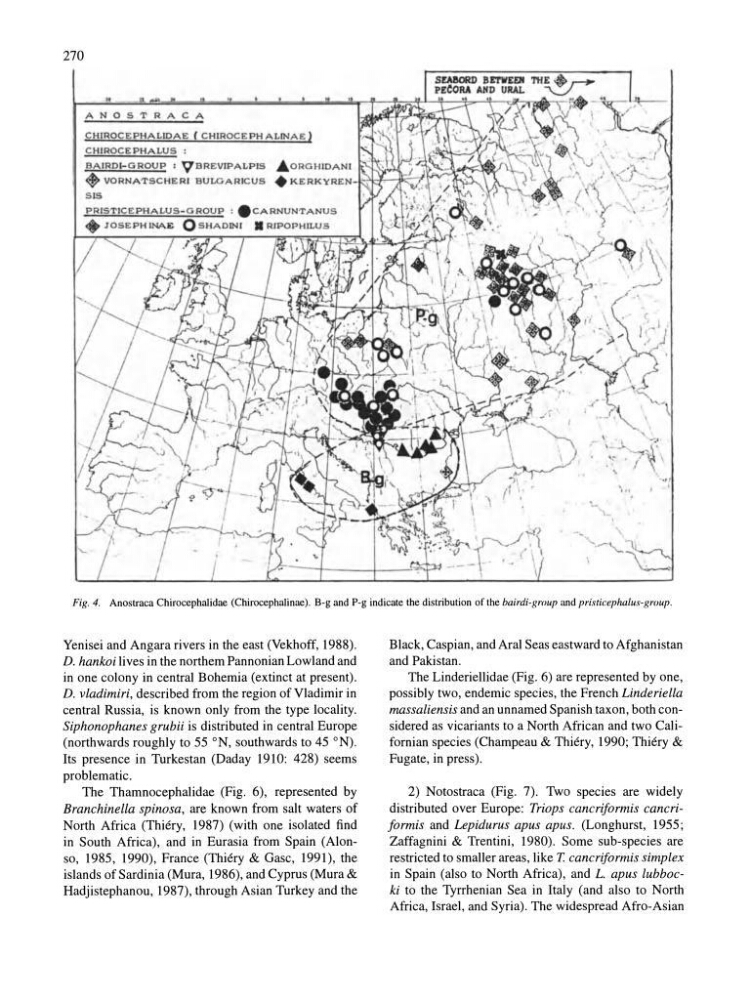
Fig. 4. Anostraca Chirocephalidae (Chirocephalinae). B-g and P-g indicate the distribution of the bairdi-group and pristicephalus-group.
Yenisei and Angara rivers in the east (Vekhoff, 1988).
D. hankoi lives in the northern Pannonian Lowland and
in one colony in central Bohemia (extinct at present).
D. vladimiri, described from the region of Vladimir in
central Russia, is known only from the type locality.
Siphonophanes grubii is distributed in central Europe
(northwards roughly to 55 oN, southwards to 45 ON).
Its presence in Turkestan (Daday 19lO: 428) seems
problematic.
The Thamnocephalidae (Fig. 6), represented by
Branchinella spinosa, are known from salt waters of
North Africa (Thiery, 1987) (with one isolated find
in South Africa), and in Eurasia from Spain (Alonso, 1985, 1990), France (Thiery & Gasc, 1991), the
islands of Sardinia (Mura, 1986), and Cyprus (Mura &
Hadjistephanou, 1987), through Asian Turkey and the
Black, Caspian, and Aral Seas eastward to Afghanistan
and Pakistan.
The Linderiellidae (Fig. 6) are represented by one,
possibly two, endemic species, the French Linderiella
massaliensis and an unnamed Spanish taxon, both considered as vicariants to a North African and two Californian species (Champeau & Thiery, 1990; Thiery &
Fugate, in press).
2) Notostraca (Fig. 7). Two species are widely
distributed over Europe: Triops cancriformis cancriformis and Lepidurus apus apus. (Longhurst, 1955;
Zaffagnini & Trentini, 1980). Some sub-species are
restricted to smaller areas, like T. cancriformis simplex
in Spain (also to North Africa), and L. apus lubbocki to the Tyrrhenian Sea in Italy (and also to North
Africa, Israel, and Syria). The widespread Afro-Asian
A N O S T R A C A
CHIROCEPHALIOAE C CHIROCEPH ALINA£)
CHIROCEPHALUS :
SlA8OR.D BETWEnt m~. ~
P£eORA A1fD URAL
."--/
BAIRDI-GROUP : V BREVrPALPIS
£ ORGHIDANI
~ VORNATSCHERI BULGARICUS • KERKYREN-l-;~1'---:II<2-/lrv
SIS
PRISTICEPHALUS - GROUP : e CARNUNTANUS
O SHADINI
• RIPOPHrLUS
."
Fig. 4. Anostraca Chirocephalidae (Chirocephalinae). B-g and P-g indicate the distribution of the bairdi-group and pristicephalus-group.
Yenisei and Angara rivers in the east (Vekhoff, 1988).
D. hankoi lives in the northern Pannonian Lowland and
in one colony in central Bohemia (extinct at present).
D. vladimiri, described from the region of Vladimir in
central Russia, is known only from the type locality.
Siphonophanes grubii is distributed in central Europe
(northwards roughly to 55 oN, southwards to 45 ON).
Its presence in Turkestan (Daday 19lO: 428) seems
problematic.
The Thamnocephalidae (Fig. 6), represented by
Branchinella spinosa, are known from salt waters of
North Africa (Thiery, 1987) (with one isolated find
in South Africa), and in Eurasia from Spain (Alonso, 1985, 1990), France (Thiery & Gasc, 1991), the
islands of Sardinia (Mura, 1986), and Cyprus (Mura &
Hadjistephanou, 1987), through Asian Turkey and the
Black, Caspian, and Aral Seas eastward to Afghanistan
and Pakistan.
The Linderiellidae (Fig. 6) are represented by one,
possibly two, endemic species, the French Linderiella
massaliensis and an unnamed Spanish taxon, both considered as vicariants to a North African and two Californian species (Champeau & Thiery, 1990; Thiery &
Fugate, in press).
2) Notostraca (Fig. 7). Two species are widely
distributed over Europe: Triops cancriformis cancriformis and Lepidurus apus apus. (Longhurst, 1955;
Zaffagnini & Trentini, 1980). Some sub-species are
restricted to smaller areas, like T. cancriformis simplex
in Spain (also to North Africa), and L. apus lubbocki to the Tyrrhenian Sea in Italy (and also to North
Africa, Israel, and Syria). The widespread Afro-Asian