

/
/
r
'", .' . ,
..
Q .•
< '--- - -
--"
.
. -,---""--"-'.r'"
,
I
\
,~
(.
ANOSTRACA
BRANCHlPODIDAE
BRANCHI PUS : . BLANCHARDI ~ CORTESI
+ INTERMEDIUS + PASAI O SERBICUS
•
SCHAEFFERI
~ SP.- (yugoslavia)
TANYMASTIX : O MOTASI .
STAGNALIS
O STELLAE
••••
"
- _ .......
-
. . .r":
269
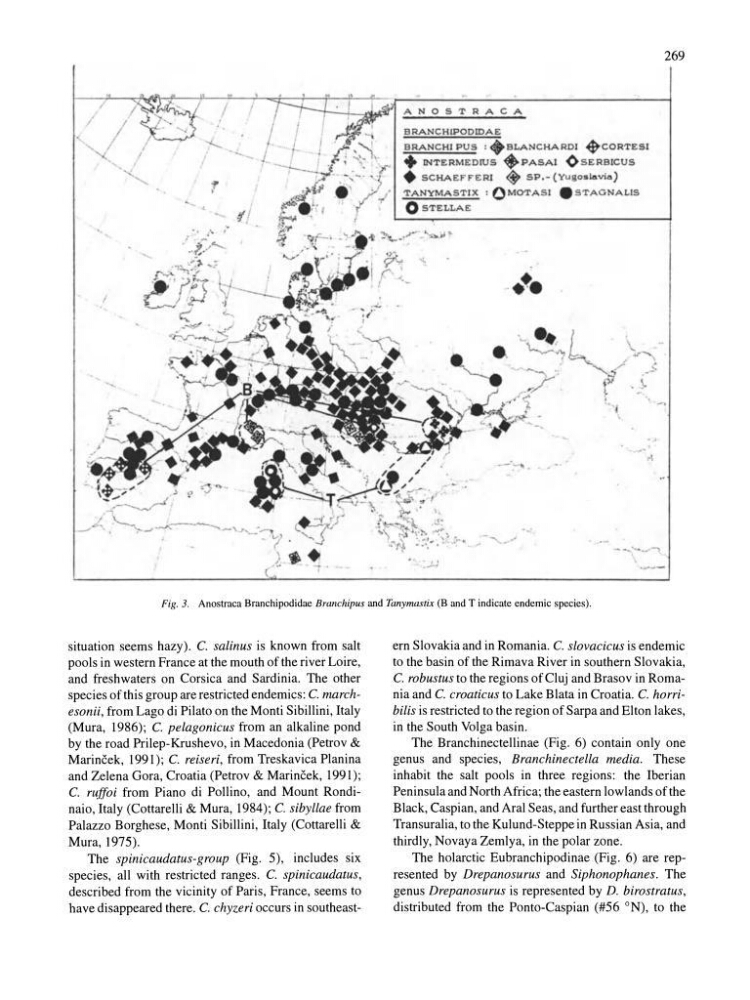
Fig. 3. Anostraca Branchipodidae Branchipus and Tanymastix (B and T indicate endemic species).
situation seems hazy). C. salinus is known from salt
pools in western France at the mouth ofthe river Loire,
and fresh waters on Corsica and Sardinia. The other
species of this group are restricted endemics: C. marchesonii, from Lago di Pilato on the Monti Sibillini, Italy
(Mura, 1986); C. pelagonicus from an alkaline pond
by the road Prilep-Krushevo, in Macedonia (Petrov &
Marincek, 1991); C. reiseri, from Treskavica Planina
and Zelena Gora, Croatia (Petro v & Marincek, 1991);
C. ruffoi from Piano di Pollino, and Mount Rondinaio, Italy (Cottarelli & Mura, 1984); C. sibyllae from
Palazzo Borghese, Monti Sibillini, Italy (Cottarelli &
Mura, 1975).
The spinicaudatus-group (Fig. 5), includes six
species, all with restricted ranges. C. spinicaudatus,
described from the vicinity of Paris, France, seems to
have disappeared there. C. chyzeri occurs in southeastern Slovakia and in Romania. C. slovacicus is endemic
to the basin of the Rimava River in southern Slovakia,
C. robustus to the regions of Cluj and Brasov in Romania and C. croaticus to Lake Blata in Croatia. C. horribilis is restricted to the region of Sarpa and Elton lakes,
in the South Volga basin.
The Branchinectellinae (Fig. 6) contain only one
genus and species, Branchinectella media. These
inhabit the salt pools in three regions: the Iberian
Peninsula and North Africa; the eastern lowlands of the
Black, Caspian, and Aral Seas, and further east through
Transuralia, to the Kulund-Steppe in Russian Asia, and
thirdly, Novaya Zemlya, in the polar zone.
The holarctic Eubranchipodinae (Fig. 6) are represented by Drepanosurus and Siphonophanes. The
genus Drepanosurus is represented by D. birostratus,
distributed from the Ponto-Caspian (#56 ON), to the
/
r
'", .' . ,
..
Q .•
< '--- - -
--"
.
. -,---""--"-'.r'"
,
I
\
,~
(.
ANOSTRACA
BRANCHlPODIDAE
BRANCHI PUS : . BLANCHARDI ~ CORTESI
+ INTERMEDIUS + PASAI O SERBICUS
•
SCHAEFFERI
~ SP.- (yugoslavia)
TANYMASTIX : O MOTASI .
STAGNALIS
O STELLAE
••••
"
- _ .......
-
. . .r":
269
Fig. 3. Anostraca Branchipodidae Branchipus and Tanymastix (B and T indicate endemic species).
situation seems hazy). C. salinus is known from salt
pools in western France at the mouth ofthe river Loire,
and fresh waters on Corsica and Sardinia. The other
species of this group are restricted endemics: C. marchesonii, from Lago di Pilato on the Monti Sibillini, Italy
(Mura, 1986); C. pelagonicus from an alkaline pond
by the road Prilep-Krushevo, in Macedonia (Petrov &
Marincek, 1991); C. reiseri, from Treskavica Planina
and Zelena Gora, Croatia (Petro v & Marincek, 1991);
C. ruffoi from Piano di Pollino, and Mount Rondinaio, Italy (Cottarelli & Mura, 1984); C. sibyllae from
Palazzo Borghese, Monti Sibillini, Italy (Cottarelli &
Mura, 1975).
The spinicaudatus-group (Fig. 5), includes six
species, all with restricted ranges. C. spinicaudatus,
described from the vicinity of Paris, France, seems to
have disappeared there. C. chyzeri occurs in southeastern Slovakia and in Romania. C. slovacicus is endemic
to the basin of the Rimava River in southern Slovakia,
C. robustus to the regions of Cluj and Brasov in Romania and C. croaticus to Lake Blata in Croatia. C. horribilis is restricted to the region of Sarpa and Elton lakes,
in the South Volga basin.
The Branchinectellinae (Fig. 6) contain only one
genus and species, Branchinectella media. These
inhabit the salt pools in three regions: the Iberian
Peninsula and North Africa; the eastern lowlands of the
Black, Caspian, and Aral Seas, and further east through
Transuralia, to the Kulund-Steppe in Russian Asia, and
thirdly, Novaya Zemlya, in the polar zone.
The holarctic Eubranchipodinae (Fig. 6) are represented by Drepanosurus and Siphonophanes. The
genus Drepanosurus is represented by D. birostratus,
distributed from the Ponto-Caspian (#56 ON), to the