

226
A
B
c
S. rothschildi
.§.. sudanicus
S. vitreus
0.3
-
i 02
.:;:
....
f 0.1
• • • • • • • • 0 • • • oJ, .... .•.•.................
'A" . , ••.. 'i.if.j:~"'" :{Jo ............ .
-- . .. -
: .- .
0.0 L..-_-'-_---' _ _ -'-_--'--_---l
2.5 ~-------------,
2.0
~ 1.5 ..................................... .
~ 1.0 ··········!r·· ........ ~~;: .......... . . ............ ~ ..... ··t······· .. ·········
~:.-. ~.
.
.............. ''''' ...... 6&'············
A .
Ai,f. .. t A
A
0.5
0.0 '----'-----''----'----'----'
2.0~----------___,
. •
1.5
111
-; .... ."
.. ,. -..
.6
~
A.6 ..
1b
0 0 0
1.0 ·························i·············
............. ~ .... ~ ................ .
......•....... ~~ ....... ~ ............. .
.::: .... ID '- 0.5
10
15
20
25
30
5
10
15
AA
20
25
30 5
10
15
20
25
30
standard length (mm)
standard length (mm)
standard length (mm)
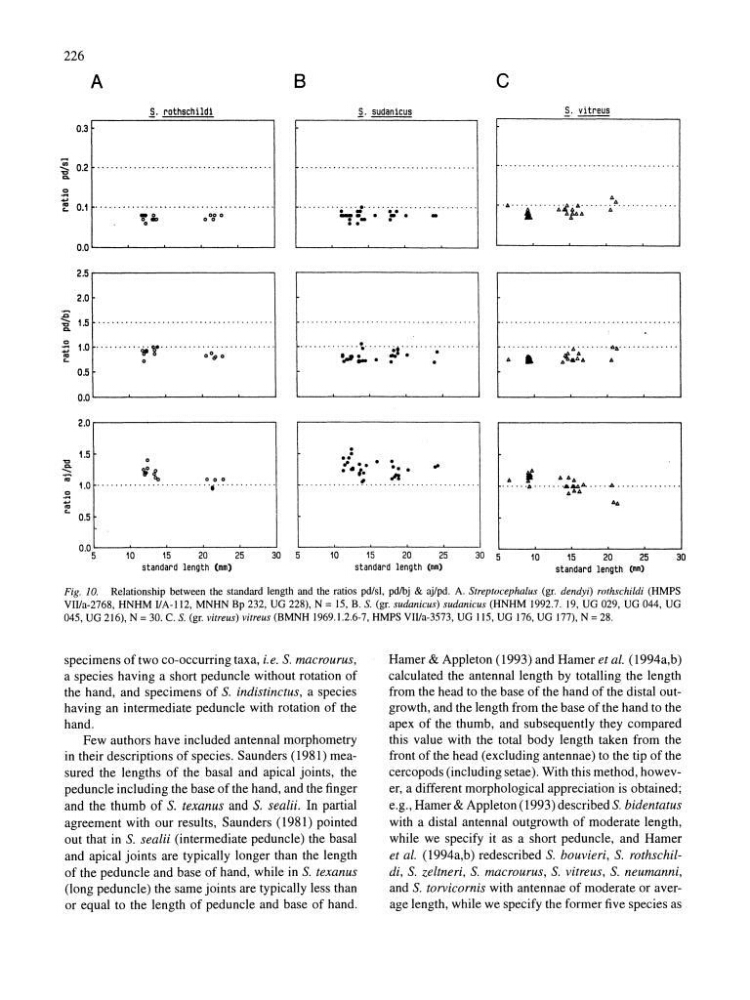
Fig. 10. Relationship between the standard length and the ratios pd/sl, pdlbj & aj/pd. A. Streptocephalus (gr. dendyi) rothschildi (HMPS
VIIIa-2768, HNHM I1A-112, MNHN Bp 232, UG 228), N = IS, B. S. (gr. sudanicus) sudanicus (HNHM 1992.7. 19, UG 029, UG 044, UG
045, UG 216), N = 30. C. S. (gr. vitreus) vitreus (BMNH 1969.1.2.6-7, HMPS VIIIa-3573, UG lIS, UG 176, UG 177), N = 28.
specimens of two co-occurring taxa, i.e. S. macrourus,
a species having a short peduncle without rotation of
the hand, and specimens of S. indistinctus, a species
having an intermediate peduncle with rotation of the
hand.
Few authors have included antennal morphometry
in their descriptions of species. Saunders (1981) measured the lengths of the basal and apical joints, the
peduncle including the base of the hand, and the finger
and the thumb of S. texan us and S. sealii. In partial
agreement with our results, Saunders (1981) pointed
out that in S. sealii (intermediate peduncle) the basal
and apical joints are typically longer than the length
of the peduncle and base of hand, while in S. texan us
(long peduncle) the same joints are typically less than
or equal to the length of peduncle and base of hand.
Hamer & Appleton (1993) and Hamer et ai. (1994a,b)
calculated the antennal length by totalling the length
from the head to the base ofthe hand of the distal outgrowth, and the length from the base of the hand to the
apex of the thumb, and subsequently they compared
this value with the total body length taken from the
front of the head (excluding antennae) to the tip of the
cercopods (including setae). With this method, however, a different morphological appreciation is obtained;
e.g., Hamer & Appleton (1993) described S. bidentatus
with a distal antennal outgrowth of moderate length,
while we specify it as a short peduncle, and Hamer
et al. (1994a,b) redescribed S. bouvieri, S. rothschildi, S. zeltneri, S. macrourus, S. vitreus, S. neumanni,
and S. torvicornis with antennae of moderate or average length, while we specify the former five species as
A
B
c
S. rothschildi
.§.. sudanicus
S. vitreus
0.3
-
i 02
.:;:
....
f 0.1
• • • • • • • • 0 • • • oJ, .... .•.•.................
'A" . , ••.. 'i.if.j:~"'" :{Jo ............ .
-- . .. -
: .- .
0.0 L..-_-'-_---' _ _ -'-_--'--_---l
2.5 ~-------------,
2.0
~ 1.5 ..................................... .
~ 1.0 ··········!r·· ........ ~~;: .......... . . ............ ~ ..... ··t······· .. ·········
~:.-. ~.
.
.............. ''''' ...... 6&'············
A .
Ai,f. .. t A
A
0.5
0.0 '----'-----''----'----'----'
2.0~----------___,
. •
1.5
111
-; .... ."
.. ,. -..
.6
~
A.6 ..
1b
0 0 0
1.0 ·························i·············
............. ~ .... ~ ................ .
......•....... ~~ ....... ~ ............. .
.::: .... ID '- 0.5
10
15
20
25
30
5
10
15
AA
20
25
30 5
10
15
20
25
30
standard length (mm)
standard length (mm)
standard length (mm)
Fig. 10. Relationship between the standard length and the ratios pd/sl, pdlbj & aj/pd. A. Streptocephalus (gr. dendyi) rothschildi (HMPS
VIIIa-2768, HNHM I1A-112, MNHN Bp 232, UG 228), N = IS, B. S. (gr. sudanicus) sudanicus (HNHM 1992.7. 19, UG 029, UG 044, UG
045, UG 216), N = 30. C. S. (gr. vitreus) vitreus (BMNH 1969.1.2.6-7, HMPS VIIIa-3573, UG lIS, UG 176, UG 177), N = 28.
specimens of two co-occurring taxa, i.e. S. macrourus,
a species having a short peduncle without rotation of
the hand, and specimens of S. indistinctus, a species
having an intermediate peduncle with rotation of the
hand.
Few authors have included antennal morphometry
in their descriptions of species. Saunders (1981) measured the lengths of the basal and apical joints, the
peduncle including the base of the hand, and the finger
and the thumb of S. texan us and S. sealii. In partial
agreement with our results, Saunders (1981) pointed
out that in S. sealii (intermediate peduncle) the basal
and apical joints are typically longer than the length
of the peduncle and base of hand, while in S. texan us
(long peduncle) the same joints are typically less than
or equal to the length of peduncle and base of hand.
Hamer & Appleton (1993) and Hamer et ai. (1994a,b)
calculated the antennal length by totalling the length
from the head to the base ofthe hand of the distal outgrowth, and the length from the base of the hand to the
apex of the thumb, and subsequently they compared
this value with the total body length taken from the
front of the head (excluding antennae) to the tip of the
cercopods (including setae). With this method, however, a different morphological appreciation is obtained;
e.g., Hamer & Appleton (1993) described S. bidentatus
with a distal antennal outgrowth of moderate length,
while we specify it as a short peduncle, and Hamer
et al. (1994a,b) redescribed S. bouvieri, S. rothschildi, S. zeltneri, S. macrourus, S. vitreus, S. neumanni,
and S. torvicornis with antennae of moderate or average length, while we specify the former five species as