

154
100
~
80
r-t
10
>
·ri
>
B
t..
60
:J
C
In
Ql
>
·ri
... 40
10
r-t
:J
A
e
:J
u
20
O~------~----~---L--~~--~--~----~--~--~
o
2
4
6
8
10
days of culture
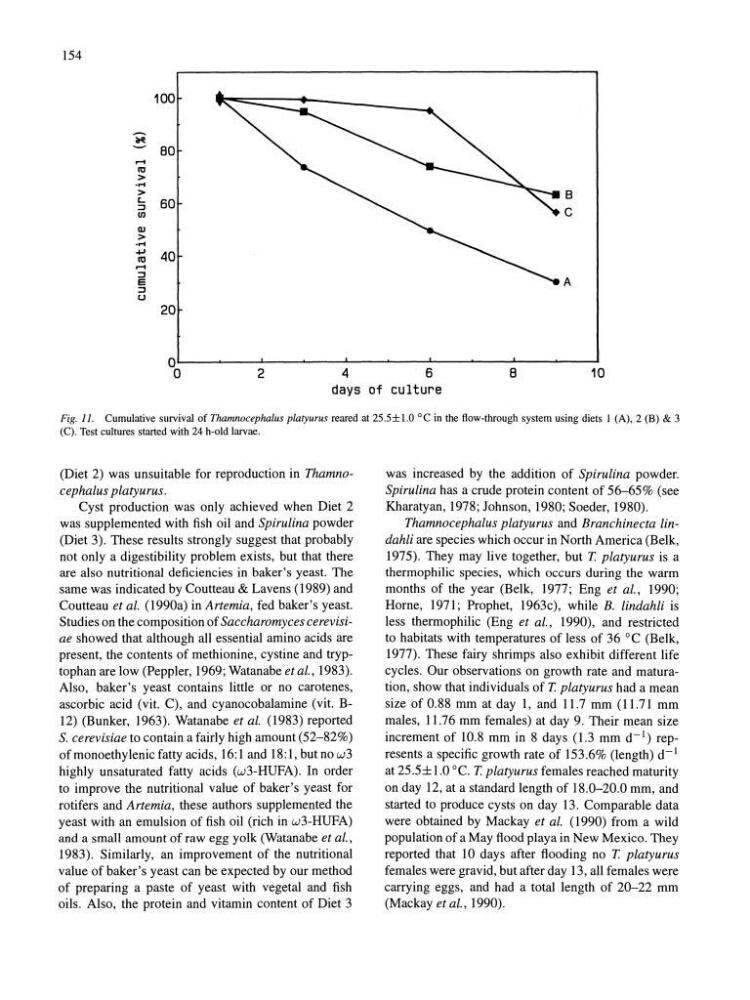
Fig. 11. Cumulative survival of Thamnocephalus platyurus reared at 25.5±1.0 °C in the flow-through system using diets I (A). 2 (B) & 3
(C). Test cultures started with 24 h-old larvae.
(Diet 2) was unsuitable for reproduction in Thamnocephalus platyurus.
Cyst production was only achieved when Diet 2
was supplemented with fish oil and Spirulina powder
(Diet 3). These results strongly suggest that probably
not only a digestibility problem exists, but that there
are also nutritional deficiencies in baker's yeast. The
same was indicated by Coutteau & Lavens (1989) and
Coutteau et al. (1990a) in Artemia, fed baker's yeast.
Studies on the composition of Saccharomyces cerevisiae showed that although all essential amino acids are
present, the contents of methionine, cystine and tryptophan are low (Peppler, 1969; Watanabe et aI., 1983).
Also, baker's yeast contains little or no carotenes,
ascorbic acid (vit. C), and cyanocobalamine (vit. B12) (Bunker, 1963). Watanabe et al. (1983) reported
S. cerevisiae to contain a fairly high amount (52-82%)
ofmonoethylenicfatty acids, 16:1 and 18:1, but no w3
highly unsaturated fatty acids (w3-HUFA). In order
to improve the nutritional value of baker's yeast for
rotifers and Artemia, these authors supplemented the
yeast with an emulsion of fish oil (rich in w3-HUFA)
and a small amount of raw egg yolk (Watanabe et aI.,
1983). Similarly, an improvement of the nutritional
value of baker's yeast can be expected by our method
of preparing a paste of yeast with vegetal and fish
oils. Also, the protein and vitamin content of Diet 3
was increased by the addition of Spirulina powder.
Spirulina has a crude protein content of 56-65% (see
Kharatyan, 1978; Johnson, 1980; Soeder, 1980).
Thamnocephalus platyurus and Branchinecta lindahli are species which occur in North America (Belk,
1975). They may live together, but T. ptatyurus is a
thermophilic species, which occurs during the warm
months of the year (Belk, 1977; Eng et at., 1990;
Horne, 1971; Prophet, 1963c), while B. lindahli is
less thermophilic (Eng et aI., 1990), and restricted
to habitats with temperatures of less of 36°C (Belk,
1977). These fairy shrimps also exhibit different life
cycles. Our observations on growth rate and maturation, show that individuals of T. ptatyurus had a mean
size of 0.88 mm at day 1, and 11.7 mm (11.71 mm
males, 11.76 mm females) at day 9. Their mean size
increment of 10.8 mm in 8 days (1.3 mm d-') represents a specific growth rate of 153.6% (length) d-'
at 25.5± 1.0 DC. T. platyurus females reached maturity
on day 12, at a standard length of 18.0-20.0 mm, and
started to produce cysts on day 13. Comparable data
were obtained by Mackay et at. (1990) from a wild
population of a May flood playa in New Mexico. They
reported that 10 days after flooding no T. platyurus
females were gravid, but after day 13, all females were
carrying eggs, and had a total length of 20-22 mm
(Mackay et al., 1990).
100
~
80
r-t
10
>
·ri
>
B
t..
60
:J
C
In
Ql
>
·ri
... 40
10
r-t
:J
A
e
:J
u
20
O~------~----~---L--~~--~--~----~--~--~
o
2
4
6
8
10
days of culture
Fig. 11. Cumulative survival of Thamnocephalus platyurus reared at 25.5±1.0 °C in the flow-through system using diets I (A). 2 (B) & 3
(C). Test cultures started with 24 h-old larvae.
(Diet 2) was unsuitable for reproduction in Thamnocephalus platyurus.
Cyst production was only achieved when Diet 2
was supplemented with fish oil and Spirulina powder
(Diet 3). These results strongly suggest that probably
not only a digestibility problem exists, but that there
are also nutritional deficiencies in baker's yeast. The
same was indicated by Coutteau & Lavens (1989) and
Coutteau et al. (1990a) in Artemia, fed baker's yeast.
Studies on the composition of Saccharomyces cerevisiae showed that although all essential amino acids are
present, the contents of methionine, cystine and tryptophan are low (Peppler, 1969; Watanabe et aI., 1983).
Also, baker's yeast contains little or no carotenes,
ascorbic acid (vit. C), and cyanocobalamine (vit. B12) (Bunker, 1963). Watanabe et al. (1983) reported
S. cerevisiae to contain a fairly high amount (52-82%)
ofmonoethylenicfatty acids, 16:1 and 18:1, but no w3
highly unsaturated fatty acids (w3-HUFA). In order
to improve the nutritional value of baker's yeast for
rotifers and Artemia, these authors supplemented the
yeast with an emulsion of fish oil (rich in w3-HUFA)
and a small amount of raw egg yolk (Watanabe et aI.,
1983). Similarly, an improvement of the nutritional
value of baker's yeast can be expected by our method
of preparing a paste of yeast with vegetal and fish
oils. Also, the protein and vitamin content of Diet 3
was increased by the addition of Spirulina powder.
Spirulina has a crude protein content of 56-65% (see
Kharatyan, 1978; Johnson, 1980; Soeder, 1980).
Thamnocephalus platyurus and Branchinecta lindahli are species which occur in North America (Belk,
1975). They may live together, but T. ptatyurus is a
thermophilic species, which occurs during the warm
months of the year (Belk, 1977; Eng et at., 1990;
Horne, 1971; Prophet, 1963c), while B. lindahli is
less thermophilic (Eng et aI., 1990), and restricted
to habitats with temperatures of less of 36°C (Belk,
1977). These fairy shrimps also exhibit different life
cycles. Our observations on growth rate and maturation, show that individuals of T. ptatyurus had a mean
size of 0.88 mm at day 1, and 11.7 mm (11.71 mm
males, 11.76 mm females) at day 9. Their mean size
increment of 10.8 mm in 8 days (1.3 mm d-') represents a specific growth rate of 153.6% (length) d-'
at 25.5± 1.0 DC. T. platyurus females reached maturity
on day 12, at a standard length of 18.0-20.0 mm, and
started to produce cysts on day 13. Comparable data
were obtained by Mackay et at. (1990) from a wild
population of a May flood playa in New Mexico. They
reported that 10 days after flooding no T. platyurus
females were gravid, but after day 13, all females were
carrying eggs, and had a total length of 20-22 mm
(Mackay et al., 1990).