

12 0
100
. .
~ 6
. ~
0
a 6 0
. .
"
~ 4 0
" c
. .
2 0
0
12 0
100
~ 6
~
0
a 60
. .
.8 e 40
" c
..
20
o
120
100
~ 60
~
~
60
Q
. .
.8 e 40
" c
20
A
~
"------2
B
~
<>---~
0
0
C
0---2
~
2
4
6
6
10
days ot=' culture
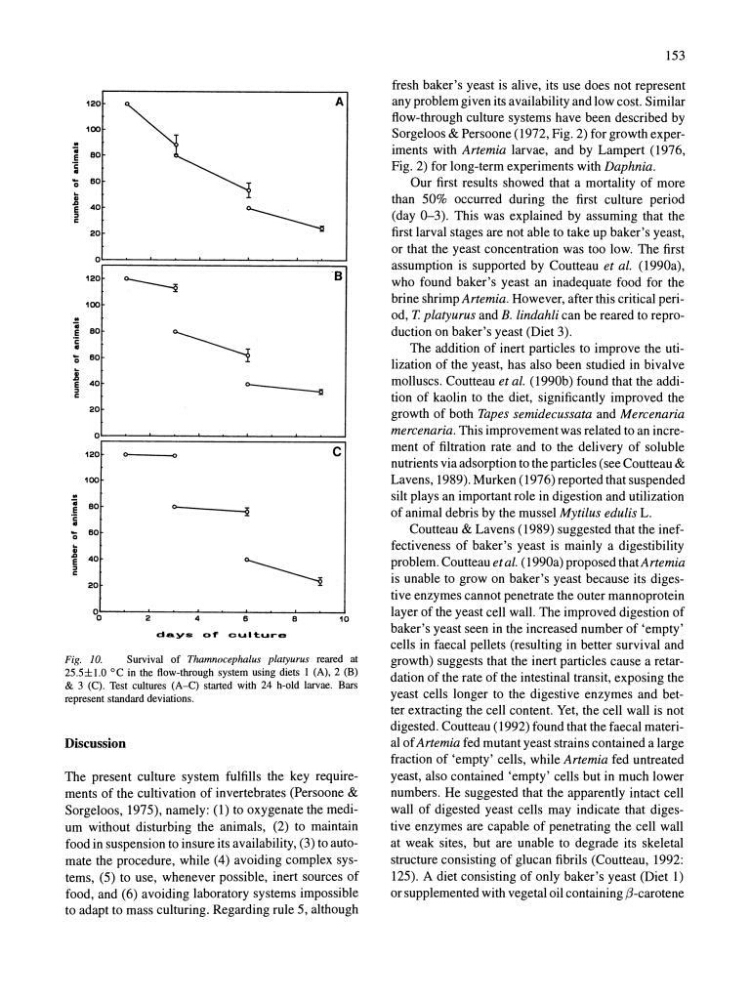
Fig. 10.
Survival of Thamnocephalus platyurus reared at
25.5±l.O °C in the flow-through system using diets I (A), 2 (B)
& 3 (C). Test cultures (A-C) started with 24 h-old larvae. Bars
represent standard deviations.
Discussion
The present culture system fulfills the key requirements of the cultivation of invertebrates (Persoone &
Sorgeloos, 1975), namely: (1) to oxygenate the medium without disturbing the animals, (2) to maintain
food in suspension to insure its availability, (3) to automate the procedure, while (4) avoiding complex systems, (5) to use, whenever possible, inert sources of
food, and (6) avoiding laboratory systems impossible
to adapt to mass culturing. Regarding rule 5, although
153
fresh baker's yeast is alive, its use does not represent
any problem given its availability and low cost. Similar
flow-through culture systems have been described by
Sorgeloos & Persoone (1972, Fig. 2) for growth experiments with Artemia larvae, and by Lampert (1976,
Fig. 2) for long-term experiments with Daphnia .
Our first results showed that a mortality of more
than 50% occurred during the first culture period
(day 0-3). This was explained by assuming that the
first larval stages are not able to take up baker's yeast,
or that the yeast concentration was too low. The first
assumption is supported by Coutteau et at. (1990a),
who found baker's yeast an inadequate food for the
brine shrimp Artemia. However, after this critical period, T. platyurus and B. lindahli can be reared to reproduction on baker's yeast (Diet 3).
The addition of inert particles to improve the utilization of the yeast, has also been studied in bivalve
molluscs. Coutteau et at. (1990b) found that the addition of kaolin to the diet, significantly improved the
growth of both Tapes semidecussata and Mercenaria
mercenaria. This improvement was related to an increment of filtration rate and to the delivery of soluble
nutrients via adsorption to the particles (see Coutteau &
Lavens, 1989). Murken (1976) reported that suspended
silt plays an important role in digestion and utilization
of animal debris by the mussel Mytilus edulis L.
Coutteau & Lavens (1989) suggested that the ineffectiveness of baker's yeast is mainly a digestibility
problem. Coutteau et at. (1990a) proposed thatArtemia
is unable to grow on baker's yeast because its digestive enzymes cannot penetrate the outer mannoprotein
layer of the yeast cell wall. The improved digestion of
baker's yeast seen in the increased number of 'empty'
cells in faecal pellets (resulting in better survival and
growth) suggests that the inert particles cause a retardation of the rate of the intestinal transit, exposing the
yeast cells longer to the digestive enzymes and better extracting the cell content. Yet, the cell wall is not
digested. Coutteau (1992) found that the faecal material of Artemia fed mutant yeast strains contained a large
fraction of 'empty' cells, while Artemia fed untreated
yeast, also contained 'empty' cells but in much lower
numbers. He suggested that the apparently intact cell
wall of digested yeast cells may indicate that digestive enzymes are capable of penetrating the cell wall
at weak sites, but are unable to degrade its skeletal
structure consisting of glucan fibrils (Coutteau, 1992:
125). A diet consisting of only baker's yeast (Diet 1)
or supplemented with vegetal oil containing /3-carotene
100
. .
~ 6
. ~
0
a 6 0
. .
"
~ 4 0
" c
. .
2 0
0
12 0
100
~ 6
~
0
a 60
. .
.8 e 40
" c
..
20
o
120
100
~ 60
~
~
60
Q
. .
.8 e 40
" c
20
A
~
"------2
B
~
<>---~
0
0
C
0---2
~
2
4
6
6
10
days ot=' culture
Fig. 10.
Survival of Thamnocephalus platyurus reared at
25.5±l.O °C in the flow-through system using diets I (A), 2 (B)
& 3 (C). Test cultures (A-C) started with 24 h-old larvae. Bars
represent standard deviations.
Discussion
The present culture system fulfills the key requirements of the cultivation of invertebrates (Persoone &
Sorgeloos, 1975), namely: (1) to oxygenate the medium without disturbing the animals, (2) to maintain
food in suspension to insure its availability, (3) to automate the procedure, while (4) avoiding complex systems, (5) to use, whenever possible, inert sources of
food, and (6) avoiding laboratory systems impossible
to adapt to mass culturing. Regarding rule 5, although
153
fresh baker's yeast is alive, its use does not represent
any problem given its availability and low cost. Similar
flow-through culture systems have been described by
Sorgeloos & Persoone (1972, Fig. 2) for growth experiments with Artemia larvae, and by Lampert (1976,
Fig. 2) for long-term experiments with Daphnia .
Our first results showed that a mortality of more
than 50% occurred during the first culture period
(day 0-3). This was explained by assuming that the
first larval stages are not able to take up baker's yeast,
or that the yeast concentration was too low. The first
assumption is supported by Coutteau et at. (1990a),
who found baker's yeast an inadequate food for the
brine shrimp Artemia. However, after this critical period, T. platyurus and B. lindahli can be reared to reproduction on baker's yeast (Diet 3).
The addition of inert particles to improve the utilization of the yeast, has also been studied in bivalve
molluscs. Coutteau et at. (1990b) found that the addition of kaolin to the diet, significantly improved the
growth of both Tapes semidecussata and Mercenaria
mercenaria. This improvement was related to an increment of filtration rate and to the delivery of soluble
nutrients via adsorption to the particles (see Coutteau &
Lavens, 1989). Murken (1976) reported that suspended
silt plays an important role in digestion and utilization
of animal debris by the mussel Mytilus edulis L.
Coutteau & Lavens (1989) suggested that the ineffectiveness of baker's yeast is mainly a digestibility
problem. Coutteau et at. (1990a) proposed thatArtemia
is unable to grow on baker's yeast because its digestive enzymes cannot penetrate the outer mannoprotein
layer of the yeast cell wall. The improved digestion of
baker's yeast seen in the increased number of 'empty'
cells in faecal pellets (resulting in better survival and
growth) suggests that the inert particles cause a retardation of the rate of the intestinal transit, exposing the
yeast cells longer to the digestive enzymes and better extracting the cell content. Yet, the cell wall is not
digested. Coutteau (1992) found that the faecal material of Artemia fed mutant yeast strains contained a large
fraction of 'empty' cells, while Artemia fed untreated
yeast, also contained 'empty' cells but in much lower
numbers. He suggested that the apparently intact cell
wall of digested yeast cells may indicate that digestive enzymes are capable of penetrating the cell wall
at weak sites, but are unable to degrade its skeletal
structure consisting of glucan fibrils (Coutteau, 1992:
125). A diet consisting of only baker's yeast (Diet 1)
or supplemented with vegetal oil containing /3-carotene