

152
100
2
3
80
- tIC
-
r l
60
10
>
-~
> t..
:J
III
40
20
4
O~---------L----------~----------~----------~
o
1
2
3
days of culture
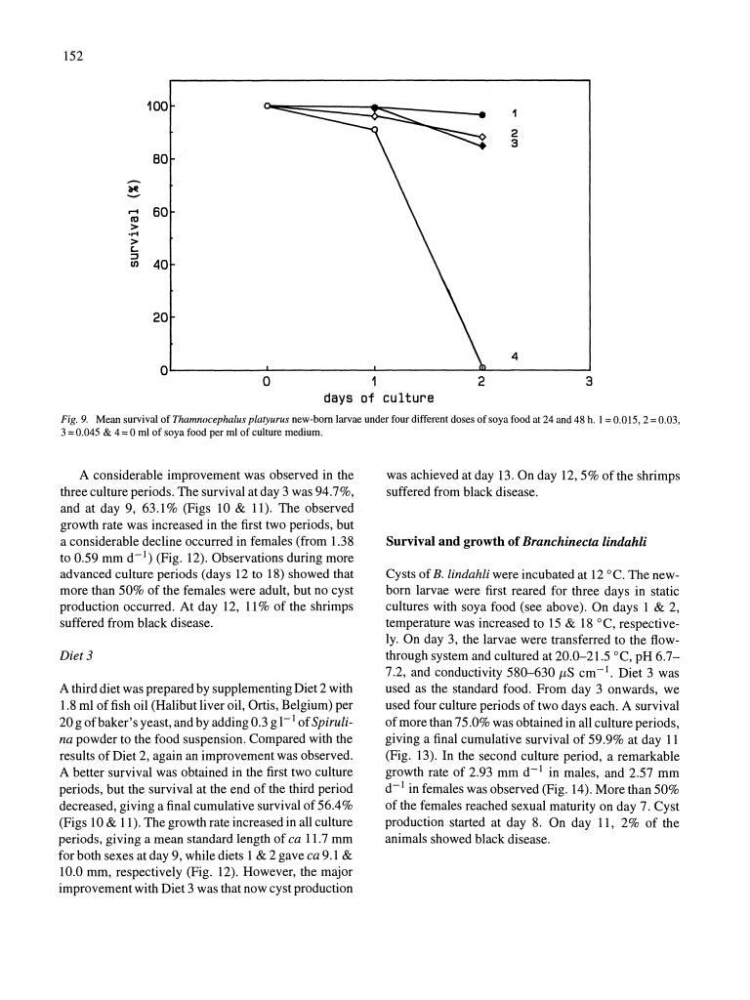
Fig. 9. Mean survival of Thamnocephalus platyurus new-born larvae under four different doses of soya food at 24 and 48 h. 1 = 0.015,2 = 0.03,
3 = 0.045 & 4 = 0 rnl of soya food per ml of culture medium.
A considerable improvement was observed in the
three culture periods. The survival at day 3 was 94.7%,
and at day 9, 63.1 % (Figs 10 & 11). The observed
growth rate was increased in the first two periods, but
a considerable decline occurred in females (from 1.38
to 0.59 mm d- I ) (Fig. 12). Observations during more
advanced culture periods (days 12 to 18) showed that
more than 50% of the females were adult, but no cyst
production occurred. At day 12, 11 % of the shrimps
suffered from black disease.
Diet 3
A third diet was prepared by supplementing Diet 2 with
1.8 ml of fish oil (Halibut liver oil, Ortis, Belgium) per
20 g of baker's yeast, and by adding 0.3 g 1-1 of Spirulina powder to the food suspension. Compared with the
results of Diet 2, again an improvement was observed.
A better survival was obtained in the first two culture
periods, but the survival at the end of the third period
decreased, giving a final cumulative survival of 56.4%
(Figs 10 & 11). The growth rate increased in all culture
periods, giving a mean standard length of ca 11.7 mm
for both sexes at day 9, while diets 1 & 2 gave ca 9.1 &
10.0 mm, respectively (Fig. 12). However, the major
improvement with Diet 3 was that now cyst production
was achieved at day 13. On day 12,5% of the shrimps
suffered from black disease.
Survival and growth of Branchinecta lindahli
Cysts of B. lindahli were incubated at 12 °C. The newborn larvae were first reared for three days in static
cultures with soya food (see above). On days 1 & 2,
temperature was increased to 15 & 18°C, respectively. On day 3, the larvae were transferred to the ftowthrough system and cultured at 20.0-21.5 °C, pH 6.77.2, and conductivity 580-630 j.LS em-I. Diet 3 was
used as the standard food. From day 3 onwards, we
used four culture periods of two days each. A survival
of more than 75.0% was obtained in all culture periods,
giving a final cumulative survival of 59.9% at day 11
(Fig. 13). In the second culture period, a remarkable
growth rate of 2.93 mm d- I in males, and 2.57 mm
d- I in females was observed (Fig. 14). More than 50%
of the females reached sexual maturity on day 7. Cyst
production started at day 8. On day 11, 2% of the
animals showed black disease.
100
2
3
80
- tIC
-
r l
60
10
>
-~
> t..
:J
III
40
20
4
O~---------L----------~----------~----------~
o
1
2
3
days of culture
Fig. 9. Mean survival of Thamnocephalus platyurus new-born larvae under four different doses of soya food at 24 and 48 h. 1 = 0.015,2 = 0.03,
3 = 0.045 & 4 = 0 rnl of soya food per ml of culture medium.
A considerable improvement was observed in the
three culture periods. The survival at day 3 was 94.7%,
and at day 9, 63.1 % (Figs 10 & 11). The observed
growth rate was increased in the first two periods, but
a considerable decline occurred in females (from 1.38
to 0.59 mm d- I ) (Fig. 12). Observations during more
advanced culture periods (days 12 to 18) showed that
more than 50% of the females were adult, but no cyst
production occurred. At day 12, 11 % of the shrimps
suffered from black disease.
Diet 3
A third diet was prepared by supplementing Diet 2 with
1.8 ml of fish oil (Halibut liver oil, Ortis, Belgium) per
20 g of baker's yeast, and by adding 0.3 g 1-1 of Spirulina powder to the food suspension. Compared with the
results of Diet 2, again an improvement was observed.
A better survival was obtained in the first two culture
periods, but the survival at the end of the third period
decreased, giving a final cumulative survival of 56.4%
(Figs 10 & 11). The growth rate increased in all culture
periods, giving a mean standard length of ca 11.7 mm
for both sexes at day 9, while diets 1 & 2 gave ca 9.1 &
10.0 mm, respectively (Fig. 12). However, the major
improvement with Diet 3 was that now cyst production
was achieved at day 13. On day 12,5% of the shrimps
suffered from black disease.
Survival and growth of Branchinecta lindahli
Cysts of B. lindahli were incubated at 12 °C. The newborn larvae were first reared for three days in static
cultures with soya food (see above). On days 1 & 2,
temperature was increased to 15 & 18°C, respectively. On day 3, the larvae were transferred to the ftowthrough system and cultured at 20.0-21.5 °C, pH 6.77.2, and conductivity 580-630 j.LS em-I. Diet 3 was
used as the standard food. From day 3 onwards, we
used four culture periods of two days each. A survival
of more than 75.0% was obtained in all culture periods,
giving a final cumulative survival of 59.9% at day 11
(Fig. 13). In the second culture period, a remarkable
growth rate of 2.93 mm d- I in males, and 2.57 mm
d- I in females was observed (Fig. 14). More than 50%
of the females reached sexual maturity on day 7. Cyst
production started at day 8. On day 11, 2% of the
animals showed black disease.