

151
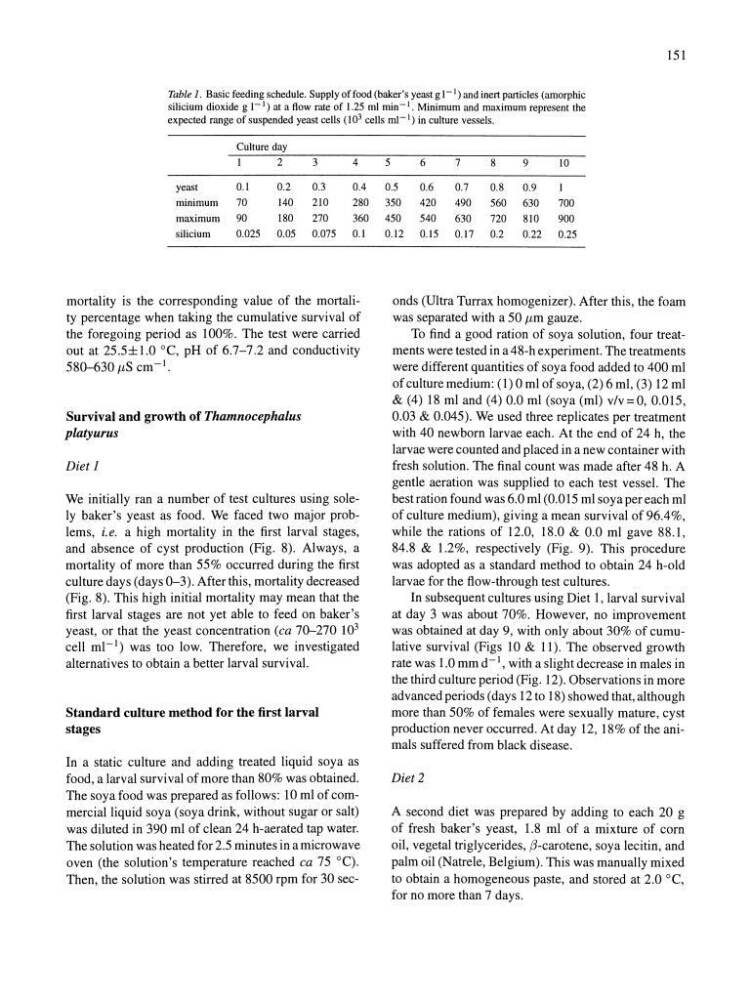
Table 1. Basic feeding schedule. Supply offood (baker's yeast g 1-1) and inert particles (amorphic
silicium dioxide g 1- 1) at a flow rate of 1.25 ml min -1 . Minimum and maximum represent the
expected range of suspended yeast cells (10 3 cells ml- 1 ) in culture vessels.
Culture day
I
2
3
4
yeast
0.1
0.2
0.3
0.4
minimum
70
140
210
280
maximum
90
180
270
360
silicium
0.025
0.05
0.075
0.1
mortality is the corresponding value of the mortality percentage when taking the cumulative survival of
the foregoing period as 100%. The test were carried
out at 25.5±1.0 DC, pH of 6.7-7.2 and conductivity
580-630 fLS cm- I .
Survival and growth of Thamnocephalus
platyurus
Diet 1
We initially ran a number of test cultures using solely baker's yeast as food. We faced two major problems, i.e. a high mortality in the first larval stages,
and absence of cyst production (Fig. 8). Always, a
mortality of more than 55% occurred during the first
culture days (days 0-3). After this, mortality decreased
(Fig. 8). This high initial mortality may mean that the
first larval stages are not yet able to feed on baker's
yeast, or that the yeast concentration (ca 70-270 10 3
cell ml- I ) was too low. Therefore, we investigated
alternatives to obtain a better larval survival.
Standard culture method for the first larval
stages
In a static culture and adding treated liquid soya as
food, a larval survival of more than 80% was obtained.
The soya food was prepared as follows: 10 ml of commercialliquid soya (soya drink, without sugar or salt)
was diluted in 390 ml of clean 24 h-aerated tap water.
The solution was heated for 2.5 minutes in a microwave
oven (the solution's temperature reached ca 75 DC).
Then, the solution was stirred at 8500 rpm for 30 sec5
6
7
8
9
10
0.5
0.6
0.7
0.8
0.9
I
350
420
490
560
630
700
450
540
630
720
810
900
0.12
0.15
0.17
0.2
0.22
0.25
onds (Ultra Turrax homogenizer). After this, the foam
was separated with a 50 fLm gauze.
To find a good ration of soya solution, four treatments were tested in a 48-h experiment. The treatments
were different quantities of soya food added to 400 ml
of culture medium: (1) 0 ml of soya, (2) 6 ml, (3) 12 ml
& (4) 18 ml and (4) 0.0 ml (soya (ml) v/v=O, 0.015,
0.03 & 0.045). We used three replicates per treatment
with 40 newborn larvae each. At the end of 24 h, the
larvae were counted and placed in a new container with
fresh solution. The final count was made after 48 h. A
gentle aeration was supplied to each test vessel. The
best ration found was 6.0 ml (0.015 ml soya per each ml
of culture medium), giving a mean survival of 96.4%,
while the rations of 12.0, 18.0 & 0.0 ml gave 88.1,
84.8 & 1.2%, respectively (Fig. 9). This procedure
was adopted as a standard method to obtain 24 h-old
larvae for the flow-through test cultures.
In subsequent cultures using Diet 1, larval survival
at day 3 was about 70%. However, no improvement
was obtained at day 9, with only about 30% of cumulative survival (Figs 10 & 11). The observed growth
rate was 1.0 mm d- I , with a slight decrease in males in
the third culture period (Fig. 12). Observations in more
advanced periods (days 12 to 18) showed that, although
more than 50% of females were sexually mature, cyst
production never occurred. At day 12, 18% of the animals suffered from black disease.
Diet 2
A second diet was prepared by adding to each 20 g
of fresh baker's yeast, 1.8 ml of a mixture of corn
oil, vegetal triglycerides, jJ-carotene, soya lecitin, and
palm oil (Natrele, Belgium). This was manually mixed
to obtain a homogeneous paste, and stored at 2.0 DC,
for no more than 7 days.
Table 1. Basic feeding schedule. Supply offood (baker's yeast g 1-1) and inert particles (amorphic
silicium dioxide g 1- 1) at a flow rate of 1.25 ml min -1 . Minimum and maximum represent the
expected range of suspended yeast cells (10 3 cells ml- 1 ) in culture vessels.
Culture day
I
2
3
4
yeast
0.1
0.2
0.3
0.4
minimum
70
140
210
280
maximum
90
180
270
360
silicium
0.025
0.05
0.075
0.1
mortality is the corresponding value of the mortality percentage when taking the cumulative survival of
the foregoing period as 100%. The test were carried
out at 25.5±1.0 DC, pH of 6.7-7.2 and conductivity
580-630 fLS cm- I .
Survival and growth of Thamnocephalus
platyurus
Diet 1
We initially ran a number of test cultures using solely baker's yeast as food. We faced two major problems, i.e. a high mortality in the first larval stages,
and absence of cyst production (Fig. 8). Always, a
mortality of more than 55% occurred during the first
culture days (days 0-3). After this, mortality decreased
(Fig. 8). This high initial mortality may mean that the
first larval stages are not yet able to feed on baker's
yeast, or that the yeast concentration (ca 70-270 10 3
cell ml- I ) was too low. Therefore, we investigated
alternatives to obtain a better larval survival.
Standard culture method for the first larval
stages
In a static culture and adding treated liquid soya as
food, a larval survival of more than 80% was obtained.
The soya food was prepared as follows: 10 ml of commercialliquid soya (soya drink, without sugar or salt)
was diluted in 390 ml of clean 24 h-aerated tap water.
The solution was heated for 2.5 minutes in a microwave
oven (the solution's temperature reached ca 75 DC).
Then, the solution was stirred at 8500 rpm for 30 sec5
6
7
8
9
10
0.5
0.6
0.7
0.8
0.9
I
350
420
490
560
630
700
450
540
630
720
810
900
0.12
0.15
0.17
0.2
0.22
0.25
onds (Ultra Turrax homogenizer). After this, the foam
was separated with a 50 fLm gauze.
To find a good ration of soya solution, four treatments were tested in a 48-h experiment. The treatments
were different quantities of soya food added to 400 ml
of culture medium: (1) 0 ml of soya, (2) 6 ml, (3) 12 ml
& (4) 18 ml and (4) 0.0 ml (soya (ml) v/v=O, 0.015,
0.03 & 0.045). We used three replicates per treatment
with 40 newborn larvae each. At the end of 24 h, the
larvae were counted and placed in a new container with
fresh solution. The final count was made after 48 h. A
gentle aeration was supplied to each test vessel. The
best ration found was 6.0 ml (0.015 ml soya per each ml
of culture medium), giving a mean survival of 96.4%,
while the rations of 12.0, 18.0 & 0.0 ml gave 88.1,
84.8 & 1.2%, respectively (Fig. 9). This procedure
was adopted as a standard method to obtain 24 h-old
larvae for the flow-through test cultures.
In subsequent cultures using Diet 1, larval survival
at day 3 was about 70%. However, no improvement
was obtained at day 9, with only about 30% of cumulative survival (Figs 10 & 11). The observed growth
rate was 1.0 mm d- I , with a slight decrease in males in
the third culture period (Fig. 12). Observations in more
advanced periods (days 12 to 18) showed that, although
more than 50% of females were sexually mature, cyst
production never occurred. At day 12, 18% of the animals suffered from black disease.
Diet 2
A second diet was prepared by adding to each 20 g
of fresh baker's yeast, 1.8 ml of a mixture of corn
oil, vegetal triglycerides, jJ-carotene, soya lecitin, and
palm oil (Natrele, Belgium). This was manually mixed
to obtain a homogeneous paste, and stored at 2.0 DC,
for no more than 7 days.