

117
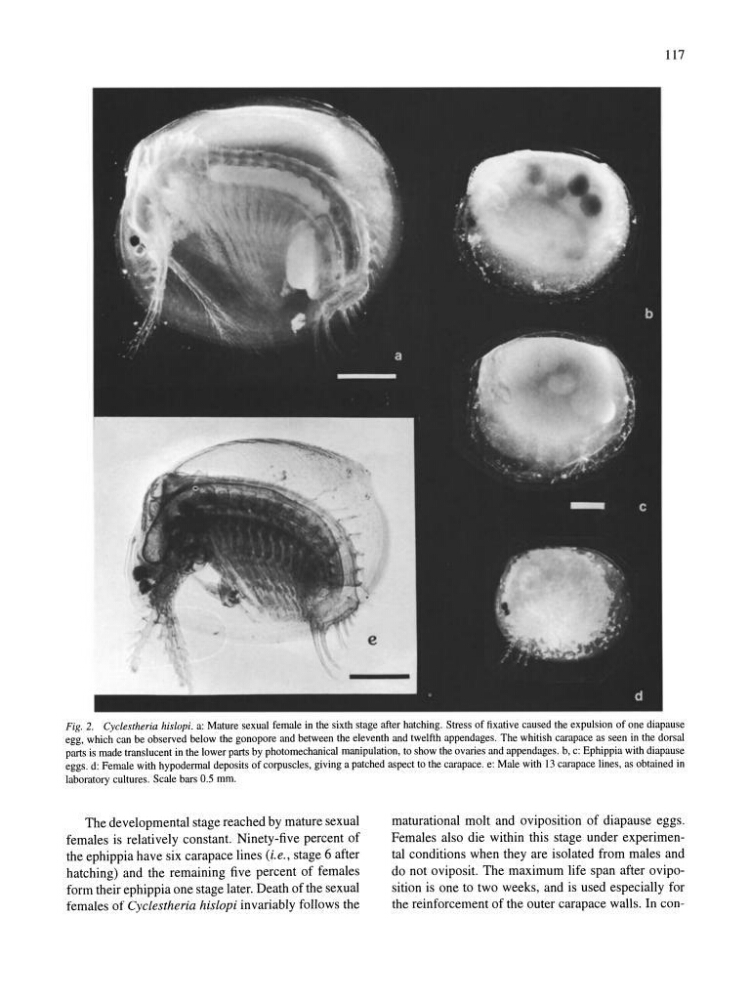
Fig. 2. Cyclestheria his/opi. a: Mature sexual female in the sixth stage after hatching. Stress of fixative caused the expulsion of one diapause
egg, which can be observed below the gonopore and between the eleventh and twelfth appendages. The whitish carapace as seen in the dorsal
parts is made translucent in the lower parts by photomechanical manipulation, to show the ovaries and appendages. b, c: Ephippia with diapause
eggs. d: Female with hypodermal deposits of corpuscles, giving a patched aspect to the carapace. e: Male with 13 carapace lines, as obtained in
laboratory cultures. Scale bars 0.5 mm.
The developmental stage reached by mature sexual
females is relatively constant. Ninety-five percent of
the ephippia have six carapace lines (i.e., stage 6 after
hatching) and the remaining five percent of females
form their ephippia one stage later. Death of the sexual
females of Cyclestheria hislopi invariably follows the
maturational molt and oviposition of diapause eggs.
Females also die within this stage under experimental conditions when they are isolated from males and
do not oviposit. The maximum life span after oviposition is one to two weeks, and is used especially for
the reinforcement of the outer carapace walls. In con-
Fig. 2. Cyclestheria his/opi. a: Mature sexual female in the sixth stage after hatching. Stress of fixative caused the expulsion of one diapause
egg, which can be observed below the gonopore and between the eleventh and twelfth appendages. The whitish carapace as seen in the dorsal
parts is made translucent in the lower parts by photomechanical manipulation, to show the ovaries and appendages. b, c: Ephippia with diapause
eggs. d: Female with hypodermal deposits of corpuscles, giving a patched aspect to the carapace. e: Male with 13 carapace lines, as obtained in
laboratory cultures. Scale bars 0.5 mm.
The developmental stage reached by mature sexual
females is relatively constant. Ninety-five percent of
the ephippia have six carapace lines (i.e., stage 6 after
hatching) and the remaining five percent of females
form their ephippia one stage later. Death of the sexual
females of Cyclestheria hislopi invariably follows the
maturational molt and oviposition of diapause eggs.
Females also die within this stage under experimental conditions when they are isolated from males and
do not oviposit. The maximum life span after oviposition is one to two weeks, and is used especially for
the reinforcement of the outer carapace walls. In con-