

o "
A
"
A
i
"
~:t=: "
J
i
J
S i 0
i
A
/I
_ Lr
(It""
(It
A
H
J
J
A
S
0
N
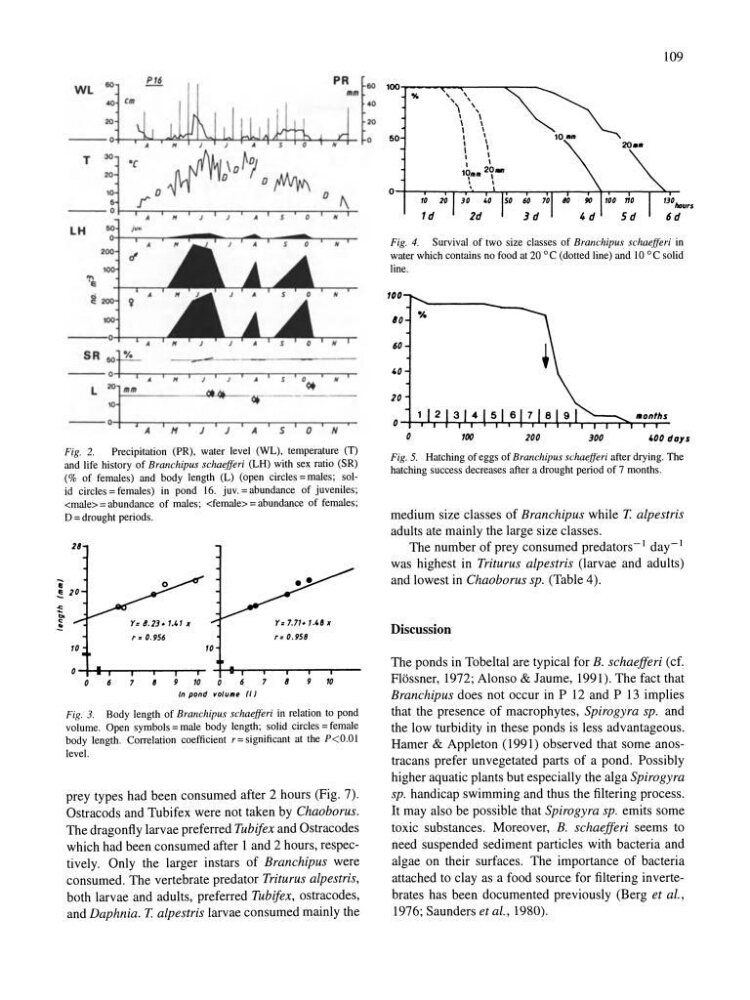
Fig. 2.
Precipitation (PR), water level (WL), temperature (T)
and life history of Branchipus schaefferi (LH) with sex ratio (SR)
(% of females) and body length (L) (open circles = males; solid circles = females) in pond 16. juv.=abundance of juveniles;
= abundance of males; = abundance of females;
D = drought periods.
r=0 . 958
10
o 6
70
0
6
8
70
In pond volume (I)
Fig. 3. Body length of Branchipus schae.fTeri in relation to pond
volume. Open symbols = male body length; solid circles = female
body length. Correlation coefficient r=significant at the P
prey types had been consumed after 2 hours (Fig. 7).
Ostracods and Tubifex were not taken by Chaoborus.
The dragonfly larvae preferred Tubifex and Ostracodes
which had been consumed after 1 and 2 hours, respectively. Only the larger instars of Branchipus were
consumed. The vertebrate predator Triturus alpestris,
both larvae and adults, preferred Tubifex, ostracodes,
and Daphnia. T. aipestris larvae consumed mainly the
109
70 10
1d
Fig. 4. Survival of two size classes of Branchipus schaefferi in
water which contains no food at 20°C (dotted line) and 10 °C solid
line.
100
o
100
200
300
400 da,s
Fig. 5. Hatching of eggs of Branchipus schaefteri after drying. The
hatching success decreases after a drought period of 7 months.
medium size classes of Branchipus while T. alpestris
adults ate mainly the large size classes.
The number of prey consumed predators-I day-I
was highest in Triturus alpestris (larvae and adults)
and lowest in Chaoborus sp. (Table 4).
Discussion
The ponds in Tobeltal are typical for B. schaefferi (cf.
F16ssner, 1972; Alonso & Jaume, 1991). The fact that
Branchipus does not occur in P 12 and P 13 implies
that the presence of macrophytes, Spirogyra sp. and
the low turbidity in these ponds is less advantageous.
Hamer & Appleton (1991) observed that some anostracans prefer unvegetated parts of a pond. Possibly
higher aquatic plants but especially the alga Spirogyra
sp. handicap swimming and thus the filtering process.
It may also be possible that Spirogyra sp. emits some
toxic substances. Moreover, B. schaefferi seems to
need suspended sediment particles with bacteria and
algae on their surfaces. The importance of bacteria
attached to clay as a food source for filtering invertebrates has been documented previously (Berg et aI.,
1976; Saunders et aI., 1980).
A
"
A
i
"
~:t=: "
J
i
J
S i 0
i
A
/I
_ Lr
(It""
(It
A
H
J
J
A
S
0
N
Fig. 2.
Precipitation (PR), water level (WL), temperature (T)
and life history of Branchipus schaefferi (LH) with sex ratio (SR)
(% of females) and body length (L) (open circles = males; solid circles = females) in pond 16. juv.=abundance of juveniles;
D = drought periods.
r=0 . 958
10
o 6
70
0
6
8
70
In pond volume (I)
Fig. 3. Body length of Branchipus schae.fTeri in relation to pond
volume. Open symbols = male body length; solid circles = female
body length. Correlation coefficient r=significant at the P
prey types had been consumed after 2 hours (Fig. 7).
Ostracods and Tubifex were not taken by Chaoborus.
The dragonfly larvae preferred Tubifex and Ostracodes
which had been consumed after 1 and 2 hours, respectively. Only the larger instars of Branchipus were
consumed. The vertebrate predator Triturus alpestris,
both larvae and adults, preferred Tubifex, ostracodes,
and Daphnia. T. aipestris larvae consumed mainly the
109
70 10
1d
Fig. 4. Survival of two size classes of Branchipus schaefferi in
water which contains no food at 20°C (dotted line) and 10 °C solid
line.
100
o
100
200
300
400 da,s
Fig. 5. Hatching of eggs of Branchipus schaefteri after drying. The
hatching success decreases after a drought period of 7 months.
medium size classes of Branchipus while T. alpestris
adults ate mainly the large size classes.
The number of prey consumed predators-I day-I
was highest in Triturus alpestris (larvae and adults)
and lowest in Chaoborus sp. (Table 4).
Discussion
The ponds in Tobeltal are typical for B. schaefferi (cf.
F16ssner, 1972; Alonso & Jaume, 1991). The fact that
Branchipus does not occur in P 12 and P 13 implies
that the presence of macrophytes, Spirogyra sp. and
the low turbidity in these ponds is less advantageous.
Hamer & Appleton (1991) observed that some anostracans prefer unvegetated parts of a pond. Possibly
higher aquatic plants but especially the alga Spirogyra
sp. handicap swimming and thus the filtering process.
It may also be possible that Spirogyra sp. emits some
toxic substances. Moreover, B. schaefferi seems to
need suspended sediment particles with bacteria and
algae on their surfaces. The importance of bacteria
attached to clay as a food source for filtering invertebrates has been documented previously (Berg et aI.,
1976; Saunders et aI., 1980).