

108
into membrane (50 /.L m) filtered pond water until their
gut was empty (~ Id). Thereafter, they were placed in
water which was completely free from seston. One set
of animals (20 of 10 mm and 20 of 20 mm) was kept
at 10 °C the second at 20°C in a temperature chamber
and survival rates were recorded.
To study the hatching of cysts, 24 culture dishes
(diameter: 8 cm; height: 8 cm) were stocked with cysts.
Each dish contained 100 cysts. Eggs were dried at room
temperature (~ 20°C). After 30 d, 60 d, 90 d, 120 d,
150 d, 180 d, 210 d, 240 d, 270 d, 300 d, 330 d, 360 d
of drying water was added to 2 dishes. The hatching
rates were monitored. To test the resistance of cysts to
low temperatures, mud samples which contained cysts
were deep frozen for about 1 week at -18 and - 25°C,
respectively. Thereafter, water of 20 °C was added and
hatching of the cysts into nauplii was monitored. One
dish was kept at 20 and 40°C as a reference.
To study the effect of predation on B. schaefferi,
5 of the most frequent predators (larvae of Chaoborus
sp., larvae of Aeschna cycanea, larvae of Lestes sponsa, larvae and adults of Triturus alpestris) were placed
in a 121 aquarium. One aquarium was stocked with 10
Chaoborus sp., the second with 2 larvae of Aeschna
cyanea, the third with 2 larvae of Lestes sponsa, the
fourth with 2 adult Triturus alpestris and the fifth
aquarium with 2 larvae of Triturus alpestris. To each
of the 5 aquaria 50 B. schaefferi (10 of 1 mm, 3 mm,
5 mm, 10 mm and 20 mm length) and 10 Daphnia sp.,
10 Ostracodes and 0-5 Tubifex sp. were added as prey.
The aquaria were observed continuously over a period
of 10 hours. Survival rates of the different prey types
were monitored and consumption rates of the various
predators were calculated.
Results
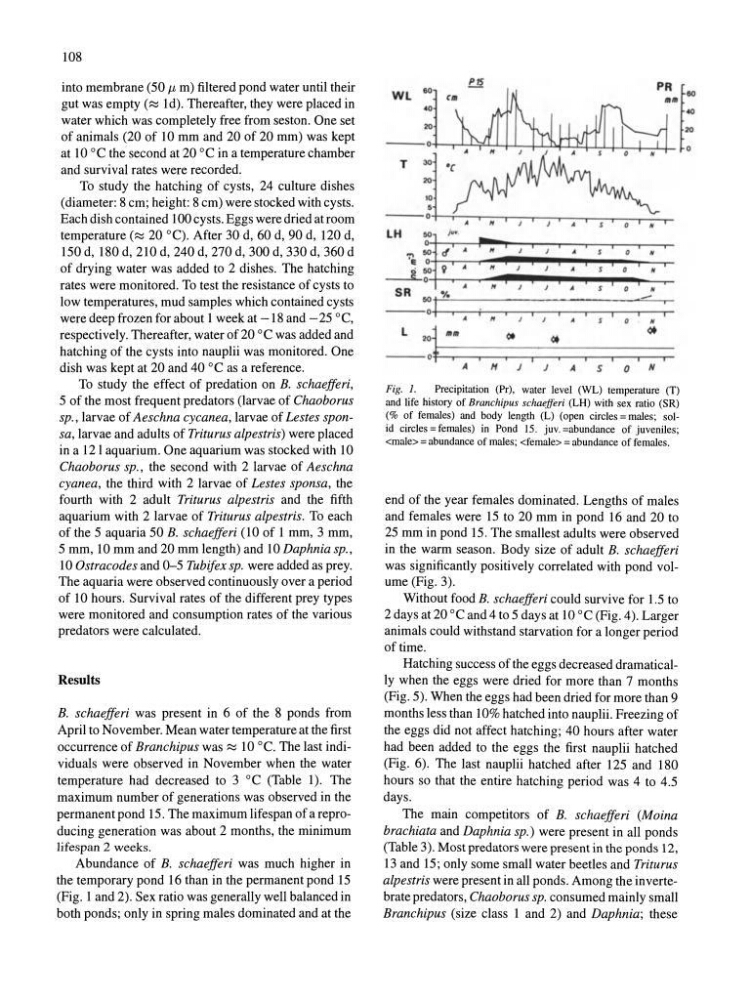
B. schaefferi was present in 6 of the 8 ponds from
April to November. Mean water temperature at the first
occurrence of Branchipus was ~ 10 dc. The last individuals were observed in November when the water
temperature had decreased to 3 °C (Table 1). The
maximum number of generations was observed in the
permanent pond IS. The maximum lifespan of a reproducing generation was about 2 months, the minimum
lifespan 2 weeks.
Abundance of B. schaefferi was much higher in
the temporary pond 16 than in the permanent pond 15
(Fig. 1 and 2). Sex ratio was generally well balanced in
both ponds; only in spring males dominated and at the
0
N
LH
60
; ..
.... 60 t! A
"
A
0
N
0
N
A
'f! 0
A
"
~~~9~~~~ . . . . . . __ ~~ __ ~~~
"
S
0
N
:-- :
~~+I~ %~----------------------~~~
"
A
s
0
N
¢t
(It
__ L ___ 2:l~_m_~ _______ ¢t ____________________ __
A
H ) )
A
S
O N
Fig. 1.
Precipitation (Pr), water level (WL) temperature (T)
and life history of Branchipus schaefferi (LH) with sex ratio (SR)
(% of females) and body length (L) (open circles = males; solid circles = females) in Pond 15. juv. =abundance of juveniles;
= abundance of males; = abundance of females.
end of the year females dominated. Lengths of males
and females were 15 to 20 mm in pond 16 and 20 to
25 mm in pond 15. The smallest adults were observed
in the warm season. Body size of adult B. schaefferi
was significantly positively correlated with pond volume (Fig. 3).
Without food B. schaefferi could survive for 1.5 to
2 days at 20°C and 4 to 5 days at 10 °C (Fig. 4). Larger
animals could withstand starvation for a longer period
of time.
Hatching success of the eggs decreased dramatically when the eggs were dried for more than 7 months
(Fig. 5). When the eggs had been dried for more than 9
months less than 10% hatched into nauplii. Freezing of
the eggs did not affect hatching; 40 hours after water
had been added to the eggs the first nauplii hatched
(Fig. 6). The last nauplii hatched after 125 and 180
hours so that the entire hatching period was 4 to 4.5
days.
The main competitors of B. schaefferi (Moina
brachiata and Daphnia sp.) were present in all ponds
(Table 3). Most predators were present in the ponds 12,
I3 and 15; only some small water beetles and Triturus
aipestris were present in all ponds. Among the invertebrate predators, Chaoborus sp. consumed mainly small
Branchipus (size class 1 and 2) and Daphnia; these
into membrane (50 /.L m) filtered pond water until their
gut was empty (~ Id). Thereafter, they were placed in
water which was completely free from seston. One set
of animals (20 of 10 mm and 20 of 20 mm) was kept
at 10 °C the second at 20°C in a temperature chamber
and survival rates were recorded.
To study the hatching of cysts, 24 culture dishes
(diameter: 8 cm; height: 8 cm) were stocked with cysts.
Each dish contained 100 cysts. Eggs were dried at room
temperature (~ 20°C). After 30 d, 60 d, 90 d, 120 d,
150 d, 180 d, 210 d, 240 d, 270 d, 300 d, 330 d, 360 d
of drying water was added to 2 dishes. The hatching
rates were monitored. To test the resistance of cysts to
low temperatures, mud samples which contained cysts
were deep frozen for about 1 week at -18 and - 25°C,
respectively. Thereafter, water of 20 °C was added and
hatching of the cysts into nauplii was monitored. One
dish was kept at 20 and 40°C as a reference.
To study the effect of predation on B. schaefferi,
5 of the most frequent predators (larvae of Chaoborus
sp., larvae of Aeschna cycanea, larvae of Lestes sponsa, larvae and adults of Triturus alpestris) were placed
in a 121 aquarium. One aquarium was stocked with 10
Chaoborus sp., the second with 2 larvae of Aeschna
cyanea, the third with 2 larvae of Lestes sponsa, the
fourth with 2 adult Triturus alpestris and the fifth
aquarium with 2 larvae of Triturus alpestris. To each
of the 5 aquaria 50 B. schaefferi (10 of 1 mm, 3 mm,
5 mm, 10 mm and 20 mm length) and 10 Daphnia sp.,
10 Ostracodes and 0-5 Tubifex sp. were added as prey.
The aquaria were observed continuously over a period
of 10 hours. Survival rates of the different prey types
were monitored and consumption rates of the various
predators were calculated.
Results
B. schaefferi was present in 6 of the 8 ponds from
April to November. Mean water temperature at the first
occurrence of Branchipus was ~ 10 dc. The last individuals were observed in November when the water
temperature had decreased to 3 °C (Table 1). The
maximum number of generations was observed in the
permanent pond IS. The maximum lifespan of a reproducing generation was about 2 months, the minimum
lifespan 2 weeks.
Abundance of B. schaefferi was much higher in
the temporary pond 16 than in the permanent pond 15
(Fig. 1 and 2). Sex ratio was generally well balanced in
both ponds; only in spring males dominated and at the
0
N
LH
60
; ..
.... 60 t! A
"
A
0
N
0
N
A
'f! 0
A
"
~~~9~~~~ . . . . . . __ ~~ __ ~~~
"
S
0
N
:-- :
~~+I~ %~----------------------~~~
"
A
s
0
N
¢t
(It
__ L ___ 2:l~_m_~ _______ ¢t ____________________ __
A
H ) )
A
S
O N
Fig. 1.
Precipitation (Pr), water level (WL) temperature (T)
and life history of Branchipus schaefferi (LH) with sex ratio (SR)
(% of females) and body length (L) (open circles = males; solid circles = females) in Pond 15. juv. =abundance of juveniles;
end of the year females dominated. Lengths of males
and females were 15 to 20 mm in pond 16 and 20 to
25 mm in pond 15. The smallest adults were observed
in the warm season. Body size of adult B. schaefferi
was significantly positively correlated with pond volume (Fig. 3).
Without food B. schaefferi could survive for 1.5 to
2 days at 20°C and 4 to 5 days at 10 °C (Fig. 4). Larger
animals could withstand starvation for a longer period
of time.
Hatching success of the eggs decreased dramatically when the eggs were dried for more than 7 months
(Fig. 5). When the eggs had been dried for more than 9
months less than 10% hatched into nauplii. Freezing of
the eggs did not affect hatching; 40 hours after water
had been added to the eggs the first nauplii hatched
(Fig. 6). The last nauplii hatched after 125 and 180
hours so that the entire hatching period was 4 to 4.5
days.
The main competitors of B. schaefferi (Moina
brachiata and Daphnia sp.) were present in all ponds
(Table 3). Most predators were present in the ponds 12,
I3 and 15; only some small water beetles and Triturus
aipestris were present in all ponds. Among the invertebrate predators, Chaoborus sp. consumed mainly small
Branchipus (size class 1 and 2) and Daphnia; these