

88
900
.. ' ". ' .
,
,
Phenological Patterns
,
.
O~~--~--~----~----~~'="'="'="-----r--------~
o
30
60
90
120
Time (months)
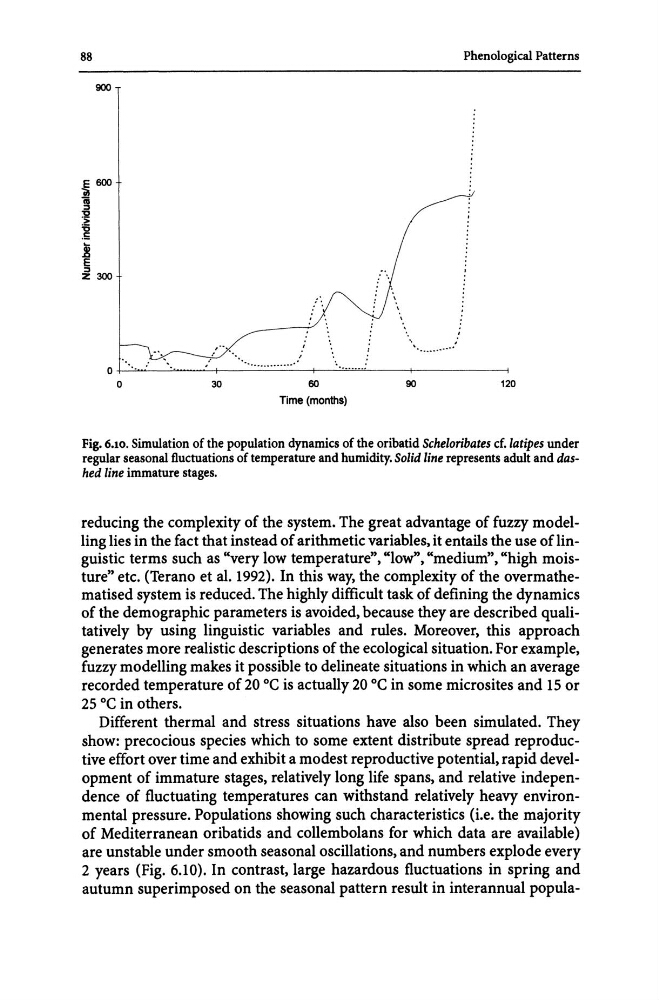
Fig. 6.10. Simulation of the population dynamics of the oribatid Scheloribates cf. latipes under
regular seasonal fluctuations of temperature and humidity. Solid line represents adult and dashed line immature stages.
reducing the complexity of the system. The great advantage of fuzzy modelling lies in the fact that instead of arithmetic variables, it entails the use of linguistic terms such as "very low temperature", "low", "medium", "high moisture" etc. (Terano et al. 1992). In this way, the complexity of the overmathematised system is reduced. The highly difficult task of defining the dynamics
of the demographic parameters is avoided, because they are described qualitatively by using linguistic variables and rules. Moreover, this approach
generates more realistic descriptions of the ecological situation. For example,
fuzzy modelling makes it possible to delineate situations in which an average
recorded temperature of 20 DC is actually 20 DC in some microsites and 15 or
25 DC in others.
Different thermal and stress situations have also been simulated. They
show: precocious species which to some extent distribute spread reproductive effort over time and exhibit a modest reproductive potential, rapid development of immature stages, relatively long life spans, and relative independence of fluctuating temperatures can withstand relatively heavy environmental pressure. Populations showing such characteristics (i.e. the majority
of Mediterranean oribatids and collembolans for which data are available)
are unstable under smooth seasonal oscillations, and numbers explode every
2 years (Fig. 6.lO). In contrast, large hazardous fluctuations in spring and
autumn superimposed on the seasonal pattern result in interannual popula-
900
.. ' ". ' .
,
,
Phenological Patterns
,
.
O~~--~--~----~----~~'="'="'="-----r--------~
o
30
60
90
120
Time (months)
Fig. 6.10. Simulation of the population dynamics of the oribatid Scheloribates cf. latipes under
regular seasonal fluctuations of temperature and humidity. Solid line represents adult and dashed line immature stages.
reducing the complexity of the system. The great advantage of fuzzy modelling lies in the fact that instead of arithmetic variables, it entails the use of linguistic terms such as "very low temperature", "low", "medium", "high moisture" etc. (Terano et al. 1992). In this way, the complexity of the overmathematised system is reduced. The highly difficult task of defining the dynamics
of the demographic parameters is avoided, because they are described qualitatively by using linguistic variables and rules. Moreover, this approach
generates more realistic descriptions of the ecological situation. For example,
fuzzy modelling makes it possible to delineate situations in which an average
recorded temperature of 20 DC is actually 20 DC in some microsites and 15 or
25 DC in others.
Different thermal and stress situations have also been simulated. They
show: precocious species which to some extent distribute spread reproductive effort over time and exhibit a modest reproductive potential, rapid development of immature stages, relatively long life spans, and relative independence of fluctuating temperatures can withstand relatively heavy environmental pressure. Populations showing such characteristics (i.e. the majority
of Mediterranean oribatids and collembolans for which data are available)
are unstable under smooth seasonal oscillations, and numbers explode every
2 years (Fig. 6.lO). In contrast, large hazardous fluctuations in spring and
autumn superimposed on the seasonal pattern result in interannual popula-