

Numerical Responses to Environmental Disasters
87
light of the ecophysiological and population features of the species concerned
(e.g. heat budgets, length of life cycle, etc.) which are the principal determinants of their ability to withstand stress.
The Leslie-type model accounts more for biological realism than for precision. It is therefore a suitable tool for exploring unknown situations given life
history traits and physiological characteristics as they are reflected by demographic parameters. Model implementation presupposes the estimation of
the demographic parameters fecundity f, mortality m, and duration of ontogenetic development 1 under different conditions. It further presupposes estimations of the distribution of reproductive effort and of the onset of egg production. Thus, it provides the information necessary for further analysis of
life history tactics.
6.4.2
Modelling Population Dynamics
The structure of the Leslie-type model is as follows:
N t + 1 =AN t
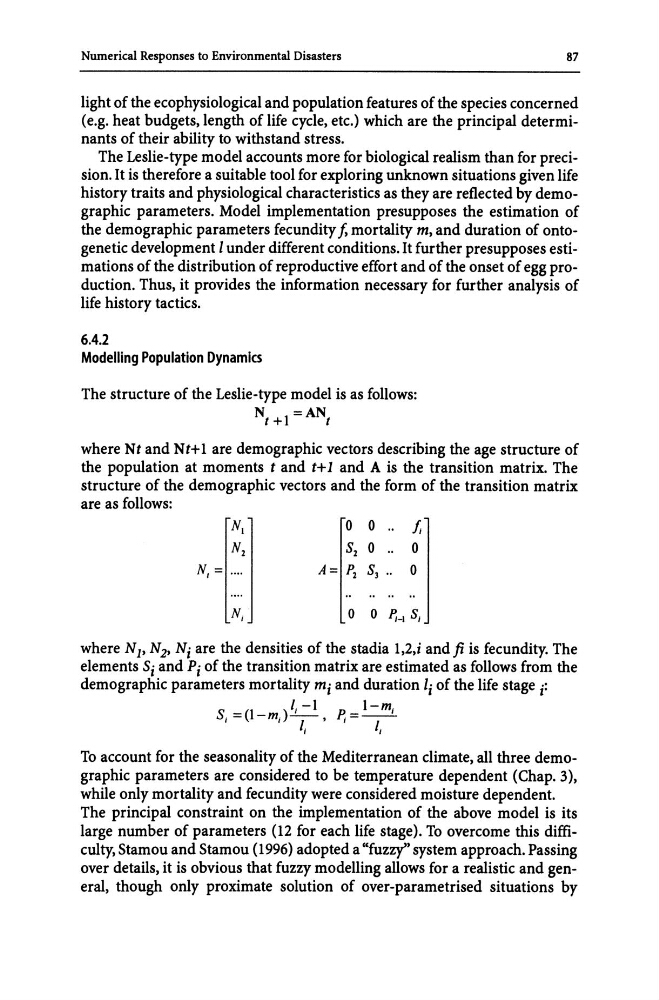
where Nt and NH 1 are demographic vectors describing the age structure of
the population at moments t and HI and A is the transition matrix. The
structure of the demographic vectors and the form of the transition matrix
are as follows:
Nl
0 0 .. h
N2
S2 0 .. 0
N= I
....
A= P2 S3 .. 0
Ni
0 0 ~-l SI
where N I , N 2 , Ni are the densities of the stadia 1,2,i and fi is fecundity. The
elements Si and Pi of the transition matrix are estimated as follows from the
demographic parameters mortality mi and duration Ii of the life stage i:
S = (1- m ) Ii -1 p = 1- mi
I
I
II ' I
II
To account for the seasonality of the Mediterranean climate, all three demographic parameters are considered to be temperature dependent (Chap. 3),
while only mortality and fecundity were considered moisture dependent.
The principal constraint on the implementation of the above model is its
large number of parameters (12 for each life stage). To overcome this difficulty, Stamou and Stamou (1996) adopted a "fuzzy" system approach. Passing
over details, it is obvious that fuzzy modelling allows for a realistic and general, though only proximate solution of over-parametrised situations by
87
light of the ecophysiological and population features of the species concerned
(e.g. heat budgets, length of life cycle, etc.) which are the principal determinants of their ability to withstand stress.
The Leslie-type model accounts more for biological realism than for precision. It is therefore a suitable tool for exploring unknown situations given life
history traits and physiological characteristics as they are reflected by demographic parameters. Model implementation presupposes the estimation of
the demographic parameters fecundity f, mortality m, and duration of ontogenetic development 1 under different conditions. It further presupposes estimations of the distribution of reproductive effort and of the onset of egg production. Thus, it provides the information necessary for further analysis of
life history tactics.
6.4.2
Modelling Population Dynamics
The structure of the Leslie-type model is as follows:
N t + 1 =AN t
where Nt and NH 1 are demographic vectors describing the age structure of
the population at moments t and HI and A is the transition matrix. The
structure of the demographic vectors and the form of the transition matrix
are as follows:
Nl
0 0 .. h
N2
S2 0 .. 0
N= I
....
A= P2 S3 .. 0
Ni
0 0 ~-l SI
where N I , N 2 , Ni are the densities of the stadia 1,2,i and fi is fecundity. The
elements Si and Pi of the transition matrix are estimated as follows from the
demographic parameters mortality mi and duration Ii of the life stage i:
S = (1- m ) Ii -1 p = 1- mi
I
I
II ' I
II
To account for the seasonality of the Mediterranean climate, all three demographic parameters are considered to be temperature dependent (Chap. 3),
while only mortality and fecundity were considered moisture dependent.
The principal constraint on the implementation of the above model is its
large number of parameters (12 for each life stage). To overcome this difficulty, Stamou and Stamou (1996) adopted a "fuzzy" system approach. Passing
over details, it is obvious that fuzzy modelling allows for a realistic and general, though only proximate solution of over-parametrised situations by