

86
7
-'
N
I Es
AWJJASONDJFWAMJJASONDJFWAWJJASON
TIME (months)
Phenological Patterns
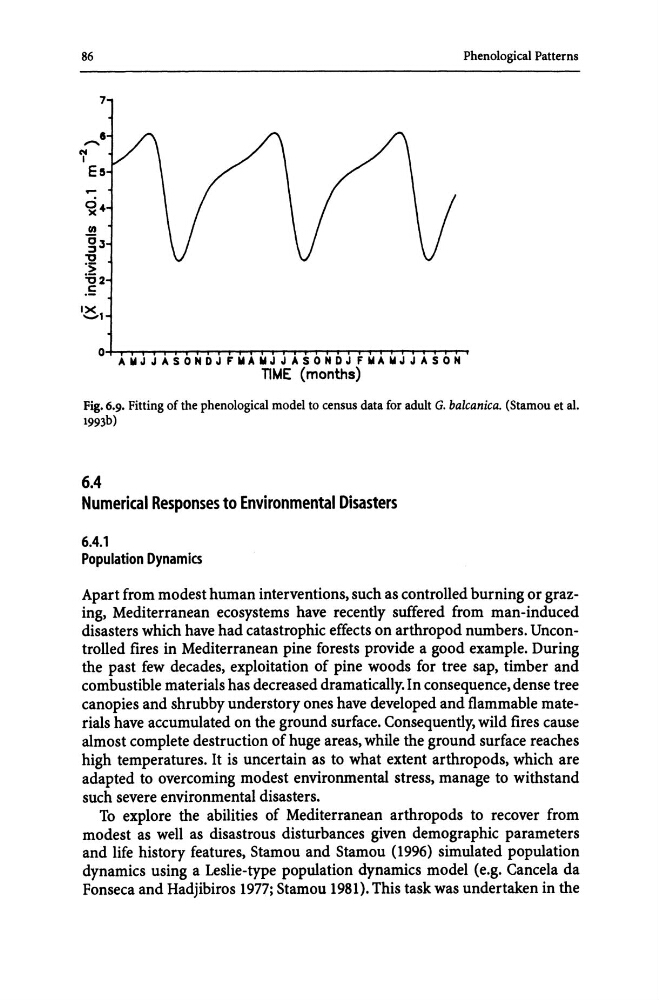
Fig. 6.9. Fitting of the phenological model to census data for adult G. balcanica. (Stamou et al.
1993b)
6.4
Numerical Responses to Environmental Disasters
6.4.1
Population Dynamics
Apart from modest human interventions, such as controlled burning or grazing, Mediterranean ecosystems have recently suffered from man-induced
disasters which have had catastrophic effects on arthropod numbers. Uncontrolled fires in Mediterranean pine forests provide a good example. During
the past few decades, exploitation of pine woods for tree sap, timber and
combustible materials has decreased dramatically. In consequence, dense tree
canopies and shrubby understory ones have developed and flammable materials have accumulated on the ground surface. Consequently, wild fires cause
almost complete destruction of huge areas, while the ground surface reaches
high temperatures. It is uncertain as to what extent arthropods, which are
adapted to overcoming modest environmental stress, manage to withstand
such severe environmental disasters.
To explore the abilities of Mediterranean arthropods to recover from
modest as well as disastrous disturbances given demographic parameters
and life history features, Stamou and Stamou (1996) simulated population
dynamics using a Leslie-type population dynamics model (e.g. Cancela da
Fonseca and Hadjibiros 1977; Stamou 1981). This task was undertaken in the
7
-'
N
I Es
AWJJASONDJFWAMJJASONDJFWAWJJASON
TIME (months)
Phenological Patterns
Fig. 6.9. Fitting of the phenological model to census data for adult G. balcanica. (Stamou et al.
1993b)
6.4
Numerical Responses to Environmental Disasters
6.4.1
Population Dynamics
Apart from modest human interventions, such as controlled burning or grazing, Mediterranean ecosystems have recently suffered from man-induced
disasters which have had catastrophic effects on arthropod numbers. Uncontrolled fires in Mediterranean pine forests provide a good example. During
the past few decades, exploitation of pine woods for tree sap, timber and
combustible materials has decreased dramatically. In consequence, dense tree
canopies and shrubby understory ones have developed and flammable materials have accumulated on the ground surface. Consequently, wild fires cause
almost complete destruction of huge areas, while the ground surface reaches
high temperatures. It is uncertain as to what extent arthropods, which are
adapted to overcoming modest environmental stress, manage to withstand
such severe environmental disasters.
To explore the abilities of Mediterranean arthropods to recover from
modest as well as disastrous disturbances given demographic parameters
and life history features, Stamou and Stamou (1996) simulated population
dynamics using a Leslie-type population dynamics model (e.g. Cancela da
Fonseca and Hadjibiros 1977; Stamou 1981). This task was undertaken in the