

The Joint Effect of Temperature and Humidity on Feeding Activity and Demography
55
100
80
Q.
:a 60
i: e
.~
, 40
fI}
~
20
0 0
10
20
30
40
SO
Time (weeks)
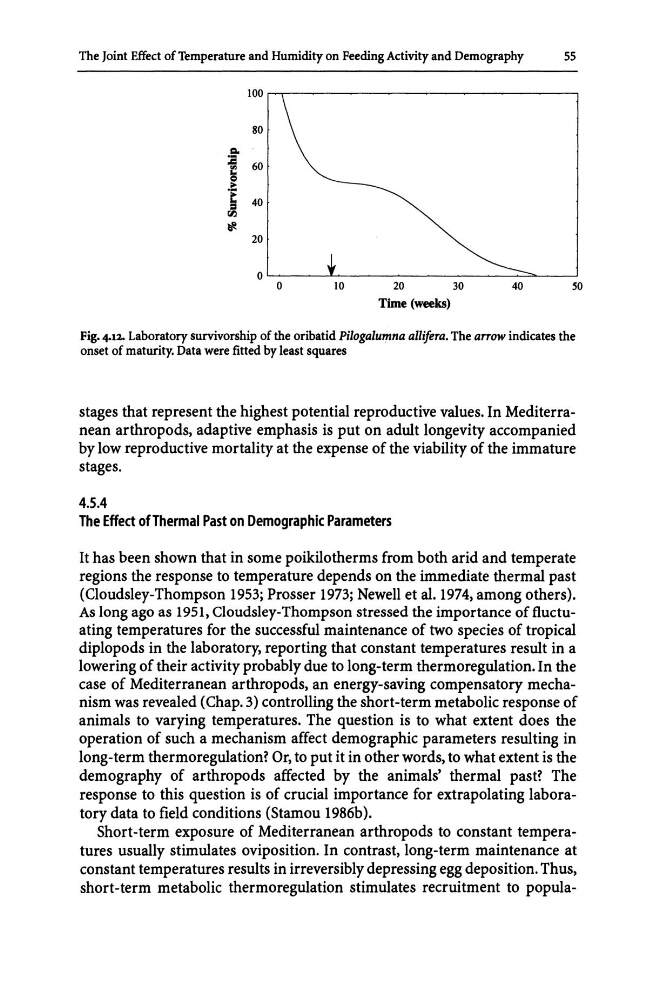
Fig. 412. Laboratory survivorship of the oribatid Pilogalumna allifera. The arrow indicates the
onset of maturity. Data were fitted by least squares
stages that represent the highest potential reproductive values. In Mediterranean arthropods, adaptive emphasis is put on adult longevity accompanied
by low reproductive mortality at the expense of the viability of the immature
stages.
4.5.4
The Effect ofThermal Past on Demographic Parameters
It has been shown that in some poikilotherms from both arid and temperate
regions the response to temperature depends on the immediate thermal past
(Cloudsley-Thompson 1953; Prosser 1973; Newell et al. 1974, among others).
As long ago as 1951, Cloudsley-Thompson stressed the importance offluctuating temperatures for the successful maintenance of two species of tropical
diplopods in the laboratory, reporting that constant temperatures result in a
lowering of their activity probably due to long-term thermoregulation. In the
case of Mediterranean arthropods, an energy-saving compensatory mechanism was revealed (Chap. 3) controlling the short-term metabolic response of
animals to varying temperatures. The question is to what extent does the
operation of such a mechanism affect demographic parameters resulting in
long-term thermoregulation? Or, to put it in other words, to what extent is the
demography of arthropods affected by the animals' thermal past? The
response to this question is of crucial importance for extrapolating laboratory data to field conditions (Stamou 1986b).
Short-term exposure of Mediterranean arthropods to constant temperatures usually stimulates oviposition. In contrast, long-term maintenance at
constant temperatures results in irreversibly depressing egg deposition. Thus,
short-term metabolic thermoregulation stimulates recruitment to popula-
55
100
80
Q.
:a 60
i: e
.~
, 40
fI}
~
20
0 0
10
20
30
40
SO
Time (weeks)
Fig. 412. Laboratory survivorship of the oribatid Pilogalumna allifera. The arrow indicates the
onset of maturity. Data were fitted by least squares
stages that represent the highest potential reproductive values. In Mediterranean arthropods, adaptive emphasis is put on adult longevity accompanied
by low reproductive mortality at the expense of the viability of the immature
stages.
4.5.4
The Effect ofThermal Past on Demographic Parameters
It has been shown that in some poikilotherms from both arid and temperate
regions the response to temperature depends on the immediate thermal past
(Cloudsley-Thompson 1953; Prosser 1973; Newell et al. 1974, among others).
As long ago as 1951, Cloudsley-Thompson stressed the importance offluctuating temperatures for the successful maintenance of two species of tropical
diplopods in the laboratory, reporting that constant temperatures result in a
lowering of their activity probably due to long-term thermoregulation. In the
case of Mediterranean arthropods, an energy-saving compensatory mechanism was revealed (Chap. 3) controlling the short-term metabolic response of
animals to varying temperatures. The question is to what extent does the
operation of such a mechanism affect demographic parameters resulting in
long-term thermoregulation? Or, to put it in other words, to what extent is the
demography of arthropods affected by the animals' thermal past? The
response to this question is of crucial importance for extrapolating laboratory data to field conditions (Stamou 1986b).
Short-term exposure of Mediterranean arthropods to constant temperatures usually stimulates oviposition. In contrast, long-term maintenance at
constant temperatures results in irreversibly depressing egg deposition. Thus,
short-term metabolic thermoregulation stimulates recruitment to popula-