

56
Activity Patterns
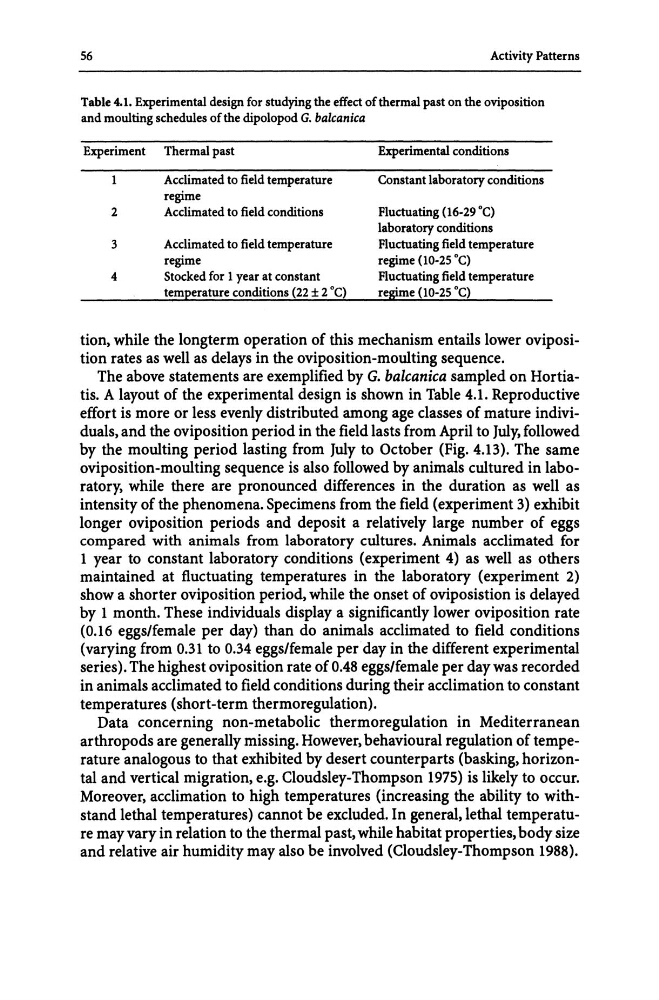
Table 4.1. Experimental design for studying the effect of thermal past on the oviposition
and moulting schedules of the dipolopod G. balcanica
Experiment Thermal past
2
3
4
Acclimated to field temperature
regime
Acclimated to field conditions
Acclimated to field temperature
regime
Stocked for 1 year at constant
temperature conditions (22 ± 2°C)
Experimental conditions
Constant laboratory conditions
Fluctuating (16-29 DC)
laboratory conditions
Fluctuating field temperature
regime (10-25 DC)
Fluctuating field temperature
regime (10-25 DC)
tion, while the longterm operation of this mechanism entails lower oviposition rates as well as delays in the oviposition-moulting sequence.
The above statements are exemplified by G. balcanica sampled on Hortiatis. A layout of the experimental design is shown in Table 4.1. Reproductive
effort is more or less evenly distributed among age classes of mature individuals, and the oviposition period in the field lasts from April to July, followed
by the moulting period lasting from July to October (Fig. 4.13). The same
oviposition-moulting sequence is also followed by animals cultured in laboratory, while there are pronounced differences in the duration as well as
intensity of the phenomena. Specimens from the field (experiment 3) exhibit
longer oviposition periods and deposit a relatively large number of eggs
compared with animals from laboratory cultures. Animals acclimated for
1 year to constant laboratory conditions (experiment 4) as well as others
maintained at fluctuating temperatures in the laboratory (experiment 2)
show a shorter oviposition period, while the onset of oviposistion is delayed
by 1 month. These individuals display a significantly lower oviposition rate
(0.16 eggs/female per day) than do animals acclimated to field conditions
(varying from 0.31 to 0.34 eggs/female per day in the different experimental
series). The highest oviposition rate of 0.48 eggs/female per day was recorded
in animals acclimated to field conditions during their acclimation to constant
temperatures (short-term thermoregulation).
Data concerning non-metabolic thermoregulation in Mediterranean
arthropods are generally missing. However, behavioural regulation of temperature analogous to that exhibited by desert counterparts (basking, horizontal and vertical migration, e.g. Cloudsley-Thompson 1975) is likely to occur.
Moreover, acclimation to high temperatures (increasing the ability to withstand lethal temperatures) cannot be excluded. In general, lethal temperature may vary in relation to the thermal past, while habitat properties, body size
and relative air humidity may also be involved (Cloudsley-Thompson 1988).
Activity Patterns
Table 4.1. Experimental design for studying the effect of thermal past on the oviposition
and moulting schedules of the dipolopod G. balcanica
Experiment Thermal past
2
3
4
Acclimated to field temperature
regime
Acclimated to field conditions
Acclimated to field temperature
regime
Stocked for 1 year at constant
temperature conditions (22 ± 2°C)
Experimental conditions
Constant laboratory conditions
Fluctuating (16-29 DC)
laboratory conditions
Fluctuating field temperature
regime (10-25 DC)
Fluctuating field temperature
regime (10-25 DC)
tion, while the longterm operation of this mechanism entails lower oviposition rates as well as delays in the oviposition-moulting sequence.
The above statements are exemplified by G. balcanica sampled on Hortiatis. A layout of the experimental design is shown in Table 4.1. Reproductive
effort is more or less evenly distributed among age classes of mature individuals, and the oviposition period in the field lasts from April to July, followed
by the moulting period lasting from July to October (Fig. 4.13). The same
oviposition-moulting sequence is also followed by animals cultured in laboratory, while there are pronounced differences in the duration as well as
intensity of the phenomena. Specimens from the field (experiment 3) exhibit
longer oviposition periods and deposit a relatively large number of eggs
compared with animals from laboratory cultures. Animals acclimated for
1 year to constant laboratory conditions (experiment 4) as well as others
maintained at fluctuating temperatures in the laboratory (experiment 2)
show a shorter oviposition period, while the onset of oviposistion is delayed
by 1 month. These individuals display a significantly lower oviposition rate
(0.16 eggs/female per day) than do animals acclimated to field conditions
(varying from 0.31 to 0.34 eggs/female per day in the different experimental
series). The highest oviposition rate of 0.48 eggs/female per day was recorded
in animals acclimated to field conditions during their acclimation to constant
temperatures (short-term thermoregulation).
Data concerning non-metabolic thermoregulation in Mediterranean
arthropods are generally missing. However, behavioural regulation of temperature analogous to that exhibited by desert counterparts (basking, horizontal and vertical migration, e.g. Cloudsley-Thompson 1975) is likely to occur.
Moreover, acclimation to high temperatures (increasing the ability to withstand lethal temperatures) cannot be excluded. In general, lethal temperature may vary in relation to the thermal past, while habitat properties, body size
and relative air humidity may also be involved (Cloudsley-Thompson 1988).