

Oviposition Patterns
47
25
c
}) 20
QI
S 15
f 10
~ 5
~ OL-------------------------16
QI
112
~ 8
D 4
8
~ O~~~----~~----~~
HL..........l-\ ---.LA~_....L.f\~A
~ JSNJMMJSNJMMJSN
1984
TIme (months)
1986
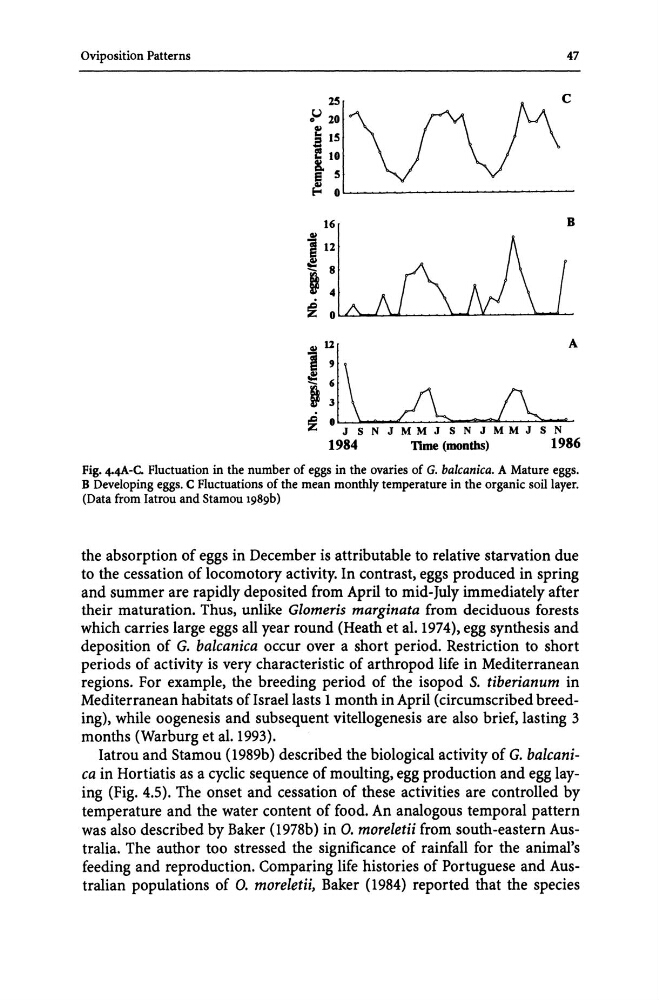
Fig. 4.4A-C. Fluctuation in the number of eggs in the ovaries of G. balcanica. A Mature eggs.
B Developing eggs. C Fluctuations of the mean monthly temperature in the organic soil layer.
(Data from Iatrou and Stamou 1989b)
the absorption of eggs in December is attributable to relative starvation due
to the cessation of locomotory activity. In contrast, eggs produced in spring
and summer are rapidly deposited from April to mid-July immediately after
their maturation. Thus, unlike Glomeris marginata from deciduous forests
which carries large eggs all year round (Heath et al. 1974), egg synthesis and
deposition of G. balcanica occur over a short period. Restriction to short
periods of activity is very characteristic of arthropod life in Mediterranean
regions. For example, the breeding period of the isopod S. tiberianum in
Mediterranean habitats of Israel lasts 1 month in April (circumscribed breeding), while oogenesis and subsequent vitellogenesis are also brief, lasting 3
months (Warburg et al. 1993).
Iatrou and Stamou (1989b) described the biological activity of G. balcanica in Hortiatis as a cyclic sequence of moulting, egg production and egg laying (Fig. 4.5). The onset and cessation of these activities are controlled by
temperature and the water content of food. An analogous temporal pattern
was also described by Baker (1978b) in O. moreletii from south-eastern Australia. The author too stressed the significance of rainfall for the animal's
feeding and reproduction. Comparing life histories of Portuguese and Australian populations of o. moreletii, Baker (1984) reported that the species
47
25
c
}) 20
QI
S 15
f 10
~ 5
~ OL-------------------------16
QI
112
~ 8
D 4
8
~ O~~~----~~----~~
HL..........l-\ ---.LA~_....L.f\~A
~ JSNJMMJSNJMMJSN
1984
TIme (months)
1986
Fig. 4.4A-C. Fluctuation in the number of eggs in the ovaries of G. balcanica. A Mature eggs.
B Developing eggs. C Fluctuations of the mean monthly temperature in the organic soil layer.
(Data from Iatrou and Stamou 1989b)
the absorption of eggs in December is attributable to relative starvation due
to the cessation of locomotory activity. In contrast, eggs produced in spring
and summer are rapidly deposited from April to mid-July immediately after
their maturation. Thus, unlike Glomeris marginata from deciduous forests
which carries large eggs all year round (Heath et al. 1974), egg synthesis and
deposition of G. balcanica occur over a short period. Restriction to short
periods of activity is very characteristic of arthropod life in Mediterranean
regions. For example, the breeding period of the isopod S. tiberianum in
Mediterranean habitats of Israel lasts 1 month in April (circumscribed breeding), while oogenesis and subsequent vitellogenesis are also brief, lasting 3
months (Warburg et al. 1993).
Iatrou and Stamou (1989b) described the biological activity of G. balcanica in Hortiatis as a cyclic sequence of moulting, egg production and egg laying (Fig. 4.5). The onset and cessation of these activities are controlled by
temperature and the water content of food. An analogous temporal pattern
was also described by Baker (1978b) in O. moreletii from south-eastern Australia. The author too stressed the significance of rainfall for the animal's
feeding and reproduction. Comparing life histories of Portuguese and Australian populations of o. moreletii, Baker (1984) reported that the species